
Rutabaga is one of those holiday sides that shows up at Upper Midwest tables year after year, often swimming in butter and cream. If your family skips dairy, that bowl usually gets passed right by. This mashed rutabaga keeps everything people love about it, the golden color, the gentle sweetness, and the peppery bite, and whips it with extra-virgin olive oil instead.
To make mashed rutabaga, peel it, cut it into 1-inch cubes, start it in cold salted water and simmer 35 to 40 minutes until a fork slides in. Drain, steam-dry the cubes in the hot pot, then mash with extra-virgin olive oil, salt, pepper and nutmeg, loosening with a little cooking water. No butter or cream needed.
In Michigan’s Upper Peninsula, Minnesota, and Wisconsin, rutabaga came with Finnish, Swedish, and Cornish families. It’s the root vegetable tucked into pasties and mashed for Thanksgiving and Christmas dinner. One Yukon Gold potato is optional here for a smoother, creamier mash, and a spoonful of maple syrup softens the turnip-like edge. It’s a simple, inexpensive side that reheats beautifully, so you can make it a day ahead. Like every Top Nine Free recipe, it’s made without milk, eggs, wheat, soy, peanuts, tree nuts, fish, shellfish and sesame.
Made without: peanuts, tree nuts, milk, eggs, wheat, soy, fish, shellfish, sesame.
Why You’ll Love This Mashed Rutabaga
- Five main ingredients: rutabaga, olive oil, salt, pepper, and a pinch of nutmeg.
- No butter or cream: fruity olive oil makes it rich and silky.
- Make-ahead friendly: it reheats without turning gluey the way potatoes can.
- A change from potatoes: lighter, brighter, and naturally golden on the holiday table.
How Mashed Rutabaga Gets Creamy Without Dairy
Rutabaga has less starch than potatoes, so it won’t turn gluey when you beat it, but it can turn watery. The trick is drying it. After draining, the cubes go back into the hot pot for a minute or two until the steam stops. Then the olive oil coats the dry vegetable instead of mixing with leftover water, so it emulsifies into a smooth, glossy mash. A few tablespoons of the starchy cooking water loosen it to the texture you want. If you add the optional potato, its starch makes the mash creamier and fluffier, closer to mashed potatoes.
Mashed rutabaga at a glance
| Step | Time | Tip |
|---|---|---|
| Peel and cube | About 15 minutes | Even 1-inch cubes; peel past the wax |
| Simmer from cold salted water | 35 to 40 minutes | Add the optional potato after 20 minutes |
| Steam-dry in the hot pot | 1 to 2 minutes | Shake until the surfaces look dry |
| Mash with olive oil | About 5 minutes | Loosen with cooking water a tablespoon at a time |
| Make ahead | Up to 4 days in the fridge | Reheat covered with a splash of water |
Ingredients and Swap Ideas
- Rutabagas (about 3 lb / 1.4 kg): pick firm, heavy ones with smooth skin. Grocery-store rutabagas are often coated in wax; peel deep enough to remove it.
- Yukon Gold potato (optional): for a smoother mash. Leave it out for a lower-starch side with more rutabaga flavor.
- Extra-virgin olive oil: the main fat and the main flavor. A buttery, mild olive oil is nice here.
- Bacon fat swap: replace half the olive oil with bacon fat and top with crumbled bacon for a smoky version.
- Maple syrup or brown sugar: optional, to round out the peppery bite. Use pure maple syrup.
- Carrot variation: swap the potato for 2 carrots, cooked alongside, for an even brighter orange mash.
- Skip: butter substitutes and plant butters, which are usually made with seed oils, and dairy-free cheese.
Kitchen Equipment
A heavy chef’s knife and a sturdy Y-peeler (rutabagas are dense), a large pot, a colander, and a potato masher or hand mixer.
Step-by-Step Tips
- Cut safely. Slice off the top and bottom so the rutabaga sits flat, then cut the peel away in strips from top to bottom. Cut into even 1-inch cubes so they cook at the same rate.
- Start in cold, salted water. It cooks more evenly from the outside in.
- Cook until truly tender. About 35 to 40 minutes. A fork should slide into the biggest cube with no resistance. Rutabaga takes longer than potatoes, so add the potato after 20 minutes.
- Steam-dry. Return the drained vegetables to the hot pot over low heat and shake for a minute or two until the surfaces look dry.
- Mash and season. Add the olive oil, maple syrup, and seasonings, then loosen with cooking water a tablespoon at a time. Taste for salt; rutabaga needs more than you’d think.
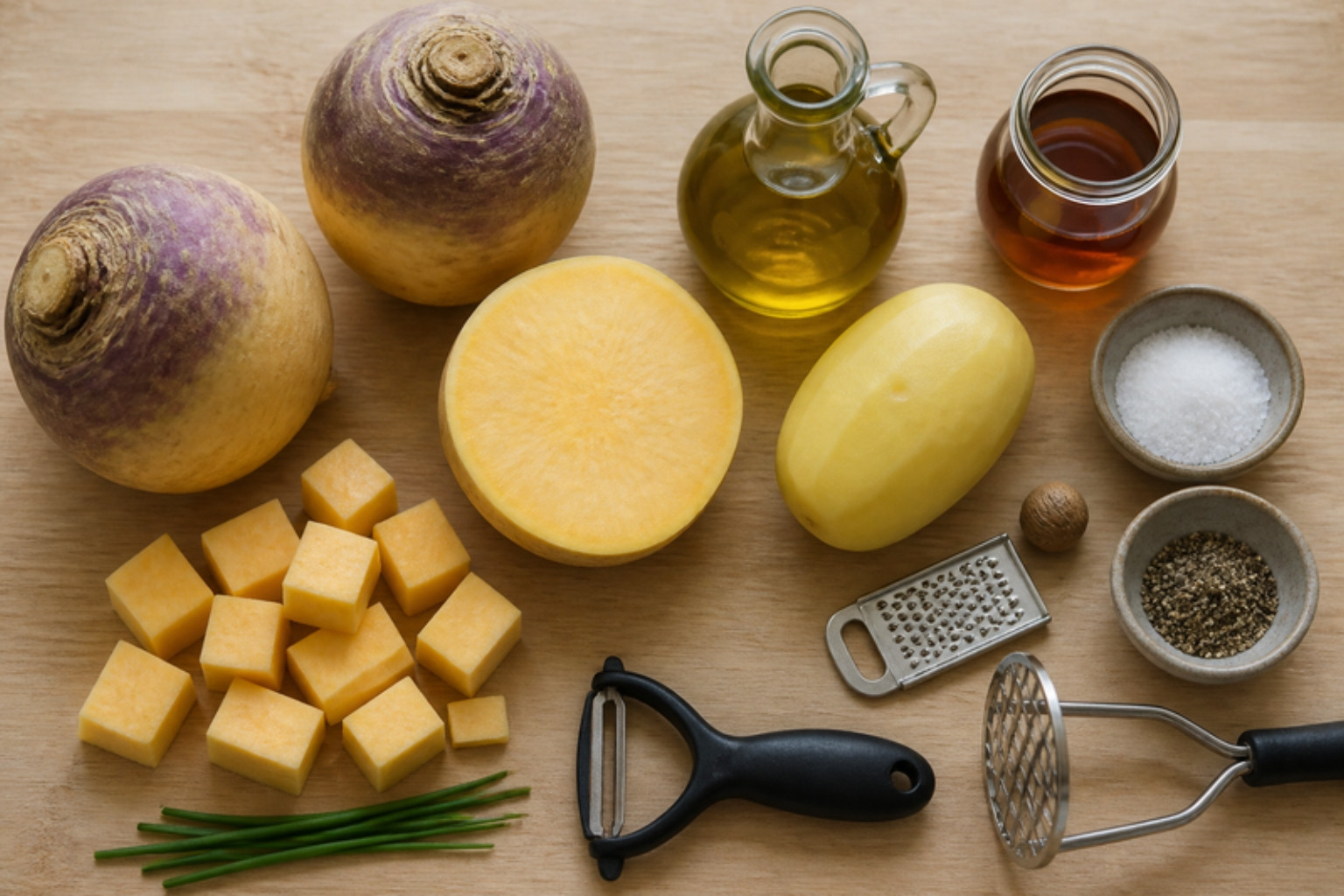
Mashed Rutabaga with Olive Oil (Dairy-Free)
Ingredients
Equipment
Method
- Cut a thin slice off the top and bottom of each rutabaga so it sits flat. Peel with a sturdy peeler or slice the skin off with a knife, going deep enough to remove the waxy layer and the paler ring just under it. Cut into 1-inch cubes.
- Put the rutabaga in a large pot, cover with cold water by 1 inch, and add 1 tablespoon kosher salt. Bring to a boil, then simmer 20 minutes.
- Add the potato (if using) and simmer 15 to 20 minutes more, until a fork slides into the largest rutabaga cube with no resistance. Rutabaga takes longer than potatoes; undercooked pieces stay lumpy.
- Scoop out 1/2 cup cooking water, then drain well. Return the vegetables to the hot pot over low heat for 1 to 2 minutes, shaking the pot, until the steam stops and the surfaces look dry. This keeps the mash from turning watery.
- Mash with a potato masher, or beat with a hand mixer for a smoother texture, adding the olive oil, maple syrup, salt, pepper, and nutmeg. Add reserved cooking water a tablespoon at a time until creamy and fluffy.
- Taste and adjust the salt. Spoon into a warm bowl, make a swirl on top, drizzle with a little more olive oil, and sprinkle with chives or parsley.
Notes
Troubleshooting and Tips
- Watery mash: it wasn’t dried enough. Stir it in the pot over low heat for a few minutes to cook off the extra liquid.
- Lumpy: some cubes were undercooked. Use a hand mixer to smooth it, or simmer stubborn pieces a few minutes longer.
- Too bitter or sharp: add the maple syrup or the potato, and a little more salt. Smaller, younger rutabagas tend to be milder.
- Bland: salt the cooking water well and finish with a final drizzle of good olive oil and fresh black pepper.
How to Serve Mashed Rutabaga
On a holiday plate, mashed rutabaga goes right where you’d put mashed potatoes or squash, next to roast turkey, ham, or prime rib, with a spoonful of gravy over the top. On an ordinary weeknight it’s good with pork chops, meatloaf, or a roast chicken. Leftovers can be stirred into a pot of beef stew to thicken it, or shaped into small patties and browned in a skillet with a little olive oil or bacon fat for a crispy breakfast side. For a brighter finish, stir in a little fresh thyme or a squeeze of lemon right before serving.
Storage, Freezing, and Reheating
Refrigerate mashed rutabaga in a covered container for up to 4 days. For a holiday, make it a day ahead and reheat in a covered pot over low heat with a splash of water, stirring often, or microwave in a covered bowl, stirring every minute. It freezes well for up to 3 months; thaw overnight in the refrigerator and stir well while reheating, since some liquid may separate.
Building a holiday menu? Mashed rutabaga sits nicely next to maple roasted butternut squash and old-fashioned Harvard beets, and it’s the classic partner for Upper Peninsula pasties. For the rest of the plate, add roast turkey without butter and mashed potatoes without milk or butter. Find more sides on our Thanksgiving recipes page.
Mashed Rutabaga FAQ
What does rutabaga taste like?
Mildly sweet and earthy with a gentle peppery bite, somewhere between a turnip and a carrot. Cooking and mashing mellows it a lot.
Is rutabaga the same as a turnip?
They’re related but different. Rutabagas are larger, with yellow flesh and purple-tinged skin, and taste sweeter. Turnips are smaller, white-fleshed, and sharper. Rutabaga is also called a swede in many places.
Do you have to peel rutabaga?
Yes. The skin is tough and often waxed for storage. Peel until you reach the even, pale yellow flesh.
Can I mash rutabaga and potatoes together?
Yes. Many families mash them half and half. Add the potatoes partway through so both finish at the same time.
How long do you boil rutabaga for mashing?
About 35 to 40 minutes for 1-inch cubes started in cold salted water. It takes longer than potatoes; it’s ready when a fork slides into the biggest cube with no resistance.
Can you make mashed rutabaga without butter?
Yes. Steam-dry the drained cubes, then mash them with extra-virgin olive oil so it coats the vegetable and turns smooth and glossy. Bacon fat can replace half the oil for a smoky version; skip plant butters, which are usually made with seed oils.
A note before you cook: These recipes are ideas and suggestions, not medical or dietary advice. As with any recipe or ingredient, it is each reader’s responsibility to confirm what they can and cannot eat, read every ingredient label, and source quality ingredients that fit their own needs. Ingredient formulations change, so always check the package you’re using.