
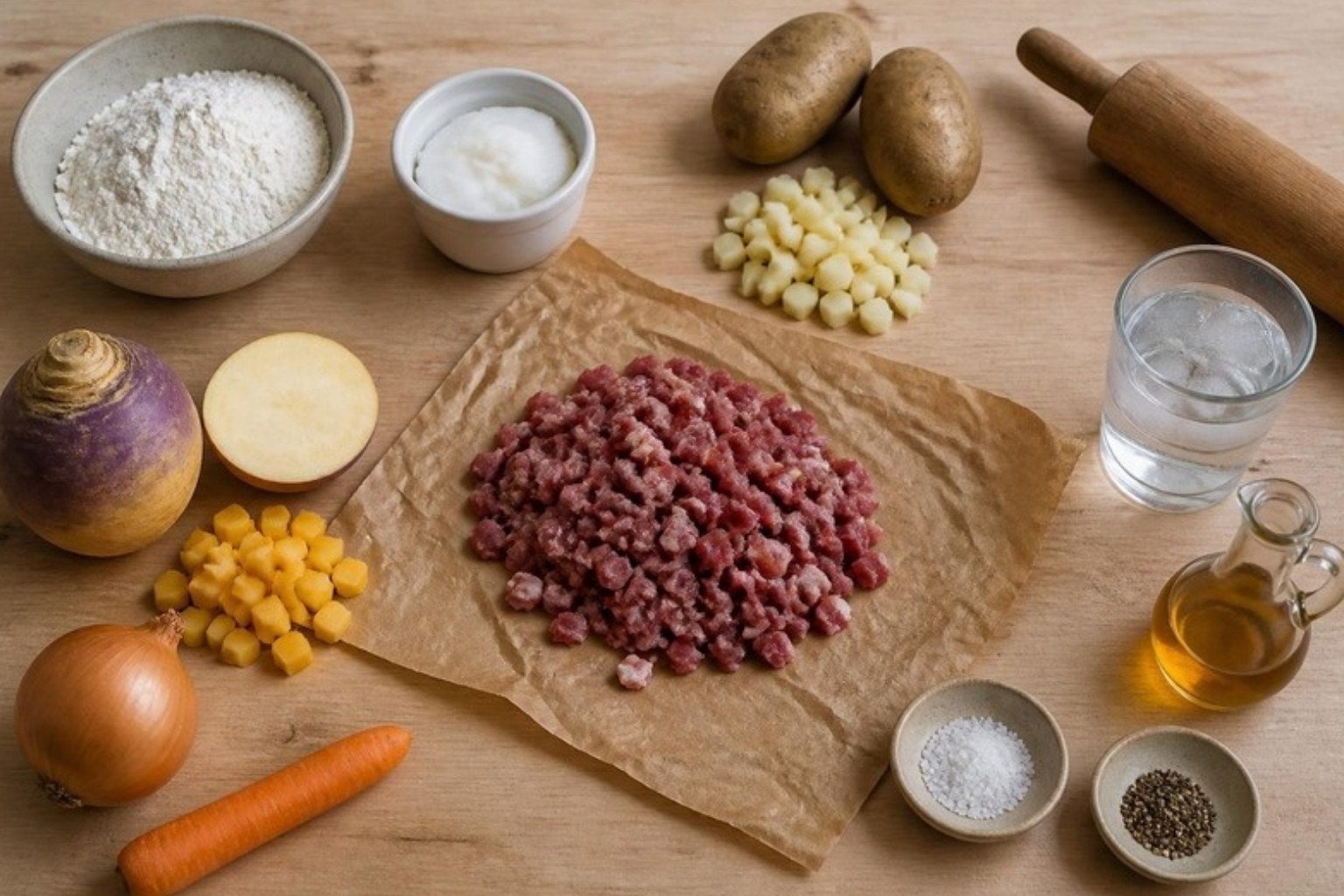
Drive across the Mackinac Bridge and the hand-lettered “PASTIES” signs start almost immediately. The Upper Peninsula pasty (it rhymes with “nasty,” not “tasty”) came to Michigan with Cornish miners in the 1800s, and it’s still the U.P.’s signature lunch: a sturdy, flaky half-moon of pastry packed with diced beef, potato, rutabaga, and onion, seasoned with little more than salt and pepper. As it bakes, the raw filling steams in its own juices into something close to a beef stew sealed in a crust.
Old-fashioned pasty dough is often made with lard, which makes it naturally free of butter and milk. This version keeps it that way and skips the egg wash many recipes brush on top, so the crust is made without eggs or dairy and still bakes up golden and crisp. It does use all-purpose flour, so it contains wheat.
Made without: eggs, milk, peanuts, tree nuts, soy, fish, shellfish, sesame.
Contains: wheat.
Why You’ll Love This Recipe
- A true Michigan classic: the traditional U.P. filling of beef, potato, rutabaga, and onion.
- Flaky lard crust: no butter, shortening, or egg wash.
- A whole meal in your hand: meat and vegetables baked inside the crust.
- Freezes beautifully: bake a batch and reheat straight from frozen.
How the Crust Works Without Butter or Eggs
Flaky pastry depends on cold pieces of solid fat scattered through the flour. In the oven, the water in the dough turns to steam around those pieces and pushes the layers apart. Lard is especially good at this: it’s firm when cold, rich in flavor, and gives a crust that’s both tender and strong enough to hold a heavy filling. A tablespoon of cider vinegar in the ice water helps keep the dough tender and easy to roll.
Egg wash is mostly about shine. Without it, a pasty still browns well thanks to the hot start at 400°F (200°C). Brushing the crimped edges with a little water helps them seal, and the small slits on top let steam escape so the crust doesn’t burst.
Ingredients & Swap Ideas
- All-purpose flour (4 cups / 500 g): contains wheat. A gluten-free flour blend hasn’t been worked out for this crust; it would change the dough’s handling and isn’t covered here.
- Lard (1 cup + 2 tbsp / 230 g, plus 2 tbsp for the filling): some lard sold on grocery shelves is hydrogenated or blended, so look for pure rendered lard. Cold beef tallow works too. Avoid shortening and margarine, which are made from seed oils.
- Beef (1 1/4 lb / 570 g): top sirloin or chuck, trimmed and diced small (about 1/4 inch). Some cooks mix in a little ground pork; diced beef is the classic choice.
- Potato, rutabaga, and onion: russet potatoes hold together well. Rutabaga (sometimes called “baga” in the U.P.) adds a mild, sweet, peppery flavor. Turnip is the closest swap.
- Carrot (optional): some U.P. families wouldn’t dream of it, others always add it. Your call.
- Salt and pepper: that’s all the seasoning a traditional pasty gets.
Kitchen Equipment
- Large bowl and pastry blender (or two forks)
- Rolling pin and a 9-inch plate or pot lid to trace circles
- 2 rimmed baking sheets lined with parchment
- Instant-read thermometer
Step-by-Step Tips
- Keep everything cold. Cold lard and ice water make a flakier crust. If the dough turns soft and greasy while rolling, chill it for 15 minutes.
- Dice small and evenly. The filling goes in raw, so 1/4-inch pieces are what let the potato and rutabaga cook through in the same time as the crust.
- Don’t overfill. About 1 1/4 cups per pasty leaves a clean 1-inch border for sealing.
- Crimp tightly. Fold the edge over itself into a rope so juices stay inside.
- Bake by sight and feel. They’re done when the crust is deep golden, juices bubble at the vents, and a skewer slides easily through the vegetables. The filling should read at least 160°F (71°C); see the USDA safe temperature chart.
Upper Peninsula Beef Pasties (Egg-Free, Dairy-Free)
Ingredients
Equipment
Method
- Whisk the flour and salt in a large bowl. Cut in the cold lard with a pastry blender until most of it is in pea-size pieces with a few larger flakes.
- Stir the vinegar into 3/4 cup ice water and drizzle it over the flour, tossing with a fork. Add more water 1 tablespoon at a time just until the dough holds together when squeezed. Divide into 6 equal pieces (about 140 g each), flatten into disks, wrap, and chill at least 1 hour.
- Toss the beef, potatoes, rutabaga, onion, and carrot (if using) with the salt and pepper in a large bowl.
- Heat the oven to 400°F (200°C) and line 2 rimmed baking sheets with parchment.
- On a floured surface, roll each disk into a 9-inch (23 cm) round about 1/8 inch thick. Mound about 1 1/4 cups filling on one half, leaving a 1-inch border, and top with a piece of lard.
- Brush the edge with water, fold the dough over, and press to seal. Crimp by folding the edge over itself into a rope. Cut 2 small slits in the top and move to the baking sheets.
- Bake 20 minutes, then reduce the heat to 350°F (175°C) and bake 35 to 40 minutes more, until the crust is deep golden and juices bubble at the vents. A skewer through a vent should slide easily through the potato and rutabaga, and the filling should read at least 160°F (71°C).
- Rest 10 minutes before serving. Serve plain, with ketchup, or with gravy (see the label check note).
Notes
Troubleshooting & Tips
- Dough cracks when folding: it’s too cold or a bit dry. Let it sit 5 minutes, and patch any cracks with a dab of water and a scrap of dough.
- Juices leaked out: the seal wasn’t tight or the pasty was overfilled. A little leaking is normal; that’s why the pans are rimmed and lined.
- Vegetables still firm: the pieces were too big. Return the pasties to the oven, loosely covered with foil, for 10 more minutes.
- Dry filling: don’t skip the piece of lard on top of each filling mound. It melts into the beef and vegetables as they cook.
Storage, Freezing & Reheating
Refrigerate baked pasties up to 4 days. Reheat at 350°F (175°C) for 20 to 25 minutes, until hot in the center (165°F / 74°C), so the crust stays crisp. To freeze, cool baked pasties completely, wrap each one, and freeze up to 3 months. Reheat from frozen at 350°F for 40 to 50 minutes. In the U.P., pasties are served plain, with ketchup, or with gravy. Store-bought gravy often contains wheat, milk, or soy, so check the label.
More Michigan Comfort Food
For another beef-and-root-vegetable dinner with no pastry at all, try the Slow Cooker Pot Roast. If you’re cooking for someone who avoids wheat, browse our Top 9 Free recipes, or see all of our egg-free recipes.
FAQ
What’s in a traditional U.P. pasty?
Diced beef (sometimes mixed with pork), potato, rutabaga, and onion, seasoned with salt and pepper and baked raw inside a sturdy crust. Carrots are a common, and much-debated, addition.
Can I make pasty dough without butter or eggs?
Yes. Lard (or beef tallow), flour, salt, ice water, and a little vinegar make a flaky, sturdy dough with no butter or eggs. Skip the egg wash; the crust still browns well.
Do you cook the filling first?
No. Traditional pasties go in the oven with a raw filling, which cooks in its own juices. Dicing everything small is what makes that work.
How do you pronounce pasty?
“PASS-tee,” with a short “a,” rhyming with “nasty.”
A note before you cook: These recipes are ideas and suggestions, not medical or dietary advice. As with any recipe or ingredient, it is each reader’s responsibility to confirm what they can and cannot eat, read every ingredient label, and source quality ingredients that fit their own needs. Ingredient formulations change, so always check the package you’re using.