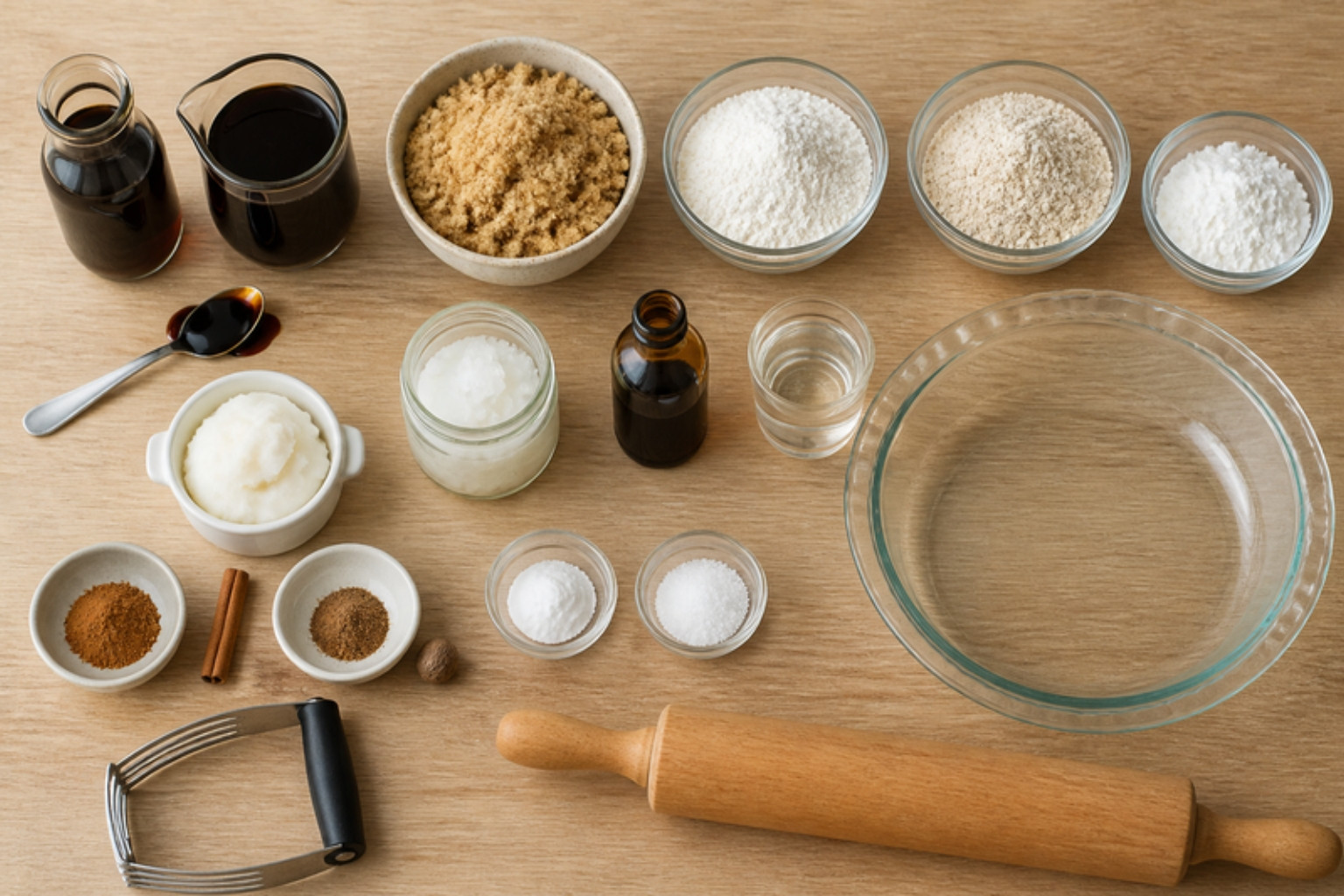
Ingredients
Equipment
Method
- Make the crust: whisk the rice flour, oat flour, cornstarch, sugar, and salt. Cut in the cold lard with a pastry blender or your fingertips until the mixture looks like coarse crumbs with some pea-size pieces. Mix the vinegar into 4 tablespoons ice water and sprinkle it over, tossing with a fork, adding more water a teaspoon at a time until the dough holds together when squeezed. Press into a disk, wrap, and chill 30 minutes.
- Roll the dough between two sheets of parchment dusted with cornstarch to an 11-inch (28 cm) round, about 1/8 inch (3 mm) thick. Peel off the top sheet, flip the dough into the pie plate, and peel off the second sheet. Press any cracks together with your fingers, patch thin spots with scraps, and crimp the edge. Chill the shell while you make the crumb and filling.
- Heat the oven to 400°F (200°C) with a rack in the lower third. Set the pie plate on a rimmed baking sheet.
- Make the crumb: whisk the oat flour, rice flour, brown sugar, cinnamon, nutmeg, and salt. Rub in the firm coconut oil with your fingertips until the mixture looks like damp sand and holds small clumps when squeezed.
- Make the filling: in a large bowl (it will foam), whisk the cornstarch into the cold water until smooth. In a heatproof measuring cup, stir the baking soda into the boiling water; it will fizz. Pour the hot soda water into the molasses and whisk well, then whisk in the cornstarch slurry, vanilla, and salt.
- Sprinkle 1/2 cup of the crumb over the bottom of the chilled shell. Slowly pour in the molasses filling (it should come no higher than about 1/2 inch below the rim). Scatter the remaining crumb evenly over the top; most of it will float.
- Bake 15 minutes at 400°F, then lower the oven to 350°F (175°C) and bake 30 to 40 minutes more, until the crust edge is golden, the crumb is lightly browned, the filling has puffed around the edges, and the center jiggles slightly as one piece, like set jelly, when you nudge the pan. If the crust edge browns too fast, cover it with a foil ring.
- Cool on a wire rack at least 3 hours. The molasses layer finishes setting as it cools; slicing warm gives a runny bottom. Serve at room temperature.
Notes
Made without: peanuts, tree nuts, milk, eggs, wheat, soy, fish, shellfish, sesame. Classic shoofly pie usually has an egg in the molasses layer and butter in the crumb; here cornstarch sets the filling and lard and refined coconut oil replace the butter. No nuts are traditional in shoofly pie, which makes it a nut-free alternative to pecan pie.
Fat swaps: use cold refined coconut oil instead of lard in the crust (the crust will be more crumbly to roll), or cold lard instead of coconut oil in the crumb. If you avoid coconut, use lard in both. Untested swaps; the recipe has not been kitchen-tested.
Label check: oat flour (certified gluten-free for barley cross-contact), lard (some shelf-stable lard is hydrogenated or blended; look for pure rendered lard), molasses (choose unsulphured), vanilla, baking soda.
Storage: cover and keep at room temperature up to 2 days, or refrigerate up to 5 days. Freeze the cooled, whole pie wrapped in plastic and foil up to 2 months; thaw overnight in the refrigerator, then bring to room temperature.
Nutrition is an automated estimate per slice (1/8 pie).
