
If you’ve been hunting for a Thanksgiving pie that skips both eggs and nuts, the dessert table can look pretty thin: pumpkin and custard pies lean on eggs, and pecan pie is all nuts. Shoofly pie is a good place to look. This Pennsylvania Dutch classic is a molasses pie with two layers that form on their own in the oven: a dark, gooey, almost pudding-like bottom and a cake-like crumb on top, covered with a sandy cinnamon brown sugar topping. It tastes like a cross between gingerbread and a molasses cookie, and it was built from pantry staples to begin with.
Most recipes add one egg to the molasses layer and use butter in the crumb. This version sets the filling with cornstarch, uses refined coconut oil in the crumb, and bakes everything in a flaky lard crust made with rice flour and certified gluten-free oat flour. The result is a dairy-free, egg-free shoofly pie with the same wet-bottom texture, and like the original, it has no nuts.
Made without: peanuts, tree nuts, milk, eggs, wheat, soy, fish, shellfish, sesame.
Why You’ll Love This Recipe
- A nut-free answer to pecan pie: the same dark, sticky sweetness, made from molasses and brown sugar.
- No egg replacer: a little cornstarch does the setting job the egg used to do.
- Pantry ingredients: molasses, brown sugar, flour, spices, and fat. Nothing to hunt down.
- Bake it ahead: shoofly pie is better the day after baking, and it freezes well.
How It Works Without Eggs or Butter
Shoofly pie is called “wet-bottom” when the molasses layer stays soft and gooey under the crumb. The filling is molasses thinned with boiling water and baking soda. In the oven, the soda reacts with the slightly acidic molasses and lifts part of the filling into a cakey middle layer, while the rest settles into a dense, jammy bottom. In most recipes the egg helps that bottom layer set enough to slice. Here, a cornstarch slurry does the same job: it thickens as the filling heats, then firms further as the pie cools, so the bottom holds together without turning rubbery.
For the crumb, firm refined coconut oil rubs into the flour and sugar just like cold butter, so you get a sandy topping that bakes into crisp, golden clumps. The crust uses lard, the traditional Pennsylvania Dutch pie fat, which makes a tender, flaky shell even without wheat.
Ingredients & Swap Ideas
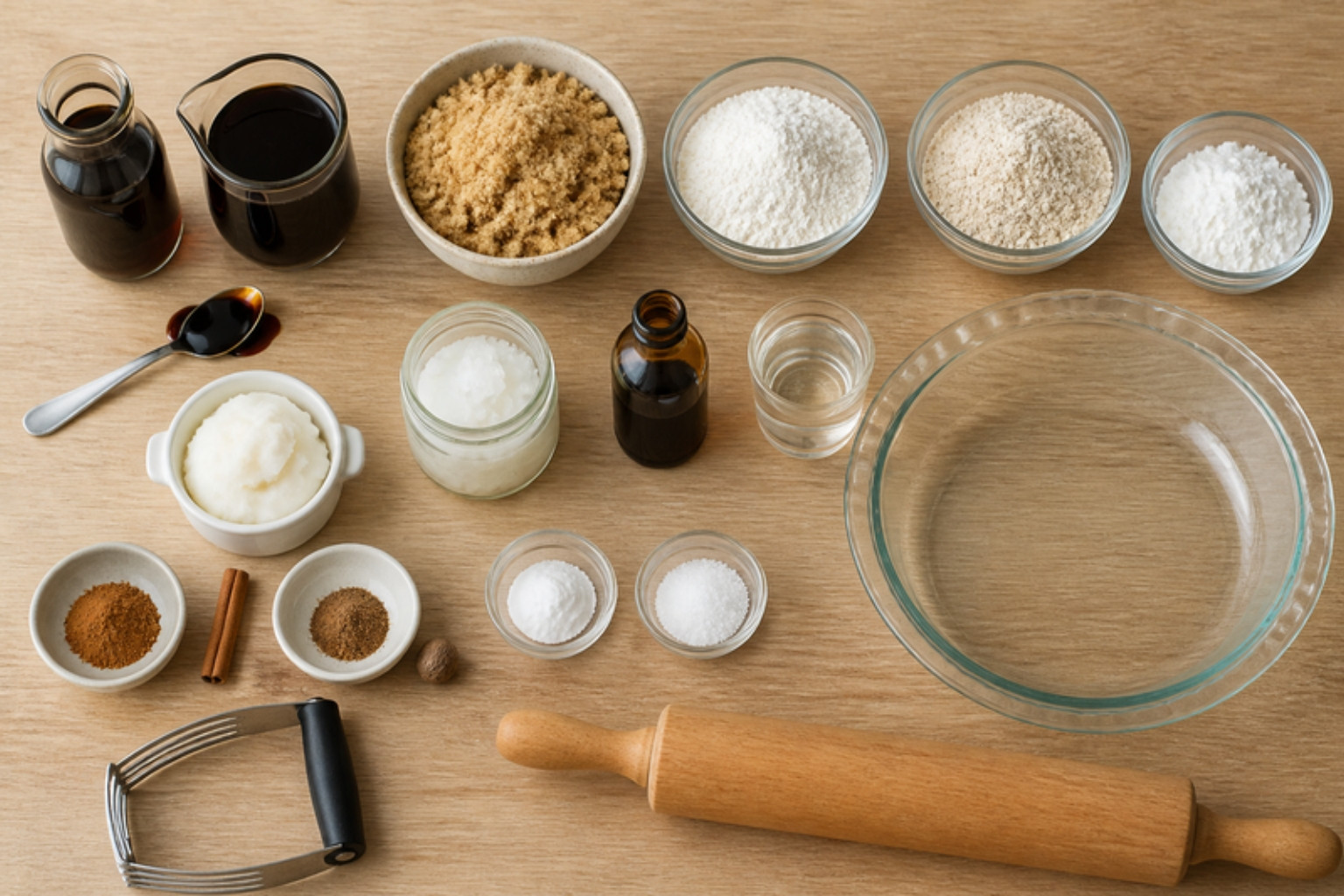
- Crust flours: 3/4 cup (120 g) finely ground white rice flour, 1/2 cup (50 g) certified gluten-free oat flour, and 1/4 cup (32 g) cornstarch. Certified gluten-free oats matter if you avoid barley, since regular oats can pick it up.
- Crust fat: 1/2 cup (100 g) cold lard. Look for pure rendered lard; some shelf-stable tubs are hydrogenated or blended. Cold refined coconut oil works too, though the dough is more crumbly to roll.
- Crumb fat: 1/4 cup (50 g) firm refined coconut oil. If you avoid coconut, use cold lard here as well. Skip shortening, margarine, and butter substitutes.
- Molasses: 1 cup (330 g) unsulphured mild or full-flavor molasses. Blackstrap is too bitter for this pie. A milder molasses gives a sweeter, caramel-like pie; full-flavor gives a darker, more gingerbread-like one.
- Spices: cinnamon and nutmeg in the crumb. A pinch of ground ginger or cloves is a nice addition if you like a spicier pie.
Kitchen Equipment
- 9-inch (23 cm) standard pie plate (not deep-dish)
- Rolling pin and two sheets of parchment
- Rimmed baking sheet to catch drips
- Large bowl for the filling (it foams when the soda water goes in)
Step-by-Step Tips
- Roll between parchment. Wheat-free dough has less stretch, so roll it between cornstarch-dusted parchment and flip it into the plate. Press cracks closed and patch thin spots with scraps; it won’t show under the filling.
- Keep the shell cold. Chill it while you make the crumb and filling so the lard stays firm and the crust bakes up flaky.
- Use a big bowl for the filling. Soda in boiling water fizzes hard when it meets the molasses. Whisk in the cornstarch slurry last.
- Layer it right. A little crumb on the bottom, the filling poured slowly over it, then the rest of the crumb on top. Most of the top crumb floats and bakes into a crisp lid.
- Judge doneness by the jiggle. The pie is ready when the edges have puffed and the center wobbles slightly as one piece, like set jelly, rather than rippling like liquid.
- Wait to slice. Cool at least 3 hours. The wet bottom finishes setting as it cools.
Shoofly Pie (Wet-Bottom Molasses Pie)
Ingredients
Equipment
Method
- Make the crust: whisk the rice flour, oat flour, cornstarch, sugar, and salt. Cut in the cold lard with a pastry blender or your fingertips until the mixture looks like coarse crumbs with some pea-size pieces. Mix the vinegar into 4 tablespoons ice water and sprinkle it over, tossing with a fork, adding more water a teaspoon at a time until the dough holds together when squeezed. Press into a disk, wrap, and chill 30 minutes.
- Roll the dough between two sheets of parchment dusted with cornstarch to an 11-inch (28 cm) round, about 1/8 inch (3 mm) thick. Peel off the top sheet, flip the dough into the pie plate, and peel off the second sheet. Press any cracks together with your fingers, patch thin spots with scraps, and crimp the edge. Chill the shell while you make the crumb and filling.
- Heat the oven to 400°F (200°C) with a rack in the lower third. Set the pie plate on a rimmed baking sheet.
- Make the crumb: whisk the oat flour, rice flour, brown sugar, cinnamon, nutmeg, and salt. Rub in the firm coconut oil with your fingertips until the mixture looks like damp sand and holds small clumps when squeezed.
- Make the filling: in a large bowl (it will foam), whisk the cornstarch into the cold water until smooth. In a heatproof measuring cup, stir the baking soda into the boiling water; it will fizz. Pour the hot soda water into the molasses and whisk well, then whisk in the cornstarch slurry, vanilla, and salt.
- Sprinkle 1/2 cup of the crumb over the bottom of the chilled shell. Slowly pour in the molasses filling (it should come no higher than about 1/2 inch below the rim). Scatter the remaining crumb evenly over the top; most of it will float.
- Bake 15 minutes at 400°F, then lower the oven to 350°F (175°C) and bake 30 to 40 minutes more, until the crust edge is golden, the crumb is lightly browned, the filling has puffed around the edges, and the center jiggles slightly as one piece, like set jelly, when you nudge the pan. If the crust edge browns too fast, cover it with a foil ring.
- Cool on a wire rack at least 3 hours. The molasses layer finishes setting as it cools; slicing warm gives a runny bottom. Serve at room temperature.
Notes
Troubleshooting
- Bottom layer is runny: the pie came out early or was sliced warm. Next time bake until the center jiggles as one piece, and let it cool fully. A runny slice firms up after a few hours in the refrigerator.
- Filling bubbled over: the plate was deep-dish-sized for a standard recipe, or overfilled. Leave about 1/2 inch of space at the top, and always bake on a rimmed sheet.
- Pie tastes bitter: blackstrap molasses or an over-dark crust edge. Use mild or full-flavor molasses and shield the edge with foil once it’s golden.
- Crust cracked while rolling: the dough was too cold or a little dry. Let it sit 5 minutes, or knead in a teaspoon of ice water, then roll again.
Make-Ahead, Storage & Freezing
Shoofly pie is a good make-ahead holiday dessert because the flavor deepens overnight. Bake it a day or two before Thanksgiving, cover it once it’s completely cool, and keep it at room temperature up to 2 days or in the refrigerator up to 5 days. The crust dough can be made up to 3 days ahead and kept wrapped in the refrigerator, or frozen up to 2 months. To freeze the baked pie, wrap the cooled pie (in its plate) in plastic and foil and freeze up to 2 months. Thaw overnight in the refrigerator, then let it come to room temperature before serving. For bringing it to a gathering, a pie carrier or a cake box with the pie plate set on a folded towel keeps the crumb top intact.
More Thanksgiving Pies
Browse every pie, side, and main in our Thanksgiving recipes collection. If you like old-fashioned sugar pies, the maple syrup pie is another nut-free stand-in for pecan pie, and the sweet potato pie uses the same style of oat and rice flour crust. Molasses fans should also try the old-fashioned gingerbread cake with lemon sauce.
FAQ
What is the difference between wet-bottom and dry-bottom shoofly pie?
Wet-bottom shoofly pie has a soft, gooey molasses layer under a cakey crumb. Dry-bottom pie mixes more of the crumb into the filling, so it bakes through into a firmer, cake-like pie. This recipe is the wet-bottom style.
Why is it called shoofly pie?
The usual story is that the sticky molasses drew flies that had to be shooed away from cooling pies, though the name’s origin isn’t certain. Either way, it has been a Pennsylvania Dutch staple for well over a century.
Can I use a store-bought crust?
Most store-bought crusts contain wheat, and many gluten-free ones contain eggs, butter, or seed oils, so read the label carefully. The homemade lard crust here takes about 15 minutes of hands-on time.
How do I serve shoofly pie?
At room temperature, often with coffee. A spoonful of whipped coconut cream is a nice dairy-free topping if coconut works for you.
A note before you cook: These recipes are ideas and suggestions, not medical or dietary advice. As with any recipe or ingredient, it is each reader’s responsibility to confirm what they can and cannot eat, read every ingredient label, and source quality ingredients that fit their own needs. Ingredient formulations change, so always check the package you’re using.