
|
Listen to this article (AI-narrated)
Getting your Trinity Audio player ready…
|
What’s It Doing There? · Episode 2 · A weekly look at what ingredients actually do, and how to cook without the top 9 allergens
Pull a piece of wheat bread apart and it stretches before it tears. Bite a gluten-free cookie made with the wrong flour and it crumbles, or worse, feels sandy. The difference comes down to one protein network that wheat builds almost by accident, and that every flour made without wheat has to fake in its own way.
Gluten isn’t one thing sitting in the flour. It’s something flour makes when you add water and start mixing. Understanding how it forms is the fastest way to understand why gluten-free baking works the way it does.
The two-minute version
- Gluten forms when two wheat proteins meet water and get mixed. One brings stretch, the other brings spring, and together they make a net that traps gas and sets into structure.
- No single flour replaces it. Gluten-free baking splits the job: rice and oat flours for body, starches for tenderness and set, sweet rice flour for chew.
- Starch is the real workhorse. It swells and sets with heat, which is what holds a gluten-free crumb together.
- Give flours time. A 20–30 minute rest lets rice and oat flours hydrate, which cuts grittiness and helps the bake hold.
- Read the label on plain wheat flour too. Many add malted barley flour, for its enzymes rather than its protein.
How gluten forms
Wheat flour carries two families of proteins, gliadins and glutenins. Dry, they just sit there. Add water and they unfold and start bonding to each other. Glutenins link up end to end into long, springy chains, the part that makes dough bounce back. Gliadins slip between those chains and let them slide, the part that lets dough stretch. Mixing and kneading line all of that up into a stretchy, elastic net.
That net does three jobs. It traps gas from yeast or baking powder, so bread rises and holds its shape. It gives chew, the pull you feel in a bagel or a pizza crust. And in the oven it sets, along with the starch around it, into the structure of the finished loaf. More water and more mixing build more gluten, which is why bread recipes call for kneading and tender muffin recipes warn you not to overmix.
A side note on barley
Barley and rye carry relatives of wheat’s gluten proteins, but they don’t build the same strong, stretchy network, which is why barley bread is dense. So it surprises people that many bags of plain wheat flour in the US list malted barley flour. It’s there for enzymes, not protein. Malting wakes up enzymes that break starch into sugars, which feed yeast and help crusts brown. It’s added in small amounts, so it rarely stands out on the label, but if barley is on your list to avoid, that ingredient line on a bag of wheat flour, and the word “malt” on cereals, is worth a look.
What happens without gluten
Take gluten away and you lose the net. Batters can’t hold big gas bubbles for long, doughs tear instead of stretch, and bakes rely almost entirely on starch to set. That’s not a dead end; plenty of baking never needed much gluten. Cookies, muffins, quick breads, cakes, pie crust and scones all do well without wheat, because they mostly need tenderness and a set crumb, not stretch. Yeasted sandwich bread with an open, chewy crumb is the hardest case, and it’s where gums and specialty binders usually come in.
Meet the team: what each flour does
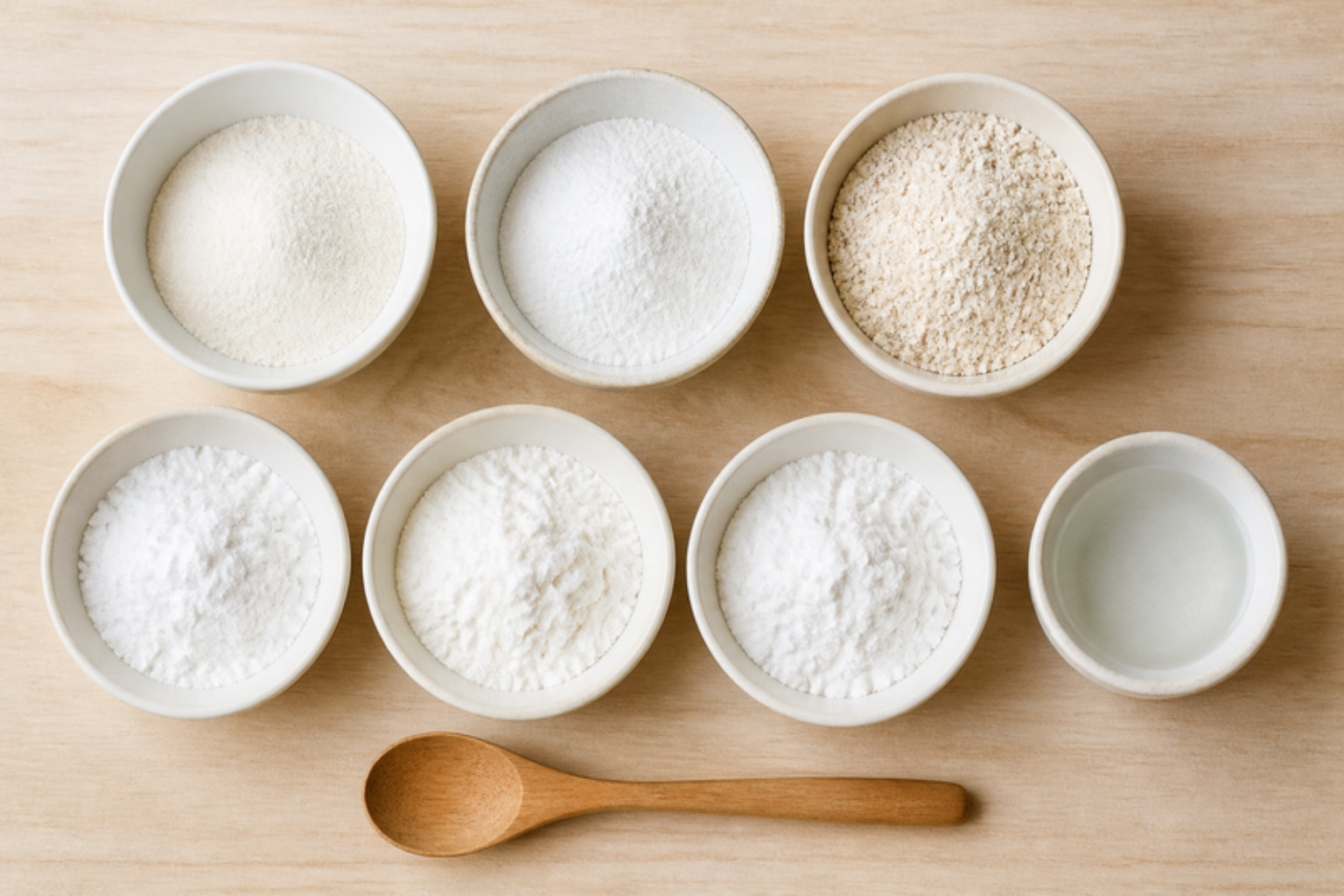
Instead of one flour doing everything, gluten-free baking uses a small team, each member covering part of the job.
White rice flour: the backbone
Neutral in flavor and color, it gives body and a fine crumb. Its weakness is texture: coarsely ground rice flour feels sandy. Finely ground flour and a rest period for the batter both help.
Sweet rice flour: the chew
Made from short-grain “glutinous” or sticky rice. Despite the name, it contains no gluten; “glutinous” describes its sticky texture. Its starch is almost all amylopectin, a branched starch that turns sticky and stretchy when cooked, so a little sweet rice flour adds chew and helps cookies and scones hold together.
Oat flour: flavor and moisture
Oat flour brings a warm, wheaty flavor and soluble fiber called beta-glucan that holds water, which keeps bakes moist and helps bind. Oats are often grown and milled near wheat and barley, so look for oats and oat flour labeled gluten-free, and check the label for barley cross-contact.
Tapioca starch: stretch and crisp edges
From the cassava root. Cooked, it turns glossy and elastic, so it adds a little springiness and helps crusts and cookie edges crisp and brown.
Cornstarch and potato starch: tenderness and set
Pure starch, no protein to speak of. They make a crumb tender and fine and do much of the setting as they gelatinize in the oven. Potato starch holds a bit more moisture. Don’t confuse it with potato flour, which is made from whole cooked potatoes and behaves very differently.
Starch: the quiet hero
If gluten is wheat’s structure, starch is everyone’s. Starch sits in flour as tiny packed granules. Heated in the batter’s water, they soak it up, swell and burst, thickening the batter. That’s gelatinization, the same thing that thickens gravy. As the bake cools, the starch firms up into a soft solid that holds the crumb in place. It’s the reason gluten-free cakes and cookies need to cool before you cut or move them: they’re still setting.
Starch keeps changing after it cools, slowly tightening and pushing water out, which is why gluten-free baked goods tend to go stale faster. That’s Episode 10.
What about xanthan gum and psyllium?
Many gluten-free recipes and flour blends add a gum to stand in for gluten’s stretch. Xanthan gum is made by fermenting sugars with bacteria, and the growth medium can vary, so check the label if that matters to you. Psyllium husk, from a seed, makes a gel strong enough for yeasted breads. Both work, but neither is needed for most cookies, muffins, quick breads and cakes. The recipes on this site mostly skip them and rely on flour and starch balance, enough liquid, and a short rest.
The cheat sheet
| Gluten’s job | Who covers it without wheat | Tip |
|---|---|---|
| Body and crumb | White rice flour, oat flour | Choose finely ground flour; rest the batter |
| Structure and set | Cornstarch, potato starch, tapioca | Bake fully and let it cool before cutting |
| Chew | Sweet rice flour, tapioca | A little goes a long way |
| Trapping gas | Thick batters, starch set, quick oven heat | Fully preheat; bake soon after the rest |
| Stretch for yeasted bread | Gums or psyllium | The hardest case; most bakes don’t need it |
A common starting point for a homemade blend is roughly two parts flour (rice and oat) to one part starch, adjusted for the texture you want: more starch for tender and crisp, more flour for hearty and moist. Weighing ingredients makes results far more repeatable, since gluten-free flours vary a lot in how densely they pack into a cup.
Try this at home: the squeeze test
- In three small bowls, mix 2 tablespoons each of white rice flour, sweet rice flour and tapioca starch with about 1 tablespoon water. Add water a few drops at a time until each forms a ball.
- Roll each into a rope and gently stretch it. Rice flour cracks almost right away. Sweet rice flour is tacky and bends. Tapioca is slick and stretches more than you’d expect.
- Flatten a little of each into a coin and cook them in a dry nonstick skillet over medium heat, 2 to 3 minutes per side. Taste: rice flour is crisp and short, sweet rice is chewy, tapioca is springy and browns at the edges.
Those three textures are the building blocks of nearly every gluten-free blend.
Common mistakes
- Swapping one gluten-free flour cup-for-cup for wheat flour. A single flour can’t cover every job. Start with a recipe built for a blend.
- Measuring by the cup. Gluten-free flours pack differently. A kitchen scale fixes most “it came out different this time” problems.
- Skipping the rest. Grittiness is usually under-hydrated flour, not bad flour.
- Cutting too soon. The starch is still setting. Let bakes cool in the pan.
- Too little liquid. Gluten-free batters often look looser than wheat batters, and that’s normal.
See it in action
These recipes use a flour-and-starch team instead of wheat: homemade graham crackers, pumpkin scones with maple glaze, sugar cookie bars, old-fashioned gumdrop cookies and chocolate crinkle cookies.
FAQ
Does glutinous rice flour contain gluten?
No. “Glutinous” refers to how sticky the rice gets when cooked. Sweet rice flour, also called glutinous rice flour, is made from rice, not wheat. As with any flour, check the package for what it’s processed alongside.
Why is my gluten-free baking gritty?
Usually coarse rice flour or batter that went into the oven before the flour had time to hydrate. Use finely ground rice flour and let the batter rest 20–30 minutes.
Can I just swap gluten-free flour for regular flour?
Sometimes, with a store-bought one-to-one blend that includes a gum, but results vary by recipe. Recipes developed for a gluten-free blend are much more reliable, because the liquid, leavening and bake time are set for how those flours behave.
Do oats have gluten?
Oats don’t contain wheat gluten, but they’re commonly grown and processed near wheat and barley. Look for oats and oat flour labeled gluten-free, and read the label for barley.
Do I need xanthan gum?
For most cookies, muffins, quick breads and cakes, no. A good flour-and-starch balance and a short rest do the job. Gums matter most for yeasted breads that need to stretch and hold a rise.
Next week
Episode 3: browning without butter, milk or eggs, and the difference between the Maillard reaction and caramelization.
Further reading: Cook’s Illustrated: a closer look at gluten · America’s Test Kitchen: what is gluten? · CooksInfo: malted barley flour
A note before you cook: These recipes are ideas and suggestions, not medical or dietary advice. As with any recipe or ingredient, it is each reader’s responsibility to confirm what they can and cannot eat, read every ingredient label, and source quality ingredients that fit their own needs. Ingredient formulations change, so always check the package you’re using.
Leave a Reply