
|
Listen to this article (AI-narrated)
Getting your Trinity Audio player ready…
|
What’s It Doing There? · Episode 1 · A weekly look at what ingredients actually do, and how to cook without the top 9 allergens
Crack an egg into a bowl and it looks like one ingredient. To a cake batter, it’s closer to a small crew of specialists. One holds things together, one lifts, one keeps the fat and water on speaking terms, one paints the crust golden, and a couple more handle moisture and richness.
That’s why “just replace the egg” so often goes sideways. A swap that does one of those jobs well can leave the others undone, and the result is a muffin that’s moist but flat, or a cookie that holds together but never browns. The fix is to stop replacing the egg and start replacing the jobs.
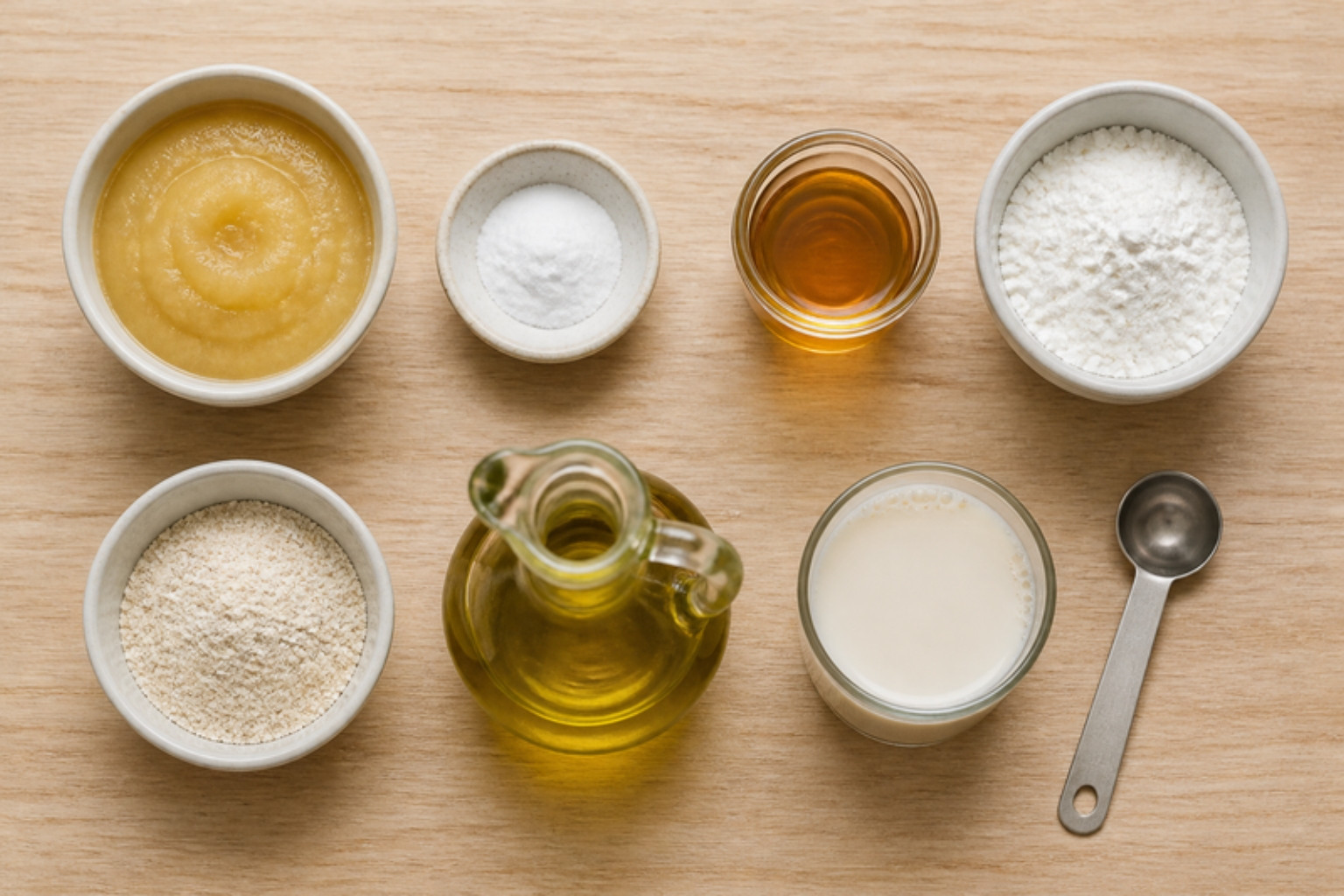
What do eggs do in baking? They do six jobs at once: bind and set the crumb, help it rise, keep fat and water mixed, brown the crust, add moisture and add richness. To bake without eggs, cover each job separately: starch for structure, baking soda plus an acid for lift, fruit purée for moisture, and brown sugar for color.
Every stand-in in this guide is made without milk, eggs, wheat, soy, peanuts, tree nuts, fish, shellfish and sesame, the nine allergens behind the name Top Nine Free.
The two-minute version
- An egg does six jobs: binding and structure, lift, emulsifying, browning, moisture, and richness and color.
- Structure comes from protein that sets with heat. Without eggs, starch takes over that job: cornstarch, tapioca, oat flour and a short rest for the batter.
- Lift comes from baking soda or baking powder plus an acid such as vinegar, brown sugar or applesauce, not from the stand-in itself.
- Browning drops without egg protein. A little extra sugar, maple syrup or an oat milk wash brings the color back.
- Fruit purées add moisture, not structure. Use them where eggs mostly add moisture, like muffins and quick breads, and expect a softer crumb. Recipes built on eggs, like meringue or soufflé, don’t have a simple pantry swap.
What’s actually in an egg
A whole large egg is roughly three-quarters water, about an eighth protein and about a tenth fat, almost all of that fat in the yolk. The white is mostly water and protein. The yolk carries the fat, plus natural emulsifiers such as lecithin. Those three things, water, protein and fat-with-emulsifiers, explain nearly everything an egg does in a recipe.
Keep that breakdown in mind, because every egg-free swap is really an answer to one question: which of those three is this recipe counting on?
Job 1: Binding and structure
Egg proteins start out folded up like balled yarn. Heat makes them unfold and link to each other, forming a mesh that traps everything around it. Whites begin to set at roughly 140 to 145°F and yolks a little higher, around 150 to 160°F. That’s why a cake goes from wobbly batter to something you can slice, and why breading stays on chicken.
Covering it without eggs: starch. When starch granules are heated in water they swell, burst and thicken, a process called gelatinization, and as they cool they firm up into a soft gel. That gel does a lot of what egg protein does in a muffin or cookie. Cornstarch, tapioca starch and potato starch are the strongest; oat flour helps too, because oats carry soluble fiber that holds water and turns slightly gummy in a good way. Letting the batter rest 15 to 30 minutes before baking gives rice and oat flours time to soak up liquid, which tightens the crumb.
For coatings, a thin slurry of flour or starch and a liquid such as oat milk does the egg’s “glue” job. That’s how the homemade chicken nuggets keep their crumb coat.
Job 2: Lift
Eggs help baked goods rise in two ways. Beaten eggs, especially whites, trap tiny air bubbles that expand in the oven. And the water in an egg turns to steam, which pushes the batter up before the proteins set around it and hold the shape.
Covering it without eggs: chemical leaveners do the heavy lifting. Baking soda is a base; it releases carbon dioxide the moment it meets an acid. Good acids in a Top 9 Free kitchen include apple cider vinegar, lemon juice, brown sugar (its molasses is slightly acidic), maple syrup, pumpkin and applesauce. Baking powder is baking soda with the acid already mixed in, and most supermarket versions are “double acting,” releasing some gas when wet and more in the oven’s heat. The usual egg-free approach is a little of both, so the batter gets an early push and a second one in the oven.
One honest limit: chemical leaveners make gas, but they can’t hold it. Something still has to set around those bubbles before they escape, and that’s the starch from Job 1. Lift and structure always work as a pair.
Job 3: Emulsifying
Fat and water don’t want to mix. An emulsifier is a molecule with one end that likes water and one end that likes fat, so it can sit between them and keep tiny droplets of one spread through the other. Egg yolk is full of them, which is why yolks hold together mayonnaise, custards and rich cake batters.
Covering it without eggs: technique does most of the work. Whisk liquid fat, such as light-tasting olive oil (light means refined and mild in flavor, not fewer calories) or melted coconut oil, into the wet ingredients until the mixture looks cloudy and evenly blended, then add the dry ingredients. Starches and the fiber in oat flour also help keep fat from pooling. In a batter that relies heavily on emulsifying, like a very rich pound cake, expect the egg-free version to be a little less velvety.
Job 4: Browning
That golden crust is mostly the Maillard reaction, a set of reactions between amino acids (the building blocks of protein) and certain sugars, which speeds up on hot, dry surfaces. Eggs bring a lot of protein to the party, so egg-free bakes often come out paler even when they’re fully baked. An egg wash on bread or pie crust is the same idea applied to the outside.
Covering it without eggs: add browning fuel. Brown sugar and maple syrup brown faster than plain white sugar. A brush of oat milk, or oat milk with a little maple syrup, stands in for egg wash, and a light brush of olive oil adds gloss. A tiny pinch of baking soda also speeds browning, because the Maillard reaction runs faster in slightly alkaline conditions; too much tastes soapy. Episode 3 covers browning in full.
Job 5: Moisture
With all that water, an egg is a liquid ingredient as much as anything else. In quick breads and muffins, much of an egg’s work is simply hydrating the flour and keeping the crumb soft.
Covering it without eggs: this is where fruit purées shine. Unsweetened applesauce and canned pumpkin add water, a little natural sugar and pectin, which helps hold that water in. A common starting point is about ¼ cup (around 60 g) of purée per egg, since a large egg weighs roughly 50 g out of the shell. Oat milk and a little extra fat also help. Just remember purée is a moisture fix, not a structure fix. Use it to replace every egg in a cake and you’ll likely get something dense and gummy, because there’s nothing left to set the crumb.
Job 6: Richness, flavor and color
Yolk fat makes a crumb tender and rich, and yolk pigment tints batters a warm yellow. This is the quietest job, but you notice when it’s gone: egg-free cakes can look whiter and taste a touch lean.
Covering it without eggs: a little more fat, pure vanilla, a pinch more salt, and warm colors from ingredients that are already in the recipe, such as pumpkin, brown sugar or a dusting of cinnamon. Coconut oil reads as rich and creamy in sweet bakes; if you avoid coconut, use light-tasting olive oil.
The cheat sheet
| Job | What the egg does | Top 9 Free stand-in | Trade-off |
|---|---|---|---|
| Binding and structure | Proteins set with heat into a mesh | Cornstarch, tapioca or potato starch; oat flour; a 15–30 minute batter rest; starch slurry for coatings | More tender, a bit more fragile |
| Lift | Traps air; water turns to steam | Baking soda plus an acid; baking powder; a hot, fully preheated oven | Needs structure to hold the rise |
| Emulsifying | Yolk keeps fat and water mixed | Whisk liquid fat into the wet ingredients first; starch and oat flour help | Slightly less velvety in very rich cakes |
| Browning | Protein feeds the Maillard reaction | Brown sugar, maple syrup, oat milk wash, a pinch of baking soda | Too much sugar burns; too much soda tastes soapy |
| Moisture | About 75% water | Applesauce, pumpkin, oat milk, a little extra fat | Too much purée turns gummy |
| Richness and color | Yolk fat and pigment | A bit more fat, vanilla, salt, pumpkin or brown sugar | Small flavor shift |
You’ll notice what’s not on the list. Many egg-free guides lean on flax or chia “eggs,” the liquid from canned chickpeas, or boxed egg replacers. They can work, but seeds, legumes and blended products bring their own allergens and label questions for a lot of readers, so this series sticks to familiar pantry starches, fruit, fats and leaveners.
Try this at home: watch starch do an egg’s job
This takes five minutes and a small saucepan, and it makes the binding job easy to see.
- Whisk 1 tablespoon cornstarch into ½ cup cold water. It looks milky and runs like water.
- Heat it over medium, stirring constantly. Somewhere short of a simmer it suddenly thickens and turns glossy and almost clear. That’s gelatinization: the starch granules have swollen and burst.
- Pour it into a small dish and let it cool for 20 minutes. It sets into a soft, sliceable gel.
- Compare a spoonful of plain applesauce left on a plate for the same time. It stays loose. Applesauce brings water; starch brings set.
That gel is the same thing holding together an egg-free muffin, just spread through the crumb instead of sitting in a dish.
Common mistakes
- Swapping every egg for applesauce. Fine for one egg in a moist muffin; trouble in a cake that uses three for structure.
- Leaving out the acid. Baking soda without an acid barely lifts and tastes metallic. Check that the recipe includes vinegar, lemon, brown sugar, buttermilk-style oat milk with vinegar, or fruit.
- Pulling bakes too early. Egg-free batters often look done before the starch has fully set. Look for a springy top and a toothpick with dry crumbs, and let them cool in the pan, where they keep firming up.
- Skipping the rest. Rice and oat flours absorb liquid slowly. A short rest means less grit and a better hold.
- Overdoing baking soda for color. A pinch helps browning; more makes cookies dark, flat and soapy.
See it in action
These recipes put the jobs to work: cranberry orange muffins (moisture and lift), soft cut-out sugar cookies (structure from flour and starch balance), Depression cake (a century-old egg-free cake that leans on baking soda and acid), chocolate crinkle cookies, pumpkin pie without eggs (cornstarch sets the filling), Belgian waffles without eggs (lift from baking powder, soda and vinegar), and royal icing without egg whites. Our pancakes without milk use the same baking powder, soda and vinegar lift, with oat flour and cornstarch binding the batter during a short rest.
FAQ
What can I use instead of eggs in baking?
It depends on which job the egg is doing in that recipe. Starch and oat flour cover structure, baking soda or powder with an acid covers lift, fruit purée and oat milk cover moisture, and a little sugar or an oat milk wash covers browning. The cheat sheet above matches each job to a stand-in.
How much applesauce replaces one egg?
A common starting point is about ¼ cup (60 g) per egg. It works best when the egg is mainly adding moisture, as in muffins and quick breads. It won’t provide lift or structure, so pair it with the recipe’s leavening and starch.
Why are my egg-free baked goods gummy?
Usually too much wet stand-in, underbaking, or cutting in too soon. Without egg protein, the crumb relies on starch, which needs full heat to set and time to firm up as it cools. Bake until the top springs back, and let it cool before slicing.
Why don’t egg-free cookies brown as much?
Egg protein is a big contributor to the Maillard reaction that browns baked goods. Brown sugar, maple syrup, an oat milk brush or a pinch of baking soda bring the color back.
Can you make custard or meringue without eggs?
Custard-style puddings, yes: cornstarch sets them, as in this butterscotch pudding. Meringue and soufflés depend on whipped egg whites to hold air, and there isn’t a simple pantry stand-in that does the same thing.
What is the best egg substitute in baking?
There isn’t one best egg substitute, because an egg does different jobs in different recipes. Match the swap to the job: cornstarch or oat flour for structure, baking soda plus vinegar for lift, and applesauce or pumpkin for moisture.
What is the best egg substitute for cakes?
Cakes count on eggs for structure and lift, so lean on a little starch, baking soda with an acid such as vinegar, and a fully preheated oven. Keep fruit purée to about one egg’s worth, or the crumb turns dense. The Depression cake shows the soda-and-acid approach.
What is the best egg substitute for cookies?
In most cookies the egg mainly binds and adds a little moisture, so a spoonful of oat milk or applesauce plus a little cornstarch usually covers it. Brown sugar brings back the color and chew that egg protein would add.
What can I use to bind ingredients without eggs?
In baking, starch does the binding: cornstarch, tapioca or oat flour, plus a short rest for the batter. In savory dishes like meatballs, rolled oats soaked in a little liquid hold things together, as in these Iowa ham balls made without eggs.
Next week
Episode 2: what gluten actually does, and how rice flour, oat flour and starches split up the work when a recipe is made without wheat.
Further reading: The Bakeshop: eggs in baking · British Egg Information Service: uses of eggs in food preparation · Food52: the Maillard reaction
A note before you cook: These recipes are ideas and suggestions, not medical or dietary advice. As with any recipe or ingredient, it is each reader’s responsibility to confirm what they can and cannot eat, read every ingredient label, and source quality ingredients that fit their own needs. Ingredient formulations change, so always check the package you’re using.