
Beef tenderloin is the roast people save for Christmas: tender enough to cut with a fork, quick to cook, and impressive when it’s sliced at the table. The usual holiday versions lean on a butter baste, a Worcestershire marinade (which contains anchovies), a flour-thickened gravy, or a creamy horseradish sauce, which leaves little for families avoiding milk, fish, or wheat. This recipe keeps everything that makes tenderloin special and drops those extras. A hard sear in beef tallow, a garlic and fresh herb crust, and a short, hot roast give a deeply browned outside and an evenly rosy center.
While the meat rests, a quick pan jus of shallot, beef broth, and a splash of balsamic captures the browned bits in the skillet. It’s made without peanuts, tree nuts, milk, eggs, wheat, soy, fish, shellfish, and sesame.
Made without: peanuts, tree nuts, milk, eggs, wheat, soy, fish, shellfish, sesame.
Why You’ll Love This Beef Tenderloin
- Fast for a holiday roast: about 45 minutes of cooking for a roast that serves 10.
- Big flavor from simple things: salt, garlic, rosemary, thyme, and a good sear.
- No butter baste, no flour, no Worcestershire.
- Even doneness from end to end thanks to tying the roast.
How to Get a Rich Crust Without Butter
Tenderloin is very lean, so flavor has to come from the outside. Butter-basting is the usual trick, but the browning really comes from the meat’s own proteins meeting high heat. Salting ahead (a dry brine) pulls moisture to the surface, which then reabsorbs, so the outside dries and sears faster. Beef tallow has a high smoke point and a beefy flavor that replaces what butter would add. A short, hot oven finishes the inside before the crust can overcook.
The herb paste goes on after searing, not before, so the garlic doesn’t scorch in the hot pan. In the oven it toasts into a fragrant crust that clings to each slice.
Ingredients & Swap Ideas
- Beef tenderloin: a center-cut roast (often sold as chateaubriand) cooks most evenly. A whole untrimmed tenderloin is cheaper; trim off the silver skin and the side “chain” muscle (save it for stir-fry), and fold the tail under. Avoid pre-marinated roasts, which can contain soy or other allergens.
- Kosher salt: about 1 1/2 teaspoons Diamond Crystal per pound. Use a little less with Morton, which is saltier by volume.
- Fat: beef tallow and extra-virgin olive oil. Bacon fat or lard also work for searing. Skip cooking spray, vegetable oil, and butter substitutes.
- Herbs: fresh rosemary and thyme are best; 1 teaspoon each dried will do.
- Beef broth: check the label, since some contain soy, wheat, or added oils. Low-sodium broth gives you control over the salt.
- Balsamic vinegar: red wine vinegar or a squeeze of lemon also brightens the jus.
Kitchen Equipment
A large oven-safe skillet (12-inch cast iron is ideal) or a roasting pan, a rack set in a rimmed baking sheet for dry brining, kitchen twine, an instant-read or leave-in probe thermometer, and a sharp carving knife. Oven at 425°F (220°C).
Step-by-Step Tips
- Tie it. Folding the thin tail under and tying every 1 1/2 inches gives an even log that cooks at one rate.
- Salt early. At least 1 hour, ideally overnight, uncovered in the fridge.
- Sear until deeply brown. Don’t move it until it releases easily from the pan, about 2 minutes per side.
- Cook to temperature, not time. Start checking at 15 minutes. Pull at 120 to 125°F for medium-rare, 135°F for medium, or about 140°F to reach the USDA’s 145°F after resting.
- Rest 15 minutes. The juices settle and the temperature rises about 5 degrees.
For food safety, the USDA recommends cooking whole cuts of beef to 145°F (63°C) with a 3-minute rest; see the USDA safe temperature chart.
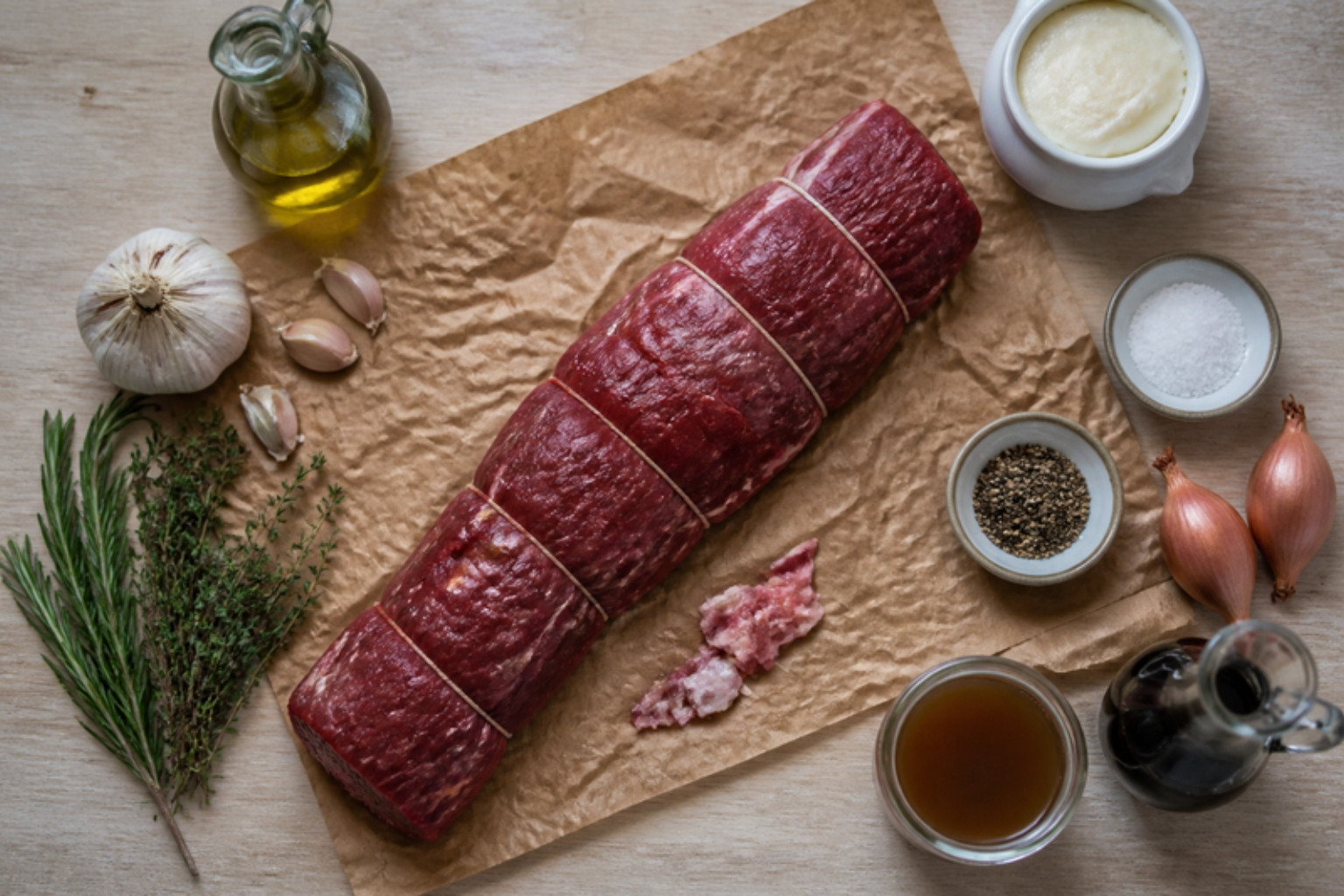
Roast Beef Tenderloin with Garlic Herb Crust and Pan Jus
Ingredients
Equipment
Method
- Pat the tenderloin dry. Tuck the thin tail end underneath so the roast is an even thickness and tie with twine every 1 1/2 inches. Season all over with the salt. Set on a rack over a rimmed sheet and refrigerate uncovered at least 1 hour or up to 24 hours.
- Take the roast out 45 minutes before cooking. Heat the oven to 425°F (220°C). Mix the garlic, rosemary, thyme, pepper, and 2 tablespoons olive oil into a paste.
- Heat the tallow and remaining tablespoon olive oil in a large oven-safe skillet over medium-high until shimmering. Sear the roast on all sides until deep brown, 8 to 10 minutes total, turning with tongs. Move to a board and let cool 2 minutes.
- Spread the herb paste over the top and sides of the roast. Return it to the skillet (or set it on the rack in the sheet) and roast until a thermometer in the thickest part reads 120 to 125°F (49 to 52°C) for medium-rare or 135°F (57°C) for medium, 20 to 30 minutes. The USDA recommends cooking whole cuts of beef to 145°F (63°C) with a 3-minute rest; for that, pull at about 140°F (60°C).
- Transfer to a board, tent loosely with foil, and rest 15 minutes; the temperature will rise about 5 degrees.
- Meanwhile, make the jus: pour off all but 1 tablespoon fat from the skillet (careful, the handle is hot). Cook the shallot over medium heat 1 to 2 minutes until soft. Add the broth, vinegar, and thyme, scraping up the browned bits, and simmer until reduced by about a third, 5 to 6 minutes. Whisk in the cornstarch slurry if you like it slightly thicker and simmer 1 minute. Add any juices from the board and season.
- Remove the twine and slice the roast 1/2 to 3/4 inch thick. Serve with the jus.
Notes
Troubleshooting
- Gray band under the crust: the sear went too long on too low heat. Get the pan very hot and keep the sear to 8 to 10 minutes total.
- Ends overcooked, center rare: the roast wasn’t even. Tie it tightly with the tail tucked, or serve the ends to guests who like it more done.
- Herb crust burned: the paste went on before searing. Add it after.
- Jus too salty: use low-sodium broth and taste before adding salt; a splash of water fixes it.
Make-Ahead & Storage
Trim, tie, and salt the roast the day before Christmas and leave it uncovered on a rack in the fridge; this is the best make-ahead step you can take. Mix the herb paste up to a day ahead and keep it covered in the fridge. Leftover sliced tenderloin keeps for up to 4 days refrigerated and makes excellent cold sandwiches. To reheat without overcooking, warm slices in a little jus over low heat, or bring to 165°F if reheating fully. Cooked slices freeze with a spoonful of jus for up to 3 months.
More Christmas Dinner Ideas
Plan the rest of the table from our Christmas recipes page. For a bone-in beef roast, see the prime rib roast with garlic herb crust, and for sides, the hasselback potatoes and creamed pearl onions both pair well with beef.
FAQ
How much beef tenderloin per person?
Plan on about 6 ounces of trimmed raw tenderloin per person, a bit less with plenty of sides. A 4-pound trimmed roast serves 10.
What’s the difference between tenderloin and prime rib?
Prime rib comes from the rib section and is well marbled with a rich, fatty flavor. Tenderloin is leaner, milder, and much more tender, and it cooks in a fraction of the time.
Can I make a horseradish sauce without sour cream?
Prepared horseradish stirred into a little olive oil, lemon juice, and salt makes a sharp, simple sauce. Check the jar’s label, since some prepared horseradish contains eggs, milk, or soybean oil.
Can I cook it on the grill?
Yes. Sear over direct high heat, then move to indirect heat with the lid closed and cook to the same temperatures. Timing varies with the grill, so rely on a thermometer.
A note before you cook: These recipes are ideas and suggestions, not medical or dietary advice. As with any recipe or ingredient, it is each reader’s responsibility to confirm what they can and cannot eat, read every ingredient label, and source quality ingredients that fit their own needs. Ingredient formulations change, so always check the package you’re using.
Leave a Reply