
A taffy pull used to be a Christmas party in itself: a pot of bubbling molasses candy, buttered hands, and a kitchen full of people stretching ropes of warm taffy until it turned golden. Most old recipes call for a big knob of butter, and store-bought taffy often adds milk, soy, or hydrogenated oils, so allergy families tend to skip it. This old-fashioned molasses taffy brings the tradition back with a short ingredient list you can read at a glance.
It’s cooked from sugar, molasses, corn syrup, water, and a splash of vinegar, with a spoonful of light-tasting olive oil in place of butter. Pulling it by hand turns the dark, glossy candy into satiny, light-brown ropes with a soft chew and a deep, gingerbread-like molasses flavor. It’s made without peanuts, tree nuts, milk, eggs, wheat, soy, fish, shellfish, and sesame.
Made without: peanuts, tree nuts, milk, eggs, wheat, soy, fish, shellfish, sesame.
Why You’ll Love This Molasses Taffy
- A hands-on holiday activity for older kids and adults once the candy has cooled.
- Nine pantry ingredients, no butter, and no special equipment beyond a candy thermometer.
- Edible gift ready: wax-paper-wrapped pieces look charming in a jar or tin.
- Deep, old-fashioned flavor that pairs well with gingerbread and spice cookies.
How It Works Without Butter
Taffy’s texture comes from sugar, temperature, and air, not from dairy. Cooking the syrup to 258 to 260°F (126 to 127°C) drives off enough water that it sets firm but still chewy. Corn syrup and vinegar both help keep the sugar from re-forming gritty crystals, so the candy stays smooth. Butter in old recipes mostly adds a little richness and keeps the candy from sticking, and a tablespoon of light-tasting olive oil does the same job without adding flavor.
Pulling is what makes taffy taffy. Every time you stretch and fold the warm candy, you trap tiny air bubbles inside. Those bubbles lighten the color from dark brown to golden tan and change the texture from hard and glassy to soft and chewy. The pinch of baking soda adds a few extra bubbles and mellows the molasses.
Ingredients & Swap Ideas
- Molasses: use regular unsulphured molasses. Blackstrap is too bitter for candy.
- Olive oil: “light-tasting” olive oil means refined and mild in flavor, not lower in calories. Refined coconut oil also works (contains coconut). Oil the pan and your hands with olive oil rather than cooking spray.
- Flavor twists: add 1/2 teaspoon ground ginger or cinnamon with the vanilla for a gingerbread taffy, or a few drops of peppermint extract.
- Wax paper: most is coated in paraffin, but some brands use soybean wax. Check the box if that matters to you.
Kitchen Equipment
A heavy 3-quart saucepan (the syrup foams up), a candy thermometer, a rimmed baking sheet or 9 x 13-inch pan, a silicone spatula, a pastry brush, kitchen scissors, and squares of wax paper. Test your thermometer in boiling water first: it should read 212°F (100°C) at sea level.
Step-by-Step Tips
- Stop stirring once it boils. Stirring boiling syrup can make it grainy.
- Watch the last few degrees. Molasses syrups climb fast near the end and can scorch. Pull the pan at 258°F for softer taffy, 260°F for firmer.
- Fold the edges in while it cools so the whole slab is the same temperature when you start pulling.
- Test before you touch. Press the center with an oiled fingertip; if it’s too hot to hold, wait a few more minutes.
- Pull until it fights back. When it turns golden tan and satiny and begins to resist, cut it right away.
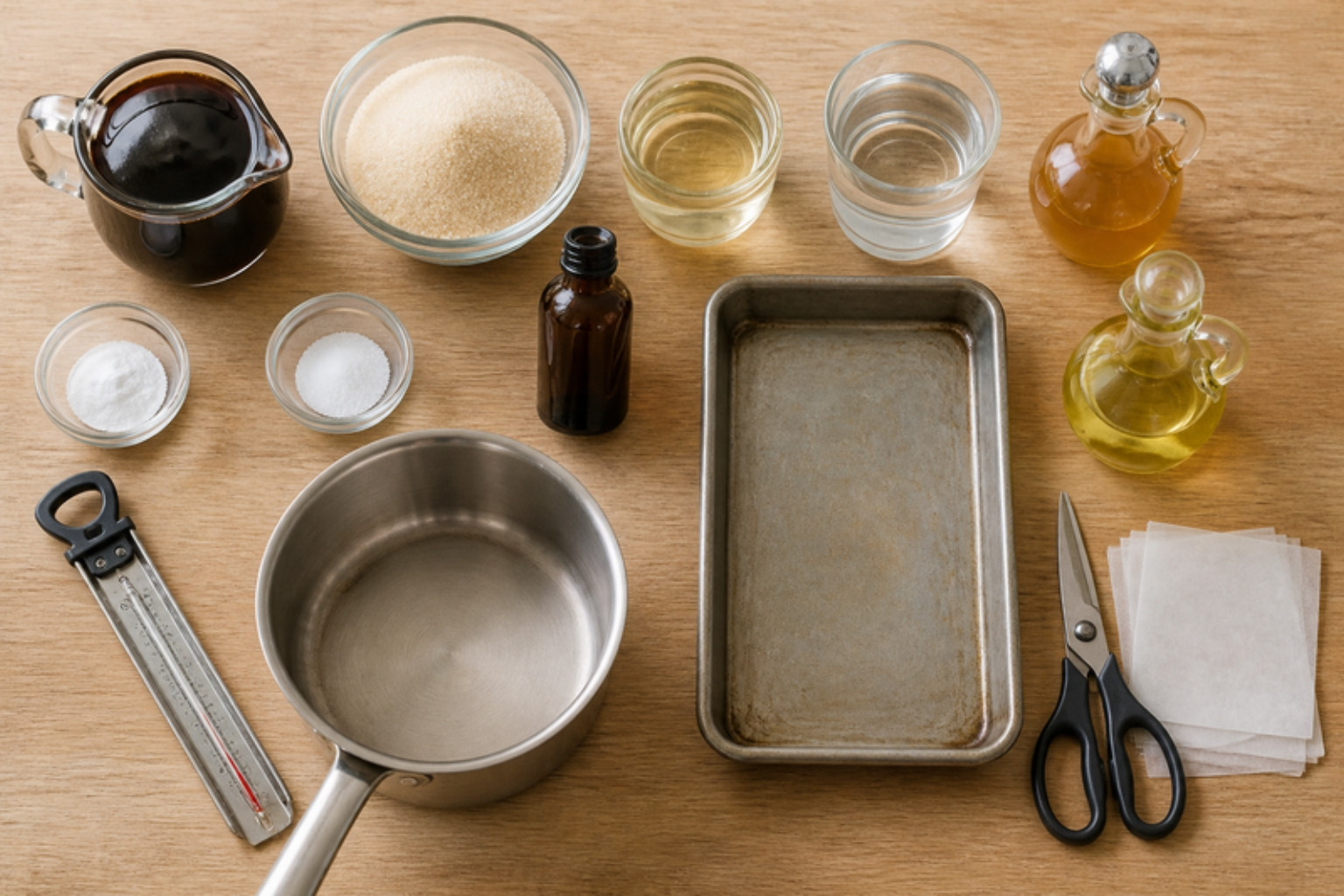
Old-Fashioned Molasses Taffy (Pulled Christmas Candy), No Butter
Ingredients
Equipment
Method
- Generously oil a rimmed baking sheet or 9 x 13-inch pan, a silicone spatula, and kitchen scissors with some of the 2 tablespoons light-tasting olive oil. Test your candy thermometer in boiling water; it should read 212°F (100°C) at sea level.
- In a heavy 3-quart saucepan, combine the sugar, molasses, corn syrup, water, vinegar, 1 tablespoon olive oil, and salt. Stir over medium heat until the sugar dissolves completely, then brush down the sides of the pan with a wet pastry brush to wash away any sugar crystals.
- Clip on the thermometer and boil without stirring until the syrup reaches 258 to 260°F (126 to 127°C), about 15 to 20 minutes. Watch the last few degrees closely, since molasses syrups climb fast and can scorch. Pull it at 258°F for softer taffy, 260°F for firmer.
- Take the pan off the heat and stir in the baking soda and vanilla. The syrup will foam up; stir until combined.
- Pour onto the oiled pan. As it cools, fold the edges into the center every few minutes with the oiled spatula so the whole slab cools evenly, about 10 to 15 minutes. It’s ready when an oiled fingertip pressed into the center is comfortable to hold there.
- Oil your hands. Lift the taffy and pull it into a rope about 18 inches long, fold it back on itself, and repeat. Keep pulling 10 to 15 minutes, until it turns golden tan and satiny and starts to resist stretching. Work with a partner for a big batch, and re-oil your hands as needed.
- Stretch the taffy into a long rope about 1/2 inch thick and snip it into 1-inch pieces with the oiled scissors. Let the pieces set a few minutes, then wrap each one in a square of wax paper, twisting the ends.
Notes
Troubleshooting
- Taffy is too soft and won’t hold its shape: it didn’t reach 258°F. Next time, cook a few degrees higher.
- Taffy is hard and brittle: it cooked past 265°F or cooled too long before pulling. Warm the slab briefly in a 200°F (95°C) oven to soften it.
- Grainy texture: sugar crystals formed. Brush down the pan sides and don’t stir once it boils.
- Sticky pieces: humidity. Store in a tight tin in a cool, dry spot and wrap every piece.
Make-Ahead, Storage & Gifting
Wrapped taffy keeps in an airtight tin at room temperature for up to 2 weeks, so it can be made well ahead of a cookie exchange. Freezing isn’t recommended because condensation makes taffy sticky as it thaws. For gifts, pile the wrapped pieces in a glass jar or a tin lined with parchment, and keep them away from soft, moist cookies, which can make the candy tacky. Taffy also travels well in holiday care packages as long as it isn’t left somewhere hot.
More Christmas Candy
Find every candy and dessert on our Christmas recipes page. For more old-fashioned sweets to fill a gift tin, try the soft caramels with coconut milk, glassy hard tack candy, or crunchy sponge candy.
FAQ
Can I make molasses taffy without a candy thermometer?
You can use the cold-water test: drop a little syrup into a glass of ice water. At the right stage, it forms a firm ball that holds its shape but can still be squashed. A thermometer is much more reliable for taffy.
Why does taffy change color when you pull it?
Pulling folds thousands of tiny air bubbles into the candy. They scatter light, so the taffy looks lighter, and they make it softer and chewier.
Can kids help pull taffy?
Older kids can help once the candy is cool enough to handle comfortably. Cooking and pouring the hot syrup is a job for adults, since cooked sugar is much hotter than boiling water and sticks to skin.
Why is there vinegar in taffy?
The acid helps keep sugar from crystallizing, so the taffy stays smooth. You won’t taste it in the finished candy.
A note before you cook: These recipes are ideas and suggestions, not medical or dietary advice. As with any recipe or ingredient, it is each reader’s responsibility to confirm what they can and cannot eat, read every ingredient label, and source quality ingredients that fit their own needs. Ingredient formulations change, so always check the package you’re using.
Leave a Reply