
Duchess potatoes look like they came from a fancy restaurant: swirls of mashed potato piped into rosettes and baked until every ridge turns golden and crisp. They’re a favorite for Christmas dinner because they can be piped a day ahead and baked while the roast rests. The classic French recipe, though, is built on butter, cream, and several egg yolks, which is a problem if your holiday table includes anyone avoiding milk or eggs.
This version keeps the elegant shape and the crisp-edged, creamy-centered texture. Riced russet potatoes are enriched with extra-virgin olive oil, and a few spoonfuls of potato starch help the rosettes hold their swirls the way egg yolks normally would. They’re made without peanuts, tree nuts, milk, eggs, wheat, soy, fish, shellfish, and sesame.
Made without: peanuts, tree nuts, milk, eggs, wheat, soy, fish, shellfish, sesame.
Why You’ll Love These Duchess Potatoes
- Holiday-table pretty with almost no extra work compared with mashed potatoes.
- Crisp outside, creamy inside: every serving gets the best part of a roasted potato.
- Make-ahead and freezer-friendly: pipe them a day ahead, or freeze them weeks ahead.
- Portioned for you: no serving spoon or gravy lake required.
How It Works Without Butter, Cream, or Egg Yolks
In traditional duchess potatoes, egg yolks do two jobs: they enrich the mash and they help it hold its shape, firming up in the oven so the rosettes don’t slump. Without yolks, the shape has to come from the potatoes themselves. That starts with russets, which are high in starch and low in moisture, and with drying them in the hot pot after draining. Pressing them through a ricer keeps the starch granules intact, so the mash is fluffy rather than gluey.
A few tablespoons of potato starch then act as a binder. As the rosettes bake, the starch absorbs moisture and sets, helping the swirls stay defined. Olive oil gives the mash richness and is what crisps and browns the ridges, and chilling the piped rosettes before baking firms them so they keep their sharp edges in a hot oven.
Ingredients & Swap Ideas
- Potatoes: russets hold their shape best. Yukon Golds taste buttery but make softer rosettes; use a little less liquid if you choose them.
- Olive oil: extra-virgin gives a savory, slightly peppery flavor. Light-tasting olive oil is milder; “light” means refined, not fewer calories.
- Potato starch: cornstarch works the same way.
- Liquid: oat milk with no added oil gives the creamiest flavor; the starchy potato cooking water works well too. Skip butter, cream, and plant butters.
- Flavor twists: add 1 clove of finely grated garlic or 1 tablespoon finely chopped chives to the mash.
Kitchen Equipment
A large pot, a potato ricer or food mill, a large piping bag with a 1/2-inch open star tip, two rimmed baking sheets lined with parchment, and a soft pastry brush. No piping bag? Use a zip-top bag with a corner snipped off for simple mounds, then drag a fork up the sides for ridges.
Step-by-Step Tips
- Start in cold, salted water so the potatoes cook evenly from the outside in.
- Dry them in the pot. One or two minutes over low heat removes surface water that would make the mash loose.
- Add liquid slowly. The mash should be stiff enough to hold a peak. It’s easy to add more liquid and hard to take it back.
- Pipe straight down, then circle up and release, for tall rosettes.
- Dab, don’t brush. A gentle dab of oil keeps the ridges sharp.
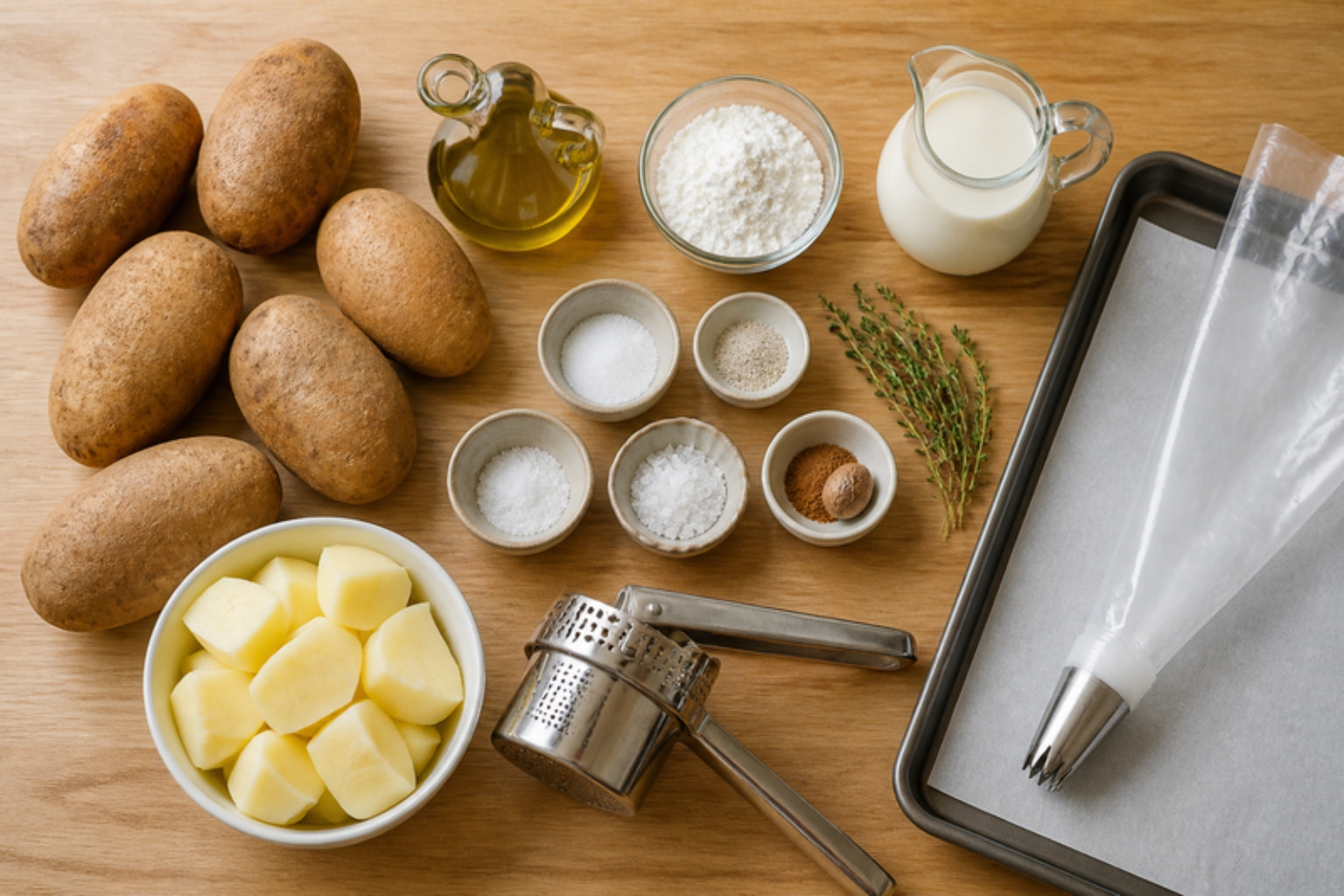
Duchess Potatoes, No Eggs, Dairy-Free
Ingredients
Equipment
Method
- Put the potato chunks in a large pot, cover with cold water by 1 inch, and add the kosher salt. Bring to a boil, then simmer 15 to 20 minutes, until a knife slides through a chunk with no resistance. Reserve 1/2 cup of the cooking water, then drain.
- Return the potatoes to the pot over low heat for 1 to 2 minutes, shaking the pot, to dry off surface water so the mash doesn’t turn loose.
- Press the hot potatoes through a ricer or food mill into a large bowl. Stir in 1/4 cup olive oil, the potato starch, fine salt, white pepper, and nutmeg until smooth.
- Add the hot oat milk (or reserved cooking water) a tablespoon at a time, stirring after each addition, until the mash is smooth and holds a soft peak but isn’t runny. Taste and adjust the salt.
- Let the mash cool for about 20 minutes, until just warm, so the rosettes hold their ridges. Heat the oven to 425°F (220°C) and line 2 rimmed baking sheets with parchment.
- Spoon the mash into a piping bag fitted with a 1/2-inch open star tip. Pipe 2-inch rosettes about 1 1/2 inches apart, finishing each with a little twist and lift. (To make ahead, cover and refrigerate the piped trays up to 1 day; add 3 to 5 minutes to the bake.)
- Gently brush the rosettes with the remaining 1 tablespoon olive oil. Bake 20 to 25 minutes, until the ridges and edges are deep golden brown. If they’re pale, broil 1 to 2 minutes, watching closely.
- Sprinkle with thyme leaves and flaky salt and serve hot.
Notes
Troubleshooting
- Rosettes slumped in the oven: the mash was too wet or too warm. Chill them longer, and use less liquid next time.
- Mash is gluey: it was overworked or blended. Rice or mill the potatoes and stir just until smooth.
- Not browning: make sure the oven is fully heated, give the rosettes a little more oil, and finish under the broiler for 1 to 2 minutes, watching closely.
- Hard to pipe: the mash is too stiff or lumpy. Stir in a teaspoon of hot liquid, and use a wide tip.
Make-Ahead, Storage & Freezing
This is the side to get done before the holiday. Pipe the rosettes, cover the trays, and refrigerate up to 1 day; bake straight from the fridge, adding 3 to 5 minutes. For longer storage, freeze the piped rosettes on the trays until firm, transfer them to a freezer bag for up to 1 month, and bake from frozen at 425°F (220°C) for 30 to 35 minutes. Leftover baked rosettes keep 3 days in the fridge and re-crisp in a 400°F (205°C) oven in about 10 minutes.
More Christmas Dinner Sides
Plan the rest of the menu on our Christmas recipes page. Duchess potatoes are a natural partner for the prime rib roast with garlic herb crust. For more potato sides, see the hasselback potatoes or the classic mashed potatoes without milk or butter.
FAQ
Can you make duchess potatoes without eggs?
Yes. Dry, starchy russets, a little potato starch, and a short chill before baking help the rosettes hold their shape without egg yolks.
Can I use leftover mashed potatoes?
Only if they’re fairly stiff. Warm them slightly, stir in the potato starch, and check that they hold a ridge before piping. Loose or very creamy leftovers will spread.
What’s the difference between duchess potatoes and mashed potatoes?
Duchess potatoes start as a stiffer mash that’s piped and baked, so they develop crisp, golden edges. Mashed potatoes are softer and served straight from the pot.
How many rosettes per person?
Plan on about three per person as a side dish. The recipe makes around 24.
A note before you cook: These recipes are ideas and suggestions, not medical or dietary advice. As with any recipe or ingredient, it is each reader’s responsibility to confirm what they can and cannot eat, read every ingredient label, and source quality ingredients that fit their own needs. Ingredient formulations change, so always check the package you’re using.
Leave a Reply