
If you’ve gone looking for gingerbread cookies without eggs or butter, you’ve probably found plenty of crisp cut-outs and very few soft, chewy ones. These gingerbread crinkle cookies fill that gap. They have the deep molasses flavor and warm ginger bite of classic gingerbread, a thick and chewy middle, and that dramatic crackled top you get from rolling each ball in sugar and then a heavy coat of powdered sugar before baking. On a holiday cookie tray they look like little snow-dusted rooftops.
The dough is built from white rice flour, gluten-free oat flour, and a little cornstarch, with applesauce and light-tasting olive oil doing the work eggs and butter usually do. Baking soda and a splash of cider vinegar give the lift that opens up those cracks. They’re made without peanuts, tree nuts, milk, eggs, wheat, soy, fish, shellfish, and sesame.
Made without: peanuts, tree nuts, milk, eggs, wheat, soy, fish, shellfish, sesame.
Why You’ll Love These Gingerbread Crinkles
- Soft and chewy, not crisp: a different texture from cut-out gingerbread men.
- Big holiday look with no decorating: the powdered sugar cracks open in the oven on its own.
- One bowl of wet, one bowl of dry, no mixer needed.
- Make-ahead friendly: the dough chills up to 2 days, and rolled dough balls bake straight from the freezer.
- No egg replacer, flax, or aquafaba: just pantry flours, starch, and applesauce.
How Crinkle Cookies Work Without Eggs or Butter
In a classic crinkle cookie, eggs set the dough into a puffy dome and butter makes it rich and tender. Here the jobs are split up. Rice flour gives structure and a clean, tender bite; oat flour adds chew and a slightly wholesome flavor that suits molasses; cornstarch keeps the crumb soft instead of gritty. Applesauce supplies moisture and a bit of binding, and molasses itself is thick and sticky enough to help hold everything together.
The crackle comes from contrast. The powdered sugar coating dries out quickly in the oven while the inside keeps rising, so the surface splits into white fissures. Baking soda reacting with the acid in the molasses and vinegar gives that rise a strong push. The first roll in granulated sugar keeps the powdered sugar from simply melting into the dough, so don’t skip it.
Chilling matters more than usual. An oil-based dough is soft at room temperature, and an hour in the fridge firms it enough to roll cleanly and keeps the cookies thick.
Ingredients & Swap Ideas
- White rice flour (160 g) and oat flour (90 g): use finely ground rice flour for the smoothest texture. The oat flour should be labeled certified gluten-free, since regular oats can pick up wheat and barley. Grinding certified gluten-free rolled oats in a blender works too.
- Cornstarch: tapioca starch or potato starch can stand in, gram for gram.
- Molasses: use regular unsulphured molasses. Blackstrap is bitter and will make the cookies taste harsh.
- Light-tasting olive oil: “light” means refined and mild in flavor, not fewer calories. Melted refined coconut oil gives a slightly firmer cookie; if you avoid coconut, stay with light-tasting olive oil. Skip vegetable oil, canola, shortening, and plant butters.
- Applesauce: unsweetened and at room temperature, so it doesn’t chill the oil into clumps.
- Spices: for more heat, increase the ginger to 1 tablespoon or add a pinch of black pepper.
Kitchen Equipment
Two rimmed baking sheets lined with parchment, two mixing bowls, a whisk, a sturdy spatula, a 1 1/2-tablespoon cookie scoop, and a wire rack. Bake at 350°F (175°C).
Step-by-Step Tips
- Whisk the dry ingredients well. Pockets of baking soda taste bitter, so whisk until the spices are evenly spread.
- Whisk the wet ingredients until glossy. The sugar, oil, and molasses should look smooth and shiny, not separated.
- Chill at least an hour. The dough goes from sticky to scoopable and rollable.
- Coat heavily. Roll each ball in granulated sugar, then roll it in powdered sugar until you can’t see the brown dough.
- Pull them while the centers look underdone. At 10 to 12 minutes the tops should be cracked and the edges set, but the centers still puffy. They firm up on the hot pan.
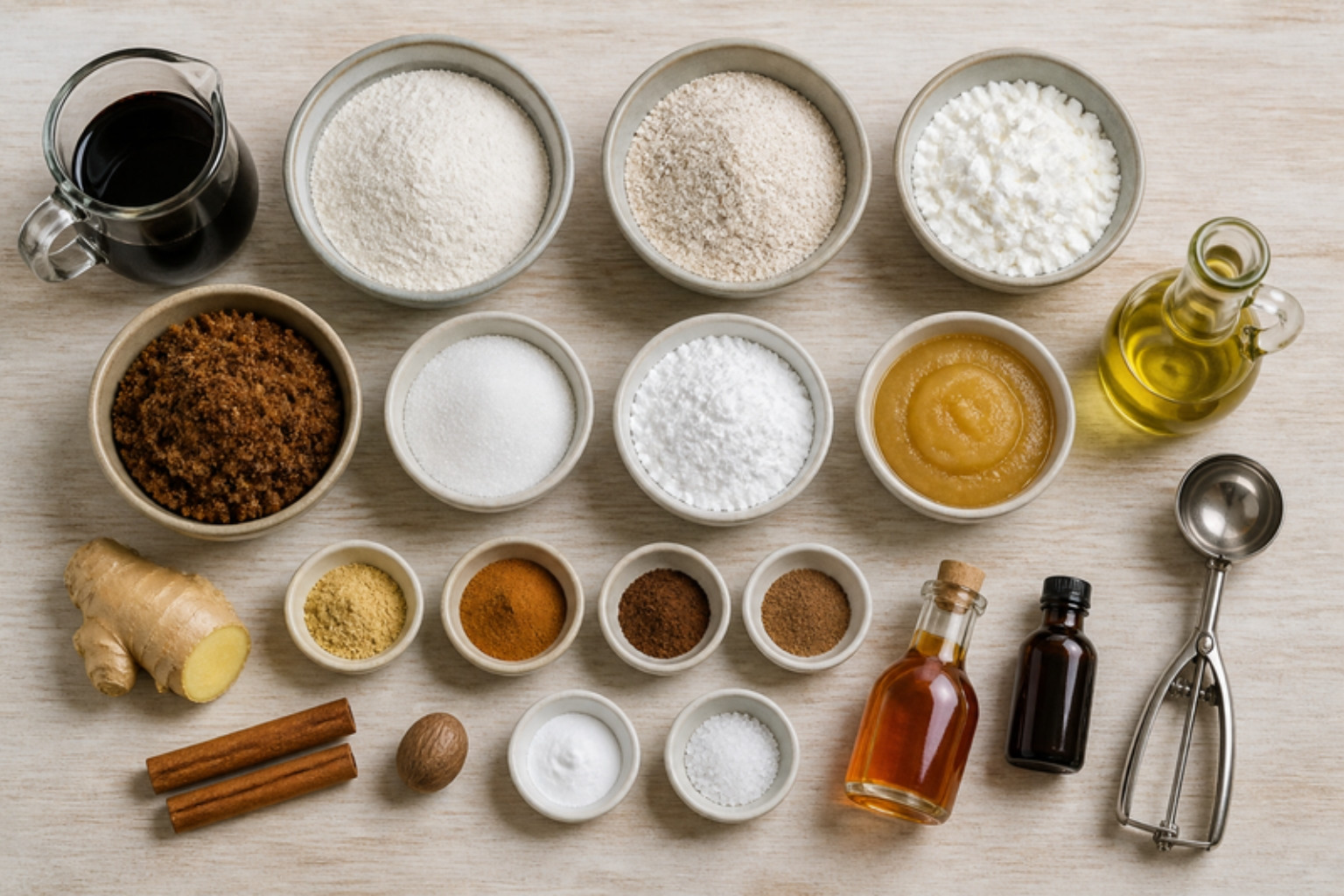
Chewy Gingerbread Crinkle Cookies
Ingredients
Equipment
Method
- In a medium bowl, whisk the rice flour, oat flour, cornstarch, baking soda, salt, ginger, cinnamon, cloves, and nutmeg until no streaks remain.
- In a large bowl, whisk the brown sugar, granulated sugar, olive oil, molasses, applesauce, vinegar, and vanilla until glossy and smooth, about 1 minute.
- Add the dry ingredients and stir with a sturdy spatula until a thick, soft dough forms with no dry pockets. It will look like stiff, shiny brownie batter.
- Cover and chill at least 1 hour (or up to 2 days). The dough firms up enough to roll and the flours hydrate, which helps the cookies stay thick and chewy.
- Heat the oven to 350°F (175°C) with racks in the upper and lower thirds. Put the granulated sugar and the powdered sugar in two separate small bowls.
- Scoop 1 1/2-tablespoon portions, roll into balls, roll in granulated sugar first, then roll generously in powdered sugar until thickly coated. Place 2 inches apart on the lined sheets.
- Bake 10 to 12 minutes, switching the pans halfway, until the cookies have spread, the tops are crackled with white fissures, and the edges look set while the centers still look puffy and soft.
- Cool on the baking sheet 10 minutes; they finish setting as they cool. Move to a rack to cool completely.
Notes
Troubleshooting
- Cookies spread flat: the dough was too warm. Chill the scooped balls 15 minutes before rolling in sugar, and use cool baking sheets between batches.
- No crackle: the powdered sugar coat was too thin or skipped the granulated sugar layer. Roll generously.
- Gritty texture: some rice flours are coarse. Look for one labeled finely ground, or let the dough rest overnight so the flour hydrates fully.
- Dry or crumbly cookies: they were baked too long. Take them out as soon as the edges set.
Make-Ahead, Freezing & Gifting
The dough keeps covered in the fridge for up to 2 days. Baked cookies stay soft in an airtight tin at room temperature for about 5 days. For holiday baking ahead, freeze baked cookies in a sealed container with parchment between layers for up to 3 months, then thaw at room temperature; the powdered sugar may soften, so a light extra dusting before serving freshens them. You can also freeze the sugar-coated dough balls on a tray, bag them, and bake from frozen, adding 1 to 2 minutes.
For cookie tins and exchanges, let the cookies cool completely, then stack them with parchment between layers. They pack well beside crisper cookies, but store them in separate tins at home so the crisp ones don’t soften.
More Christmas Baking
Find every holiday cookie, candy, and dessert in one place on our Christmas recipes page. If you prefer gingerbread you can decorate, try the cut-out gingerbread cookies. For another crackled cookie, the cocoa crinkle cookies make a striking pair on the same tray, and the hermit bars are a molasses spice cookie in bar form with raisins.
FAQ
How are these different from molasses cookies or gingersnaps?
Molasses cookies are usually rolled only in granulated sugar and bake up flatter and sparkly. Gingersnaps are thin and crisp. These are thick, soft, and chewy, with a powdered sugar coat that cracks into a white crinkle pattern.
Can I skip chilling the dough?
It isn’t recommended. Without chilling, the dough is too soft to roll and the cookies spread thin. If you’re short on time, freeze the dough for 20 to 25 minutes instead.
Can I use all-purpose gluten-free flour blend instead?
Blends vary a lot, and many contain bean flours or other ingredients that change the profile, so the results would differ from this recipe. If you try one, check its label for the allergens you avoid and expect to adjust the chilling time.
Why do they need vinegar?
Baking soda needs an acid to react. Molasses supplies some, and a teaspoon of cider vinegar makes sure the cookies puff enough to crack. You won’t taste it after baking.
A note before you cook: These recipes are ideas and suggestions, not medical or dietary advice. As with any recipe or ingredient, it is each reader’s responsibility to confirm what they can and cannot eat, read every ingredient label, and source quality ingredients that fit their own needs. Ingredient formulations change, so always check the package you’re using.
Leave a Reply