
Decorating gingerbread men is one of those holiday traditions kids remember, and it’s one of the hardest to recreate without eggs, butter, or wheat. Many gluten-free doughs crack when rolled, and egg-free ones can spread into blobs in the oven. These gingerbread cookies are written specifically for rolling and cutting, so your gingerbread men come out with clean edges, crisp outsides, and slightly soft middles.
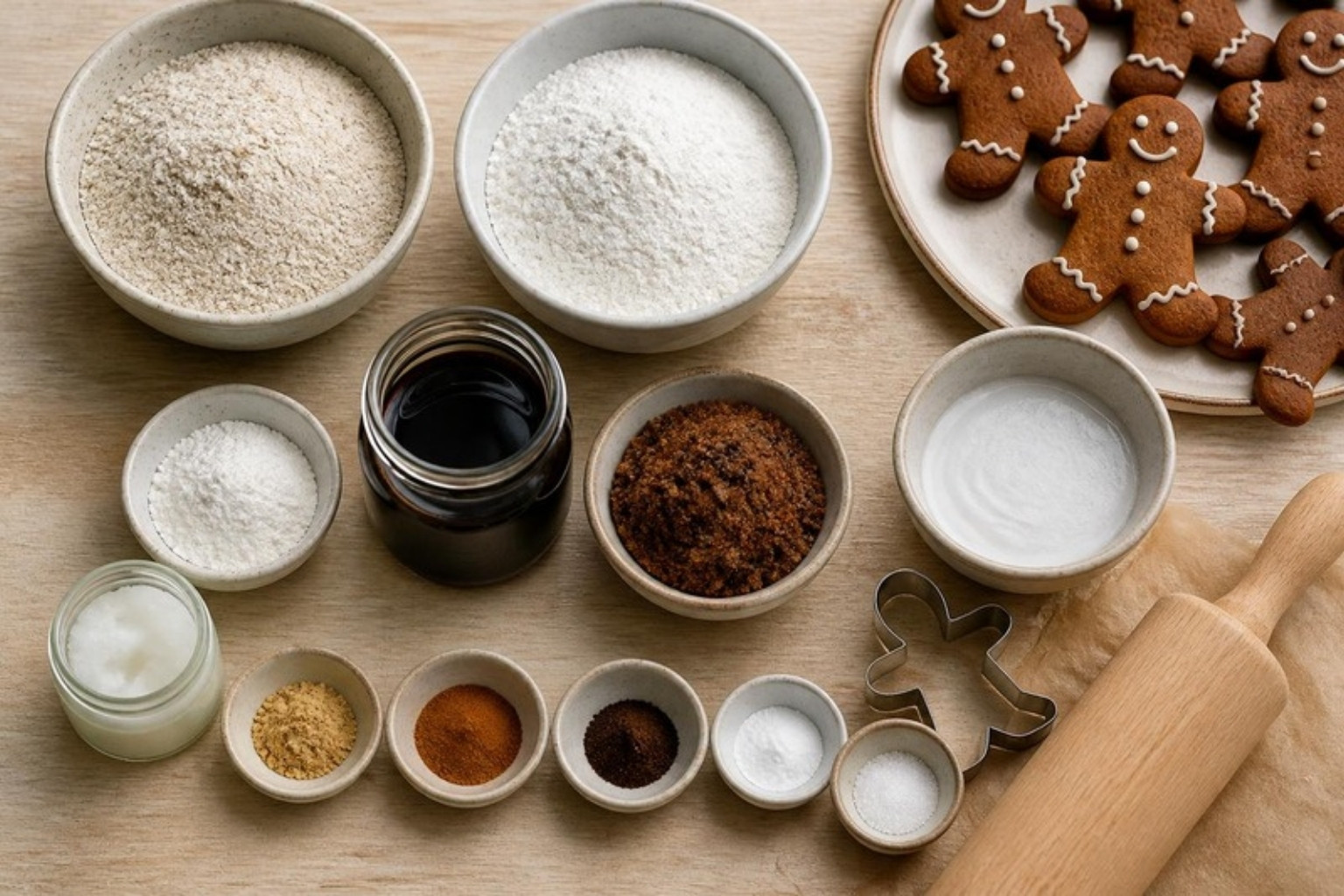
The dough is classic gingerbread in flavor: dark molasses, brown sugar, plenty of ground ginger, cinnamon, and a little clove. For structure, it uses certified gluten-free oat flour, white rice flour, and tapioca starch, with refined coconut oil standing in for butter and a spoonful of applesauce for moisture. A short chill before rolling and another after cutting help every shape hold. A simple powdered-sugar glaze finishes them. They’re made without milk, eggs, wheat, soy, peanuts, tree nuts, fish, shellfish, and sesame.
Made without: peanuts, tree nuts, milk, eggs, wheat, soy, fish, shellfish, sesame.
Why You’ll Love These Gingerbread Cookies
- A dough designed to roll, cut, and keep its shape.
- Real molasses-and-ginger flavor, warm but not too spicy for kids.
- Bake them soft or crisp by adjusting the time a minute or two.
- The dough keeps for days in the fridge, so you can split the work.
- Sturdy enough for gift tins and cookie exchanges once glazed.
How This Dough Rolls Without Wheat or Eggs
Wheat gluten and egg normally hold a cut-out cookie together. Here, the job is split between three ingredients. Oat flour gives body and a hearty, wheat-like flavor. Rice flour adds firmness and the crisp snap at the edges. Tapioca starch is the binder: it turns slightly stretchy when hydrated, which makes the dough pliable enough to roll and lift without tearing. Molasses is thick and sticky, which helps glue everything together too.
Coconut oil matters for shape. Like butter, it’s solid at cool room temperature, so after chilling the dough is firm enough to cut cleanly. Chilling the cut-outs for 10 minutes before baking keeps their arms and legs from spreading. Without eggs these cookies don’t puff much, which is exactly what you want for decorating.
Ingredients and Swap Ideas
- Molasses: use unsulphured molasses for a classic flavor. Blackstrap is too bitter for these cookies.
- Flours: certified gluten-free oat flour limits wheat and barley cross-contact. Use finely ground white rice flour so the cookies aren’t gritty.
- Tapioca starch: gives the dough its flexibility. Cornstarch works if that’s what you have, though the dough is a bit more fragile.
- Spices: ginger, cinnamon, and cloves are the classic trio. Add 1/4 teaspoon nutmeg or allspice if you like. For a milder cookie for small kids, reduce the ginger to 2 teaspoons.
- Fat: refined coconut oil should be soft like room-temperature butter, not melted. If you avoid coconut, pure lard is the closest swap. Light-tasting olive oil also works (light means refined and mild-flavored, not fewer calories), but chill the dough 2 hours and expect slightly softer edges.
- Applesauce: unsweetened, apples only. It adds moisture in place of egg.
Kitchen Equipment
- Stand mixer or hand mixer
- Rolling pin and parchment paper (rolling between sheets prevents sticking)
- Gingerbread man cutter, about 4 inches (10 cm), or any shapes you like
- 2 rimmed baking sheets
- Thin metal spatula for moving cut shapes
- Small piping bag or zip-top bag for the glaze
Step-by-Step Tips
- Cream the fat and sugar. Beat soft coconut oil with brown sugar until creamy, then add the molasses, applesauce, and vanilla.
- Aim for play-dough texture. After adding the dry ingredients, the dough should be soft and smooth. Add water a spoonful at a time only if it looks crumbly.
- Chill in disks. Flat 1-inch disks chill faster and roll more evenly than a ball.
- Roll between parchment. Dust lightly with rice flour and roll to an even 1/4 inch. Even thickness means even baking.
- Chill the cut shapes. Ten minutes on the sheet in the fridge keeps edges sharp.
- Bake until matte. The cookies are done when the shine disappears and the edges feel firm. For soft cookies, take them out at 8 minutes; for crisp ones, 11 to 12.
- Glaze only when cool. Warm cookies melt the glaze. Let the glaze dry 1 to 2 hours before stacking.
Gingerbread Cookies for Cutting Out Gingerbread Men (Top 9 Free)
Ingredients
Equipment
Method
- Beat the softened coconut oil and brown sugar on medium speed 2 minutes, until creamy. Beat in the molasses, applesauce, and vanilla until smooth and glossy.
- Whisk the oat flour, rice flour, tapioca starch, ginger, cinnamon, cloves, baking soda, and salt in a separate bowl. Add to the mixer and mix on low until a soft, cohesive dough forms, like play dough. If it looks crumbly, add water 1 tablespoon at a time.
- Divide the dough in half, flatten each half into a 1-inch-thick disk, wrap, and chill 1 hour, until firm but not hard. (Up to 3 days; let very cold dough sit 10 minutes before rolling.)
- Heat the oven to 350°F (175°C) and line two baking sheets with parchment.
- Roll one disk between two sheets of parchment, lightly dusted with rice flour, to an even 1/4 inch (6 mm). Peel off the top sheet, cut gingerbread men, and lift them with a thin spatula onto the lined sheets 1 inch apart. Press scraps together and re-roll once.
- Chill the cut cookies on the sheet 10 minutes so they keep sharp edges.
- Bake one sheet at a time for 9 to 11 minutes, until the surface looks matte instead of shiny, the edges feel firm, and the centers spring back lightly. Bake 8 minutes for softer cookies or 11 to 12 for crisp ones. Cool on the sheet 10 minutes, then move to a rack.
- Make the glaze: whisk the powdered sugar, corn syrup, vanilla, and 2 tablespoons water, adding more water a few drops at a time until it falls from the whisk in a thick ribbon, like toothpaste for piping or slightly thinner for flooding. Pipe or spread on completely cooled cookies and let set at room temperature 1 to 2 hours, until dry to the touch.
Notes
Troubleshooting and Tips
- Dough cracks when rolling: it’s too cold or a little dry. Let it sit 10 minutes, or knead in a teaspoon of water.
- Dough sticks: it’s too warm. Slide the parchment and dough onto a sheet and chill 10 minutes.
- Shapes spread: chill the cut-outs longer and make sure the oven is fully heated.
- Arms break off: move cut shapes with a thin spatula, and let baked cookies cool 10 minutes on the sheet before moving them.
- Glaze too runny: whisk in more powdered sugar a tablespoon at a time. Too thick: add water a few drops at a time.
Decorating With a Simple Glaze
This post uses an easy powdered-sugar glaze with a teaspoon of light corn syrup, which dries smooth and shiny. It’s thick enough to pipe eyes, buttons, and zigzag trim. For detailed decorating and stacking, use our royal icing without egg whites or meringue powder, which dries hard overnight. For a plainer cut-out cookie in the same tin, try the shortbread cookies without butter. If you use colored sprinkles, candies, or gel colors, read the labels; some contain milk, soy lecithin, wheat starch, or seed oils.
Make-Ahead, Freezing, and Gifting
- Make ahead: refrigerate wrapped dough disks up to 3 days, or freeze up to 3 months and thaw overnight in the fridge.
- Storage: keep glazed cookies airtight at room temperature up to 1 week. Layer with parchment once the glaze is completely dry.
- Freezing: freeze unglazed baked cookies up to 3 months, then thaw and decorate. Glazed cookies can be frozen in a single layer, but the glaze may get tacky as it thaws.
- Gift tins: let the glaze dry overnight, then stand cookies on their sides or layer them flat between parchment in a tin. Pack them with other crisp cookies rather than soft ones.
Find more holiday cookies in our Christmas recipes hub. For another rolled cookie, try shortbread made without butter or wheat. If wheat is part of your diet, our chewy molasses cookies (egg-free, dairy-free, contains wheat) are a soft drop-cookie cousin of these.
Gingerbread Cookies FAQ
Will these gingerbread cookies hold their shape?
That’s what the dough is built for. Chill the dough before rolling and the cut shapes before baking, and the cookies spread very little.
Can I make soft gingerbread cookies with this dough?
Yes. Roll a little thicker, about 3/8 inch, and bake 8 to 9 minutes, just until the surface looks matte.
Can I use these for a gingerbread house?
They’re designed as eating cookies. For house panels, roll the dough 1/4 inch thick and bake the full 12 minutes or a bit longer until very firm, then use a stiff icing. Results may vary since the dough is softer than traditional construction gingerbread.
How is this different from molasses cookies?
Molasses cookies are soft, sugar-rolled drop cookies. This is a firmer, spicier dough meant for rolling, cutting, and decorating.
A note before you cook: These recipes are ideas and suggestions, not medical or dietary advice. As with any recipe or ingredient, it is each reader’s responsibility to confirm what they can and cannot eat, read every ingredient label, and source quality ingredients that fit their own needs. Ingredient formulations change, so always check the package you’re using.