
If you’ve searched for shortbread cookies without butter or wheat, you’ve probably noticed the problem: shortbread is basically butter, flour, and sugar, so taking out two of the three usually leaves you with something greasy or crumbly. These classic shortbread cookies take a different route. They lean on an old Scottish trick, rice flour, which bakers have long added to shortbread for its sandy, delicate snap, and pair it with cornstarch and refined coconut oil.
This is shortbread without butter: a crisp, sandy cookie made with refined coconut oil in place of butter, and white rice flour, sweet rice flour and cornstarch in place of wheat flour. It is made without milk, eggs, wheat, soy, peanuts, tree nuts, fish, shellfish and sesame. Creaming the soft-solid coconut oil with powdered sugar gives it the melt-away texture.
The result is a pale, crisp cookie that breaks cleanly and melts on the tongue, with plenty of vanilla and just enough salt. Roll and cut them into stars and trees, or press the dough into a pan and score it into fingers. They’re made without milk, eggs, wheat, soy, peanuts, tree nuts, fish, shellfish, and sesame, and they hold up beautifully in a Christmas cookie tin.
Made without: peanuts, tree nuts, milk, eggs, wheat, soy, fish, shellfish, sesame. Uses coconut oil; lard works if you avoid coconut.
Why You’ll Love These Shortbread Cookies
- Classic sandy texture from rice flour, the way traditional Scottish shortbread often includes it.
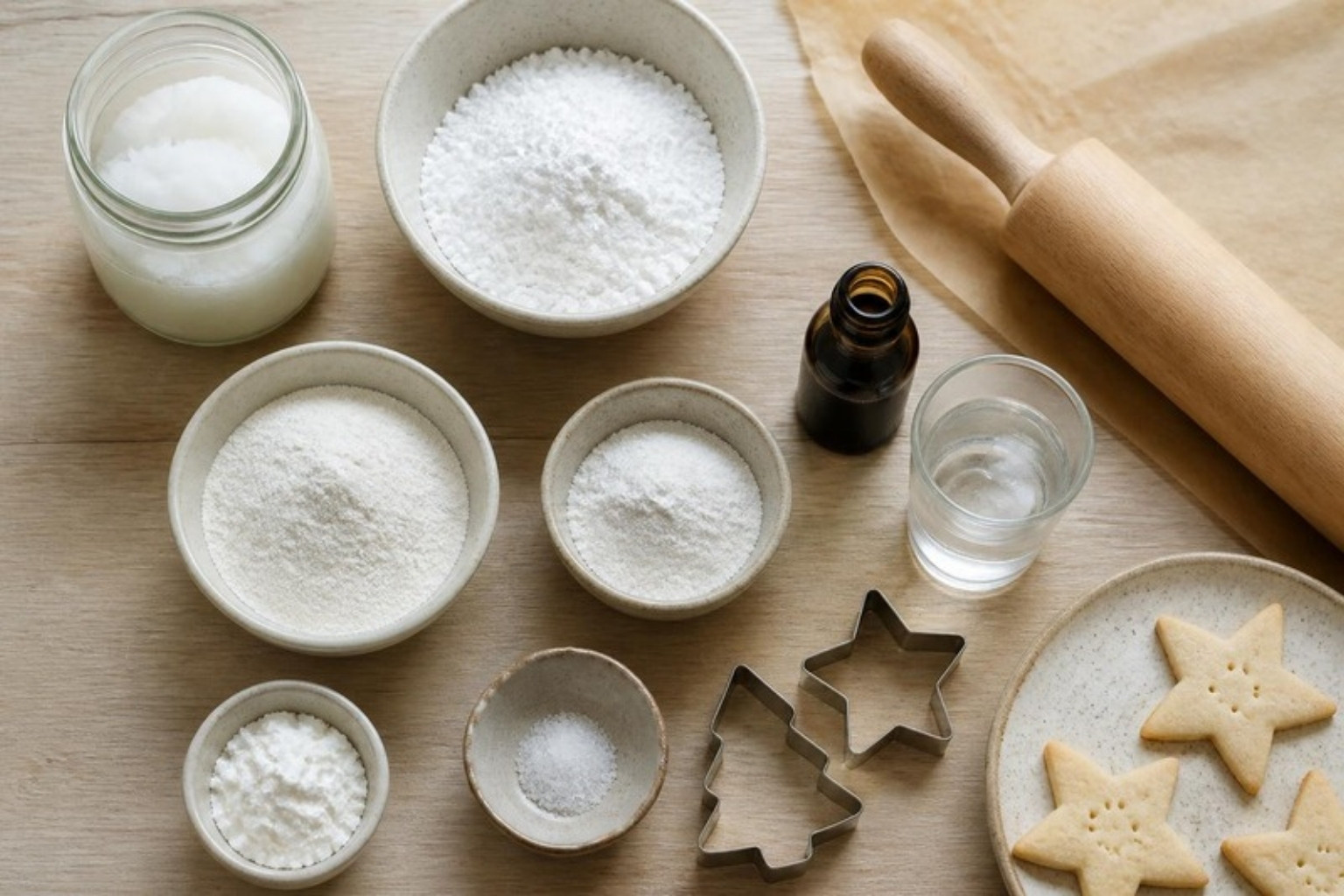
- Just a handful of ingredients: two rice flours, cornstarch, coconut oil, powdered sugar, vanilla, salt, and water.
- No eggs at all, and none needed. Shortbread never relied on them.
- Cut-out friendly. The dough rolls between parchment and holds its shape in the oven.
- Great keeper for cookie exchanges, tins, and baking ahead.
How Shortbread Works Without Butter or Wheat
Butter is about 80% fat and 15% water. Refined coconut oil is nearly 100% fat, and at a cool room temperature it’s soft and solid like butter, so it creams with sugar and traps air the same way. To make up for the water butter would bring, a couple of tablespoons of cold water go into the dough at the end. That’s just enough to help the flour hold together without turning the cookies hard.
Without wheat, there’s no gluten, which is actually helpful in shortbread, since you want tenderness, not chew. White rice flour gives the sandy crumb, cornstarch makes it melt in your mouth, and a little sweet (glutinous) rice flour adds just enough stickiness to keep cut shapes from crumbling. Despite the name, sweet rice flour contains no gluten.
Ingredients & Swap Ideas
- Refined coconut oil (150 g): refined has no coconut taste. It should be soft-solid, about 68 to 72°F (20 to 22°C). If your kitchen is warm and it’s liquid, chill it until it looks like soft butter.
- If you avoid coconut: use the same weight of pure leaf lard (not hydrogenated or blended). Light-tasting olive oil is liquid at room temperature, so it can’t give shortbread its structure and isn’t recommended here.
- White rice flour (160 g): look for a fine grind; coarse rice flour tastes gritty.
- Sweet rice flour (60 g): often sold as mochiko in the baking or Asian foods aisle.
- Cornstarch (60 g): tapioca starch can replace it, though the cookies will be slightly chewier.
- Powdered sugar (100 g): dissolves more easily than granulated, which keeps the crumb fine.
- Decorations: sanding sugar and sprinkles can contain milk, soy lecithin, wheat starch, or seed oils, so read the label.
Kitchen Equipment
- Stand mixer or hand mixer.
- Rolling pin and two sheets of parchment.
- 2-inch (5 cm) cookie cutters, or an 8-inch square pan for pressed shortbread.
- Two baking sheets lined with parchment, and a kitchen scale for the flours.
Step-by-Step Tips
- Cream until fluffy. Two minutes of beating gives the cookies a lighter, finer crumb.
- Add water slowly. Stop as soon as a squeezed handful holds together like modeling clay.
- Roll between parchment so you don’t need extra flour, which can make the cookies dry.
- Chill briefly. Fifteen to twenty minutes is plenty. Coconut oil gets very hard in the fridge, and over-chilled dough cracks when cut.
- Bake low and pale. At 325°F (165°C), look for dry, matte tops, barely golden edges, and pale gold bottoms.
- Let them rest on the sheet for 10 minutes. They’re fragile while hot and crisp up as they cool.
Classic Shortbread Cookies, No Butter or Wheat (Top 9 Free)
Ingredients
Equipment
Method
- Heat the oven to 325°F (165°C). Line two baking sheets with parchment.
- Beat the coconut oil, powdered sugar, salt, and vanilla on medium speed for about 2 minutes, until pale, smooth, and fluffy, like a soft frosting.
- Whisk the white rice flour, sweet rice flour, and cornstarch in a separate bowl. Add to the mixer and mix on low until the dough looks like coarse, damp crumbs.
- Add the cold water 1 tablespoon at a time, mixing on low, until a handful of dough holds together firmly when squeezed and feels like smooth modeling clay. Stop as soon as it holds; too much water makes the cookies hard instead of sandy.
- Press the dough into a disk and roll between two sheets of parchment to 1/4 inch (6 mm) thick. Slide onto a baking sheet and chill 15 to 20 minutes, just until firm. Coconut oil firms quickly; if the dough cracks at the edges when you cut, let it sit 5 minutes.
- Cut 2-inch (5 cm) shapes and arrange 1 inch (2.5 cm) apart on the lined sheets. Re-roll scraps once. Prick each cookie twice with a fork and sprinkle with granulated sugar if using.
- Bake one sheet at a time for 16 to 20 minutes, until the tops look dry and matte, the edges are just barely tinged golden, and the bottoms are pale gold. Shortbread should stay light; deep browning means overbaked.
- Cool on the sheet 10 minutes (they are fragile while hot), then move to a rack to cool completely. They crisp as they cool.
Notes
Troubleshooting
- Dough won’t hold together: add water a teaspoon at a time, and make sure the coconut oil wasn’t rock-hard when you creamed it.
- Cookies spread or look greasy: the coconut oil was too warm or melted. Chill the cut shapes 10 minutes on the sheet before baking.
- Hard instead of tender: too much water, or the dough was overmixed after the water went in.
- Gritty texture: the rice flour is coarse. A finely milled white rice flour makes the biggest difference.
Make-Ahead, Freezing & Gift Tins
Dough: wrap the disk tightly and refrigerate up to 3 days or freeze up to 3 months. Let refrigerated dough sit at room temperature 15 to 20 minutes before rolling; thaw frozen dough in the fridge overnight.
Baked cookies: store airtight in a cool spot for up to 2 weeks. Coconut oil softens above about 76°F (24°C), so keep tins away from the stove and radiators. Freeze baked cookies in a rigid container, layered with parchment, for up to 3 months; thaw with the lid on so condensation doesn’t soften them.
Gifting: shortbread is sturdy enough for tins and shipping. Stack the cookies in short columns, fill gaps with crumpled parchment, and pack them separately from soft or moist cookies, which can make shortbread lose its snap.
More Christmas Cookies
Fill out your cookie tray from the Top Nine Free Christmas recipes hub, which is organized by cookies, candy, dinner, and breakfast. For decorating, the soft cut-out sugar cookies and a batch of royal icing without egg whites pair well with these shortbread cut-outs. For a spiced contrast, the chewy molasses cookies are egg-free and dairy-free (they contain wheat), and a bag of dairy-free caramel corn makes an easy tin filler.
FAQ
Will the shortbread taste like coconut?
Not if you use refined coconut oil, which is processed to be neutral in flavor. Unrefined (virgin) coconut oil has a strong coconut taste and aroma.
Can I make pressed shortbread instead of cut-outs?
Yes. Press the dough evenly into a parchment-lined 8-inch square pan, prick all over with a fork, and score into 16 fingers. Bake at 325°F for 30 to 35 minutes, until the edges are barely golden, then re-cut along the scores while warm and cool completely in the pan.
Can I dip them in chocolate?
You can, but read the chocolate label closely. Many dark chocolates contain milk or soy lecithin, or are made on shared lines with milk, and some candy coatings use seed oils.
Can I add flavors?
Try 1 tablespoon finely grated orange or lemon zest, 1/2 teaspoon ground cardamom, or 1/4 teaspoon peppermint extract in place of half the vanilla.
What replaces butter in shortbread?
Refined coconut oil, used at a cool room temperature so it is soft-solid like butter, plus a couple of tablespoons of cold water for the moisture butter would have brought. Pure leaf lard works the same way if you avoid coconut. Plant butters, shortening and liquid oils are not used here: the first two are usually made with seed oils, and a liquid oil can’t give shortbread its structure.
Do these work as a nut-free classroom or party treat?
They are made without peanuts, tree nuts, milk, eggs, wheat, soy, fish, shellfish and sesame, they travel well, and the dough can be made days ahead. Check your school’s treat policy and read the labels on any sprinkles or sanding sugar you add.
A note before you cook: These recipes are ideas and suggestions, not medical or dietary advice. As with any recipe or ingredient, it is each reader’s responsibility to confirm what they can and cannot eat, read every ingredient label, and source quality ingredients that fit their own needs. Ingredient formulations change, so always check the package you’re using.