
Concord grape pie is a heritage fruit pie from grape country: Concord grapes are slipped from their skins, simmered, strained of seeds and set with cornstarch, so the filling needs no eggs. It’s made without milk, eggs, wheat, soy, peanuts, tree nuts, fish, shellfish and sesame, with a flaky lard crust and a brown sugar oat crumb on top.
If you have looked for a holiday pie without eggs, butter, or wheat, you know how quickly the options shrink: custard pies lean on eggs, cream pies on milk, and pecan pie is off the table entirely. Fruit pies are the friendliest place to start, and Concord grape pie is one of the most overlooked, a pie from western New York to southwest Michigan, where Concord vineyards ripen in early fall and families freeze the pulp to bake into pies for Thanksgiving.
The flavor is pure, bold grape, tart and jammy, nothing like grape candy. The filling bakes into a glossy deep purple that sets cleanly with cornstarch, so there’s no egg in sight. A flaky lard crust made with rice and oat flour holds it, and a brown sugar oat crumb on top adds crunch and a little caramel flavor. It takes some handwork to slip the grapes from their skins, but the pulp can be made weeks ahead and frozen.
Made without: peanuts, tree nuts, milk, eggs, wheat, soy, fish, shellfish, sesame.
Why You’ll Love This Grape Pie
- A true heritage pie that looks striking on a Thanksgiving dessert table.
- The filling has no eggs, no butter, and no cream; cornstarch does the setting.
- A crumb topping means only one crust to roll, which is easier with wheat-free dough.
- The grape filling freezes for months, so you can make it in season and bake in November.
- Tart-sweet flavor that balances a heavy holiday meal.
How This Pie Works Without Eggs, Butter, or Wheat
Fruit pie fillings rarely need eggs; the thickener does the work. Concord grapes are naturally high in pectin, and a quarter cup of cornstarch turns their juice into a sliceable, glossy filling once it bubbles in the center of the pie. Bubbling matters: cornstarch only reaches full thickening power near the boiling point, so pull the pie when you see thick, slow bubbles in the middle, not just at the edge.
The crust replaces wheat with three flours that split the job. White rice flour gives structure and crispness, oat flour adds tenderness and a wheaty flavor, and sweet rice flour adds just enough stretch to roll the dough without crumbling. Cold lard stands in for butter: it stays in flat flakes in the dough and melts in the oven to leave layers. A teaspoon of vinegar keeps the dough tender.
Ingredients and Swap Ideas
- Concord grapes: fresh in September and October; after that, look for frozen Concord pulp at orchards and farm markets, or use pulp you froze earlier. Other seeded slip-skin grapes work. Grape juice or jelly can’t stand in; you need the skins for color and body.
- Cornstarch: the thickener. Tapioca starch also works (use 3 tablespoons) but sets a bit stringier.
- Lard: buy pure rendered lard and keep it cold. Cold refined coconut oil also works, but the crust will be crisper and less flaky. Skip shortening, margarine, and butter substitutes.
- Oats and oat flour: choose certified gluten-free oats, since regular oats can pick up wheat or barley.
- Topping fat: melted refined coconut oil; if you avoid coconut, use light-tasting olive oil. “Light” means refined and mild in flavor, not fewer calories.
- Want a double crust? Double the crust ingredients and use a lattice instead of the crumb, as in our raisin pie.
Equipment
- 9-inch standard pie plate (glass lets you check the bottom crust)
- Fine-mesh strainer or food mill for the seeds
- Medium saucepan, mixing bowls, pastry cutter
- Rolling pin and two sheets of parchment
- Rimmed baking sheet to catch drips
Step-by-Step Tips
- Slip the skins. Pinch each grape at the stem end over a saucepan; the soft green pulp pops out and the skin stays in your fingers. Drop skins in a bowl. It’s quicker than it sounds: about 20 minutes for 2 pounds.
- Cook and strain the pulp. A 5-minute simmer loosens the seeds. Press the hot pulp through a strainer straight onto the skins; the heat softens the skins and pulls out their color.
- Roll between parchment. Wheat-free dough is more fragile than regular pastry, so roll it between sheets and flip it into the plate. Press any cracks closed.
- Bake hot, then moderate. Starting at 400°F sets the bottom crust; finishing at 350°F lets the filling come to a full bubble without burning the crumb.
- Wait to slice. The filling finishes setting as it cools. Four hours is the minimum; overnight is better.
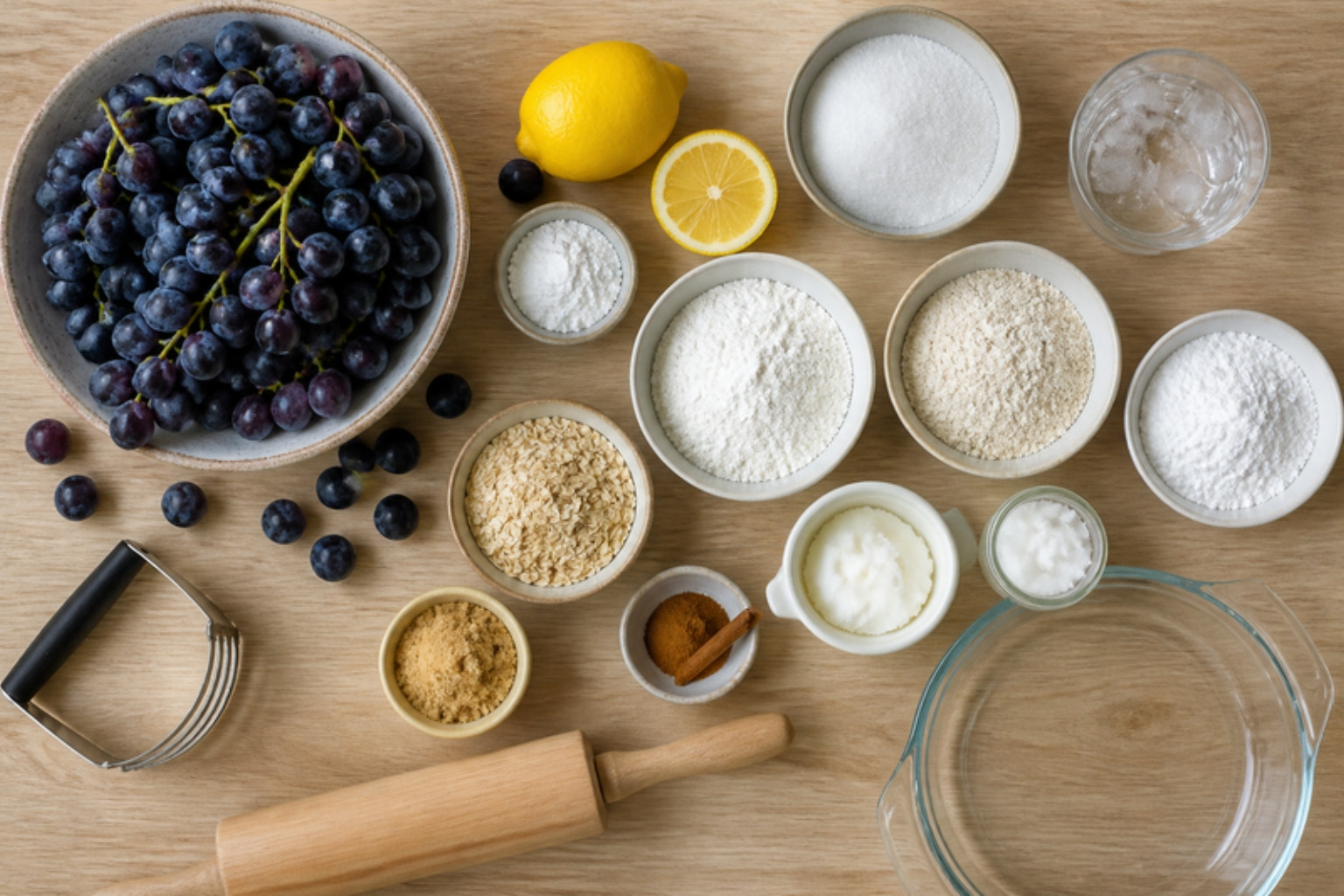
Concord Grape Pie with Oat Crumb Topping
Ingredients
Equipment
Method
- Whisk the rice flour, oat flour, sweet rice flour, cornstarch, sugar, and salt. Cut in the cold lard with a pastry cutter or your fingertips until the largest pieces are the size of small peas.
- Stir the vinegar into 4 tablespoons of ice water and drizzle it over the flour, tossing with a fork. Add more water a teaspoon at a time until the dough holds together when squeezed. Press into a disk, wrap, and chill 30 minutes.
- Roll the dough between two sheets of parchment into an 11-inch round. Peel off the top sheet, flip it into the pie plate, and peel away the second sheet. Patch any cracks by pressing with your fingers, then crimp the edge. Chill while you make the filling.
- Slip the skins off the grapes by pinching each one at the stem end; the green pulp pops out. Put the pulp in a saucepan and the skins in a large bowl.
- Bring the pulp to a boil over medium heat and simmer 5 minutes, stirring, until the pulp turns soft and the seeds float free. Press the hot pulp through a strainer or food mill into the bowl of skins. Discard the seeds.
- Whisk the sugar, cornstarch, and salt together, then stir them into the warm pulp and skins with the lemon juice. The mixture will look loose and deep purple; it thickens in the oven.
- Heat the oven to 400°F (200°C) with a rack in the lower third. Stir the oats, rice flour, brown sugar, cinnamon, and salt, then stir in the melted coconut oil until clumpy crumbs form.
- Set the pie plate on a rimmed baking sheet. Pour in the grape filling and scatter the crumbs evenly over the top.
- Bake 15 minutes, then lower the oven to 350°F (175°C) and bake 40 to 50 minutes more, until the crumb is deep golden and the filling bubbles thickly in the center, not only at the edges. Tent loosely with foil if the crumb browns too fast.
- Cool on a rack at least 4 hours so the filling sets before slicing.
Notes
Troubleshooting
- Runny filling: the center didn’t bubble long enough, or the pie was cut warm. Bake until the middle bubbles thickly and cool completely.
- Dough cracks when rolling: it’s too cold or too dry. Let it sit 5 minutes, or knead in a teaspoon of ice water.
- Pale bottom crust: bake on the lower rack and use a glass or dark metal plate.
- Gritty bits: a few seeds slipped through. A food mill or a fine strainer catches them best.
Make-Ahead, Storage, and Freezing
Make the filling up to 2 days ahead and refrigerate it, or freeze it up to 6 months in a freezer bag; thaw overnight in the fridge before filling the crust. The crust dough keeps 2 days in the fridge or 2 months frozen. The baked pie keeps 1 day covered at room temperature, then up to 4 days in the fridge. To freeze the baked pie, cool it completely, wrap it tightly in plastic and foil, and freeze up to 2 months. Thaw overnight in the fridge and refresh the crumb in a 325°F oven for 10 minutes. For bringing to a Thanksgiving gathering, bake it the day before and carry it in a pie carrier.
More Thanksgiving Pies
Find every pie and dessert on our Thanksgiving recipes page. For another heritage fruit pie, try the old-fashioned raisin pie, or bake a tart cherry pie alongside the classic pumpkin pie or Top Nine Free’s sweet potato pie without eggs or milk.
FAQ
How do you make grape pie without eggs?
Let cornstarch do the thickening. Concord grapes are naturally high in pectin, and a quarter cup of cornstarch sets the juice into a sliceable filling once the center of the pie bubbles thickly. Cool it at least 4 hours before slicing.
Is this grape pie dairy-free?
Yes. The crust uses cold lard instead of butter, and the oat crumb topping uses melted refined coconut oil or light-tasting olive oil. There’s no milk, cream, or butter in the filling.
Can I use seedless grapes?
Table grapes are much milder and juicier, so the pie tastes flat. If Concords aren’t available, frozen Concord pulp is the best substitute.
Do I have to remove the skins?
Only long enough to cook the pulp and strain out the seeds. The skins go back into the filling for color and texture.
Can I make this pie without coconut?
Yes. The crust uses lard, and the crumb topping works with light-tasting olive oil in place of coconut oil.
Why does the filling look thin before baking?
Cornstarch thickens only when it gets close to boiling. The filling turns thick and glossy in the oven and sets fully as the pie cools.
What does Concord grape pie taste like?
Bold, tart and jammy, closer to a good grape jam than to grape candy or juice. The skins give it a deep purple color and a slight tannic edge that keeps the sweetness in check, which is why it works so well after a heavy Thanksgiving meal.
Is this an egg-free and dairy-free grape recipe?
Yes. The filling is grapes, sugar, cornstarch and lemon, the crust is rice and oat flour with lard, and the crumb uses coconut oil or olive oil, so the whole pie is made without eggs, milk, butter, wheat, soy, peanuts, tree nuts, fish, shellfish and sesame. Check the labels on your oats and lard.
A note before you cook: These recipes are ideas and suggestions, not medical or dietary advice. As with any recipe or ingredient, it is each reader’s responsibility to confirm what they can and cannot eat, read every ingredient label, and source quality ingredients that fit their own needs. Ingredient formulations change, so always check the package you’re using.