
Alfajores are the cookie people fall for at a holiday party: two pale, crumbly-tender rounds that melt as soon as you bite them, held together with a thick layer of caramel-like dulce de leche. They’re also built almost entirely on ingredients many allergy families skip, including butter, egg yolks, and a sweetened milk filling. If you’ve searched for alfajores without eggs or dairy and found nothing that looked like the real thing, this version keeps the texture and swaps the rest.
The good news is that alfajores are traditionally made with a lot of cornstarch, which is what gives them their sandy, tender bite. That makes them a natural fit for baking without wheat. Here the dough is cornstarch, rice flour, powdered sugar, and refined coconut oil, bound with a splash of oat milk and lifted with baking powder and soda. The filling is a slow-simmered coconut milk dulce de leche, cooked down until it’s thick, glossy, and deep caramel brown.
Made without: peanuts, tree nuts, milk, eggs, wheat, soy, fish, shellfish, sesame. Contains coconut.
Why You’ll Love This Recipe
- A melt-in-your-mouth sandwich cookie that looks bakery-made on a Christmas tray.
- Cornstarch-based dough works naturally without wheat or eggs.
- The coconut milk dulce de leche is rich, thick, and caramel-sweet with no dairy.
- The filling and cookies can both be made ahead and frozen, then assembled when you need them.
How Alfajores Work Without Eggs, Butter, or Milk
Classic alfajores use egg yolks for richness and butter for tenderness, plus a little brandy or lemon zest for flavor. In this version, refined coconut oil takes over the butter’s job. Rubbing it into the dry ingredients until the mix looks like damp sand coats the starch in fat, which keeps the cookies short and tender instead of tough. Oat milk adds just enough moisture to bring the dough together, and the baking powder and soda give a gentle puff that the yolks would normally help with. Lemon zest and vanilla carry the flavor.
Dulce de leche is usually sweetened milk cooked for hours until the sugars caramelize. Full-fat coconut milk behaves surprisingly similarly. Simmered with sugar and a pinch of baking soda (which raises the pH and speeds browning, the same trick used with dairy dulce de leche), it reduces to a thick, spreadable caramel in about an hour. The coconut flavor mellows as it cooks.
Ingredients & Swap Ideas
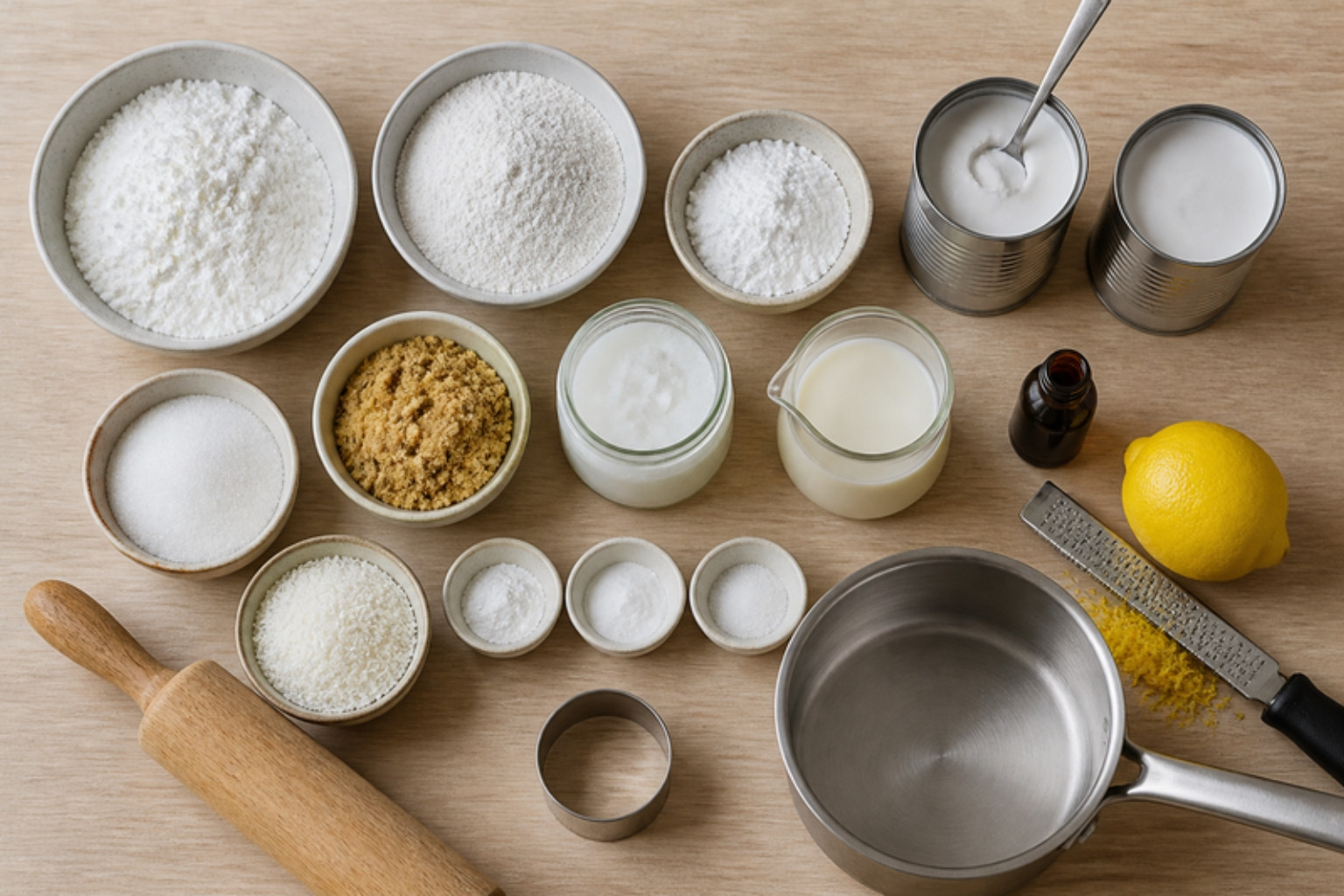
- Cornstarch: 1 1/2 cups (190 g). This is the backbone of the cookie, so don’t reduce it.
- White rice flour: 3/4 cup (120 g), finely ground, for a little structure.
- Powdered sugar: 1/2 cup (60 g). It dissolves into the dough for a fine, smooth crumb.
- Refined coconut oil: 1/2 cup (100 g), soft-solid. If you avoid coconut, use 1/2 cup (108 g) light-tasting olive oil (“light” means refined and mild, not fewer calories), chill the dough an hour, and handle gently; the cookies are more fragile. In that case, fill them with thick raspberry jam instead of the coconut filling. Skip butter substitutes, shortening, and vegetable oil.
- Oat milk: 3 to 4 tablespoons, with no added oil. Many brands contain canola or sunflower oil, so check the label.
- Leaveners: gluten-free baking powder plus a little baking soda.
- Flavor: vanilla and finely grated lemon zest.
- Dulce de leche: 2 cans full-fat coconut milk (choose one without added oils), granulated and brown sugar, baking soda, salt, and vanilla.
- Finishing: finely shredded unsweetened coconut for rolling the edges, or a dusting of powdered sugar.
Many alfajores are rolled in chopped walnuts or peanuts. This version uses coconut or powdered sugar instead.
Kitchen Equipment
- Heavy-bottomed 3-quart saucepan (the coconut milk foams up)
- 2 rimmed baking sheets and parchment paper
- Rolling pin
- 2-inch (5 cm) round cutter
- Wire rack and a small offset spatula or piping bag
Step-by-Step Tips
- Make the filling first. It needs to cool completely to thicken, so cook it a day ahead if you can.
- Watch the boil. Coconut milk foams up when it first boils. Use a big enough pan and whisk.
- Scrape as it thickens. In the last 20 minutes, stir often and scrape the bottom so it doesn’t scorch. It’s ready when a spoon dragged across the bottom leaves a trail that closes slowly.
- Add oat milk slowly. Stop as soon as the dough holds together without cracking when pressed. Too wet and the cookies spread.
- Roll between parchment. The dough is tender and doesn’t need extra starch for rolling.
- Keep them pale. Alfajores should look matte and dry on top with barely blond bottoms. Browning dries them out.
- Cool on the pan. They’re fragile while warm. Ten minutes on the sheet firms them up before you move them.
Alfajores (Dulce de Leche Sandwich Cookies)
Ingredients
Equipment
Method
- Make the dulce de leche (up to 1 week ahead): in the saucepan, whisk the coconut milk, both sugars, baking soda, and salt. Bring to a boil over medium heat, whisking; it will foam up, so stay close.
- Lower the heat to keep a steady simmer and cook 60 to 75 minutes, stirring every few minutes and scraping the bottom more often near the end, until it reduces to about 1 1/4 cups, turns a deep caramel color, and a spoon dragged across the bottom leaves a trail that slowly closes. Stir in the vanilla and cool completely; it thickens to a spreadable paste as it cools. Refrigerate if it seems loose.
- Make the cookies: whisk the cornstarch, rice flour, powdered sugar, baking powder, baking soda, and salt. Rub in the coconut oil with your fingertips until the mixture looks like damp sand.
- Add the vanilla, lemon zest, and 3 tablespoons oat milk and press together. Add more oat milk a teaspoon at a time only until the dough holds together without cracking when pressed. Flatten into a disk, wrap, and chill 30 minutes.
- Heat the oven to 325°F (165°C) and line the baking sheets with parchment. Roll the dough between two sheets of parchment to 1/4 inch (6 mm) thick. Cut 2-inch rounds, re-rolling scraps, and set 1 inch apart. Chill the sheets 10 minutes if the dough softened.
- Bake one sheet at a time for 10 to 12 minutes, until the tops look dry and matte and the bottoms are just barely blond. They should stay pale. Cool on the pan 10 minutes (they’re very tender while warm), then move to a rack and cool completely.
- Spread or pipe about 2 teaspoons dulce de leche onto the flat side of half the cookies and top with the rest, pressing gently until the filling reaches the edges. Roll the edges in shredded coconut or dust the tops with powdered sugar.
Notes
Troubleshooting & Tips
- Dulce de leche is runny: it needs more time. Cook it 10 minutes more, then cool fully; it thickens a lot as it cools. Chilling helps too.
- Filling went grainy: it boiled too hard near the end or wasn’t stirred enough. Whisk in a tablespoon of hot water off the heat to smooth it.
- Cookies crumble when filled: they need to be completely cool, and the filling should be spreadable, not stiff. Warm cold filling briefly before spreading.
- Dough cracks when rolling: add oat milk a teaspoon at a time, or let it warm for a few minutes if it’s straight from the fridge.
Make-Ahead, Freezing & Gifting
Make the dulce de leche up to 1 week ahead and refrigerate, or freeze it up to 3 months. Unfilled cookies keep airtight 1 week at room temperature or 3 months in the freezer. Filled cookies keep up to 4 days at cool room temperature or 1 week in the fridge, and they’re even more tender on day two as the cookies soften around the filling. You can freeze filled cookies, without the powdered sugar, in a single layer for up to 1 month.
For gifting, nestle them in mini paper cups inside a tin so they don’t slide, and add the powdered sugar dusting just before giving. Keep tins in a cool spot, away from the oven and radiators, since the coconut oil softens in warm rooms.
More Christmas Cookies
Browse every cookie in our Christmas recipes hub. If you love caramel, the millionaire shortbread bars use a similar coconut milk caramel, and our classic shortbread cookies share that same sandy, melt-away texture.
FAQ
What are alfajores?
Alfajores are sandwich cookies popular across South America and Spain. The best-known style uses tender cornstarch cookies filled with dulce de leche and rolled in coconut or dusted with powdered sugar.
Does coconut milk dulce de leche taste like coconut?
Lightly. The long simmer and brown sugar give it a strong caramel flavor, and the coconut becomes a background note.
Can I use store-bought dulce de leche?
Most store-bought dulce de leche is made from milk. Some coconut-based caramel sauces exist, but check the ingredients for added oils, soy, or other allergens.
Why are my alfajores so crumbly?
A little crumbliness is normal; that’s the melt-away texture. If they fall apart before you can fill them, the dough was a bit dry or they were overbaked. Add a teaspoon more oat milk next time and pull them while pale.
A note before you cook: These recipes are ideas and suggestions, not medical or dietary advice. As with any recipe or ingredient, it is each reader’s responsibility to confirm what they can and cannot eat, read every ingredient label, and source quality ingredients that fit their own needs. Ingredient formulations change, so always check the package you’re using.