
Millionaire shortbread is usually a triple hit of the ingredients allergy families skip: butter shortbread made with wheat flour, a caramel built on sweetened condensed milk, and a layer of milk chocolate. If you’ve wanted those layered caramel bars on your cookie tray anyway, this version rebuilds each layer from scratch, the same way our magic cookie bars without nuts do.
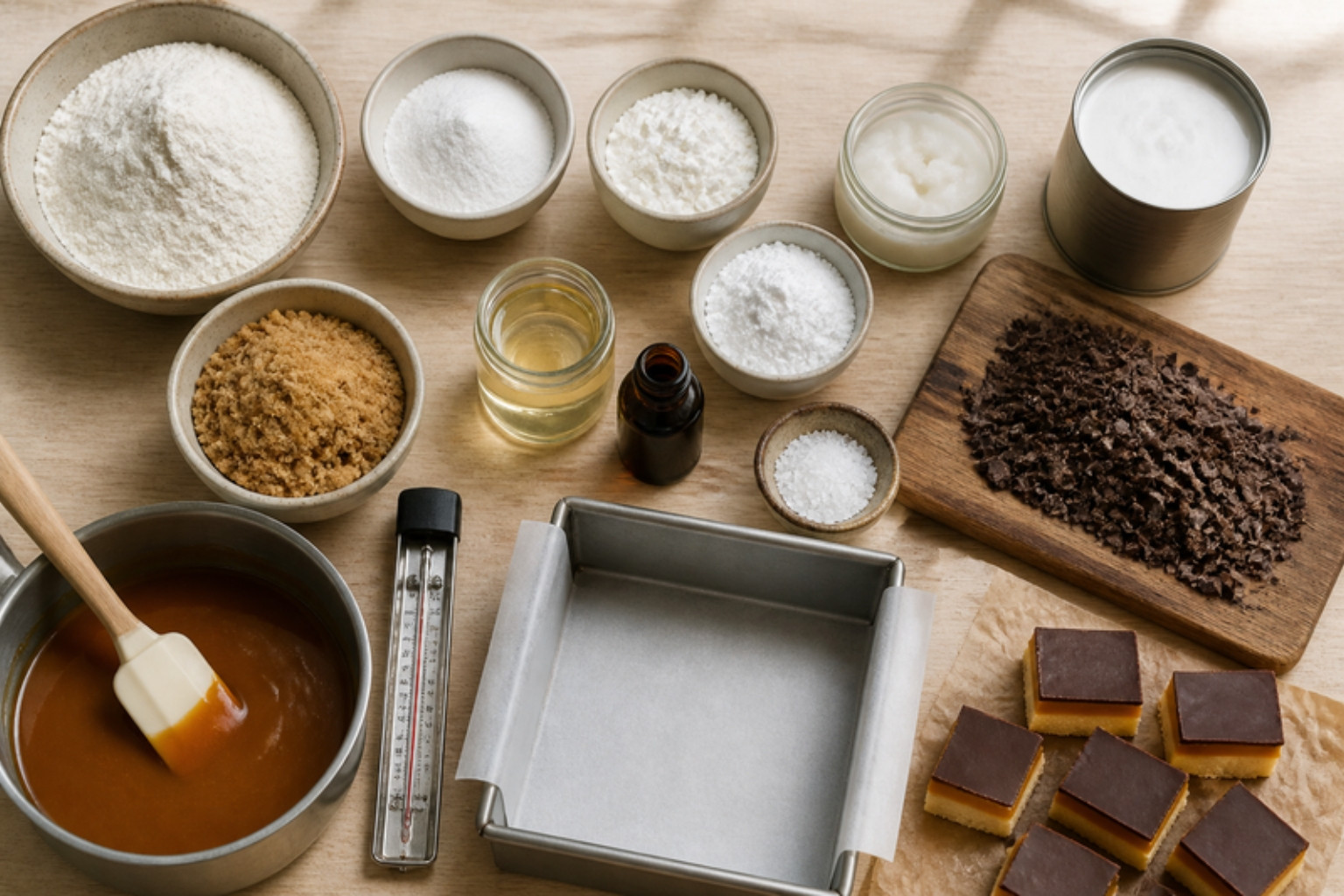
The base is a crisp, sandy shortbread of white rice flour, sweet rice flour, cornstarch, and powdered sugar, pressed into an 8×8 pan with refined coconut oil. The middle is a thick, chewy caramel cooked from full-fat coconut milk, brown sugar, and a little corn syrup until it turns deep amber. On top goes a thin layer of dairy-free dark chocolate and, if you like, a pinch of flaky salt. Cut into small squares, they’re rich enough that one goes a long way, which makes a single pan perfect for gifting and cookie exchanges.
Made without: peanuts, tree nuts, milk, eggs, wheat, soy, fish, shellfish, sesame. Contains coconut (coconut milk and refined coconut oil).
Why You’ll Love These Bars
- Three textures in one bite: crisp shortbread, chewy caramel, snappy chocolate.
- No rolling or cutters. The base is pressed into the pan by hand.
- Caramel without butter or cream. Coconut milk cooks down into a rich, toffee-like caramel.
- Freezer-friendly. Make a batch in early December and pull squares out for parties and tins.
How Each Layer Works Without Butter, Milk, or Wheat
- Shortbread: Scottish shortbread has long used some rice flour for its sandy snap. Here, white rice flour does most of the work, sweet rice flour (glutinous rice flour, which has no gluten) holds the crumbs together, and cornstarch keeps the texture tender. Refined coconut oil is firm at room temperature, so it behaves much like butter in a pressed crust. There are no eggs in classic shortbread, so nothing needs replacing there.
- Caramel: condensed milk is milk and sugar cooked down until thick. Full-fat coconut milk does the same thing: its fat and natural proteins give the caramel body as the water evaporates, and brown sugar adds a toffee flavor. Corn syrup helps keep the caramel smooth instead of grainy.
- Chocolate: a dairy-free dark chocolate with a teaspoon of coconut oil melts into a smooth layer that cuts cleanly once it’s chilled.
Ingredients and Swap Ideas
Exact amounts in cups and grams are in the recipe card below.
- Coconut milk: use canned full-fat coconut milk, shaken well. Light coconut milk and coconut milk beverages are too thin to make caramel.
- Dark chocolate: look for a bar or chips made without milk, soy lecithin, or added seed oils. “Dark” on the label doesn’t guarantee there’s no milk, so read the ingredients.
- Fat: refined coconut oil throughout (it has no coconut taste). Skip butter substitutes and margarine, which are usually made with seed oils.
- Sweet rice flour: sold in Asian groceries and the baking aisle, sometimes labeled mochiko. If you can’t find it, replace it with more white rice flour plus 1 tablespoon of tapioca starch; the base will be a little more crumbly.
- Corn syrup: light corn syrup keeps the caramel smooth and keeps the sugar from crystallizing. Skip brown rice syrup, which is sometimes made with barley enzymes.
Equipment
- An 8×8-inch (20×20 cm) metal pan with a parchment sling (two strips crossed, hanging over the sides)
- A heavy-bottomed 3-quart saucepan (the caramel foams up as it cooks)
- A candy or instant-read thermometer, a heatproof spatula, and a large sharp knife
Step-by-Step Tips
- Press the base firmly. Use the flat bottom of a measuring cup to pack it into an even layer, especially in the corners. Loose spots crumble when you cut.
- Bake until golden at the edges. Pale shortbread tastes floury; aim for golden edges and a firm, dry-looking center.
- Cook the caramel patiently. It will look thin and foamy for the first 15 minutes. Stir often and scrape the bottom so it doesn’t scorch. It’s done at 225 to 230°F (107 to 110°C), when a spatula leaves a trail that slowly fills in.
- Chill between layers. If the chocolate goes onto warm caramel, the layers smear. Wait until the caramel surface feels firm.
- Cut with a hot knife. Let the slab sit 10 minutes out of the fridge so the chocolate doesn’t crack, then cut with a knife dipped in hot water and wiped dry between cuts.
Hot sugar can cause serious burns, so keep kids and pets clear of the stove while the caramel cooks.
Millionaire Shortbread Bars (No Butter, Milk or Wheat)
Ingredients
Equipment
Method
- Heat the oven to 350°F (175°C). Whisk the rice flour, sweet rice flour, cornstarch, powdered sugar, and salt. Rub in the coconut oil and vanilla with your fingers until the mix looks like damp sand, adding cold water a tablespoon at a time until it holds together when squeezed.
- Press the dough firmly and evenly into the lined pan (the bottom of a measuring cup helps) and prick it all over with a fork. Bake 25-30 minutes, until pale golden at the edges and firm in the center. Cool completely in the pan.
- Combine the coconut milk, brown sugar, corn syrup, coconut oil, and salt in the saucepan. Bring to a boil over medium heat, stirring, then simmer, stirring often and scraping the bottom, 25-35 minutes. It will foam, then thicken and darken to deep amber. It’s ready at 225-230°F (107-110°C), when a spatula dragged across the bottom leaves a trail that slowly fills in. Stir in the vanilla.
- Pour the caramel over the cooled base and spread it evenly. Cool 30 minutes, then refrigerate about 1 hour, until the surface is firm to a light touch.
- Melt the chocolate with 1 tsp coconut oil in short microwave bursts or over barely simmering water, stirring until smooth and just warm. Spread it over the caramel and sprinkle with flaky salt if you like. Chill 30 minutes, until the chocolate is set but not rock hard.
- Lift the slab out with the parchment. Let it sit 10 minutes, then cut into 16 squares with a large knife dipped in hot water and wiped dry between cuts.
Notes
Troubleshooting
- Caramel is runny after chilling: it didn’t cook long enough. Scrape it back into the pot and simmer a few minutes more to 228 to 230°F.
- Caramel is hard and toffee-like: it cooked too far. It’s still tasty; let the bars sit at room temperature 15 minutes before eating.
- Caramel looks oily or separated: whisk vigorously off the heat for a minute, then add a tablespoon of hot water and whisk again until glossy.
- Chocolate cracks when cutting: the bars are too cold. Let the slab warm up for 10 to 15 minutes.
Make-Ahead, Freezing, and Gifting
- Fridge: store airtight in the refrigerator up to 1 week. The caramel softens after a few hours at warm room temperature, so serve them cool.
- Freezer: freeze cut squares layered with parchment in a rigid container up to 3 months. Thaw in the fridge.
- Cookie tins: set each square in a paper candy cup so the caramel doesn’t stick to its neighbors, and keep the tin in a cool spot. They’re a good fit for a tin with crisp cookies, since they won’t make them soggy.
- Party trays: cut 25 smaller squares (5 by 5) for a bigger tray.
Find more bars, candy, and cookies in our Christmas recipes collection. For another coconut milk candy, try the old-fashioned dairy-free fudge, or keep it simple with plain shortbread cookies made without butter.
FAQ
Why is it called millionaire shortbread?
The name refers to how rich the bars are: shortbread on its own was already considered a treat, and adding caramel and chocolate made it a “millionaire’s” version. They’re also called caramel shortbread or caramel slices in the UK.
Does the caramel taste like coconut?
Mildly. Cooking it down with brown sugar turns it toasty and toffee-like, and most of the coconut flavor fades into the background, especially under dark chocolate.
Is there a coconut-free version?
Not yet. The caramel depends on coconut milk for its body, and a coconut-free caramel for these bars hasn’t been worked out. For a coconut-free candy, the hard tack candy is made from sugar, corn syrup, and water.
Can I make them without a candy thermometer?
Yes. Use the spatula test: when you drag a spatula across the bottom of the pot, the caramel should part and leave a trail that slowly fills back in. Another check is to drop a little into cold water; it should form a soft, pliable ball.
A note before you cook: These recipes are ideas and suggestions, not medical or dietary advice. As with any recipe or ingredient, it is each reader’s responsibility to confirm what they can and cannot eat, read every ingredient label, and source quality ingredients that fit their own needs. Ingredient formulations change, so always check the package you’re using.