
Pinwheel cookies are the showpiece of an old-fashioned Christmas cookie tray: a tight chocolate and vanilla spiral in every slice. They look fussy, but they’re really a make-ahead cookie. You roll two sheets of dough together into a log, chill it, and slice and bake whenever you need a fresh batch. The catch for allergy families is that the usual dough is butter, eggs, and wheat flour, and the egg is what keeps it from cracking as you roll.
This version starts from the same rice flour, oat flour, and refined coconut oil dough family as our soft cut-out sugar cookies, adjusted to roll into a log without splitting. Applesauce supplies the moisture an egg would, tapioca starch adds a little stretch, and a short chill before rolling keeps the coconut oil firm but bendable. Half the dough gets cocoa, the two layers are stacked and rolled, and the result is a crisp-edged, tender cookie with a clean swirl.
Made without: peanuts, tree nuts, milk, eggs, wheat, soy, fish, shellfish, sesame. Contains coconut (refined coconut oil; a leaf lard option is below).
Why You’ll Love This Recipe
- A classic chocolate and vanilla swirl that looks great in a cookie tin.
- Slice-and-bake: the dough logs keep in the freezer for up to 3 months.
- No eggs, butter, or wheat, and no commercial egg replacer.
- Only one dough to mix; cocoa turns half of it chocolate.
- A rolled sanding-sugar edge makes them extra festive.
How This Dough Rolls Without Eggs or Wheat
Gluten from wheat makes a dough stretchy, and egg holds it together, so a wheat-free, egg-free dough needs help to bend into a spiral. Three things do that here. First, a mix of rice flour (for a crisp, sandy structure), oat flour (for tenderness and flavor), and tapioca starch (for a bit of chew and flexibility). Second, applesauce, which adds moisture and pectin so the dough holds together. Third, temperature: refined coconut oil acts like butter when it’s soft but solid. Too warm and the dough is greasy and sticky; too cold and it cracks. A 15- to 20-minute chill after rolling the sheets lands it in the middle.
Ingredients & Swap Ideas
- Refined coconut oil, ¾ cup (165 g): refined, so the cookies don’t taste of coconut. Scoopable like soft butter, not melted. If you avoid coconut, use the same weight of pure leaf lard. Light-tasting olive oil isn’t recommended here, because liquid oil makes a dough too soft to roll and slice cleanly. Skip shortening, margarine, and plant butters, which are made with seed oils.
- Granulated sugar, 1 cup (200 g).
- Unsweetened applesauce, ¼ cup (60 g): at room temperature so it doesn’t firm up the coconut oil.
- White rice flour, certified gluten-free oat flour, tapioca starch, and cornstarch: use finely ground rice flour for the smoothest texture. Oat flour should be certified gluten-free because oats are often cross-contacted with barley and wheat.
- Baking powder: just ½ teaspoon, for a tender bite without losing the swirl. Choose one labeled gluten-free.
- Dutch-process cocoa, ¼ cup (25 g), plus 1 tablespoon water: Dutch-process cocoa gives a darker swirl. Natural cocoa works too.
- Sanding sugar (optional): red or green for the edges. Check the label; some contain milk, wheat starch, soy lecithin, or seed-oil coatings.
Kitchen Equipment
- Stand or hand mixer
- Rolling pin and plenty of parchment paper
- A ruler (for even 9 x 12-inch rectangles)
- A sharp, thin knife for slicing
- Two baking sheets lined with parchment
Step-by-Step Tips
- Weigh the halves. Splitting the dough by weight gives an even swirl. A kitchen scale makes this easy.
- Roll between parchment. Roll each dough to a 9 x 12-inch rectangle about ¼ inch thick. Square up the corners with the edge of the ruler.
- Chill flat, briefly. 15 to 20 minutes in the fridge, until the dough is firm but still bends without cracking.
- Stack and seal. Brush the vanilla layer lightly with water, flip the chocolate layer on top, and press with the rolling pin so the layers stick together.
- Roll with the paper. Lift the parchment to start the roll, then keep using it to push the dough forward into a tight log. Small cracks press closed after a 2-minute rest.
- Chill, then slice cold. At least 2 hours. Slice ¼ inch thick, giving the log a quarter turn every few cuts so it stays round.
- Bake until just set. 10 to 12 minutes at 350°F, until the tops look dry and the bottoms are pale golden. The vanilla swirl should stay light, not brown.
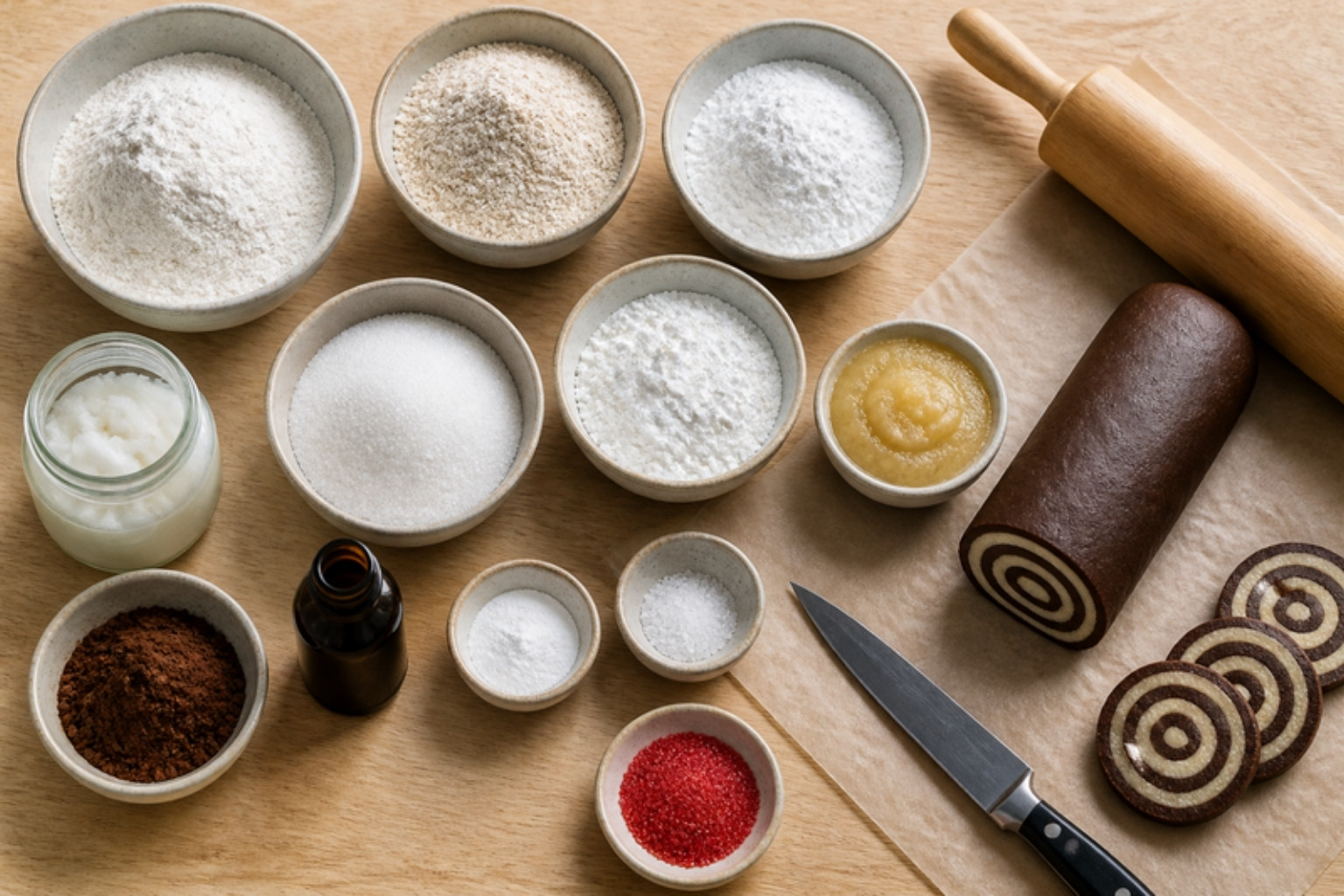
Chocolate and Vanilla Pinwheel Cookies
Ingredients
Equipment
Method
- Beat the coconut oil and sugar on medium speed until creamy and smooth, about 2 minutes. Beat in the applesauce and vanilla.
- Whisk the rice flour, oat flour, tapioca starch, cornstarch, baking powder, and salt in another bowl. Add to the wet mixture and mix on low until a soft dough forms. If it stays crumbly, add cold water 1 teaspoon at a time until it holds together when squeezed.
- Divide the dough in half by weight. Return one half to the bowl and beat in the cocoa and 1 tablespoon water until evenly brown with no streaks.
- Roll each dough between two sheets of parchment into a 9 x 12-inch rectangle, about ¼ inch (6 mm) thick. Slide onto a baking sheet and refrigerate flat for 15 to 20 minutes, until firm but still bendable.
- Peel the top parchment off both doughs. Brush the vanilla dough very lightly with water. Flip the chocolate dough onto it, peel off the parchment, press gently with the rolling pin to seal, and trim the edges straight.
- Starting at a long edge, use the bottom parchment to lift and roll the stacked dough into a tight log. If it cracks, let it sit 2 to 3 minutes and press the crack closed.
- Cut the log in half. Roll each piece in sanding sugar if using, wrap in parchment, and refrigerate at least 2 hours or overnight (or freeze up to 3 months).
- Heat the oven to 350°F (175°C). Slice the cold logs ¼ inch (6 mm) thick with a sharp knife, giving the log a quarter turn every few slices so it stays round.
- Place 1 inch apart on lined sheets. Bake one sheet at a time for 10 to 12 minutes, until the tops look dry and set and the bottoms are just pale golden. The vanilla swirl should stay light.
- Cool on the sheet 5 minutes, then move to a rack to cool completely.
Notes
Troubleshooting & Tips
- Dough cracks as you roll the log: it’s too cold. Let it sit a few minutes at room temperature and try again. A little cold water brushed on the cracks helps seal them.
- Dough is sticky and greasy: it’s too warm. Chill the sheets 10 more minutes before stacking.
- A gap in the center of the swirl: roll the first turn as tightly as possible, pressing the edge down before continuing.
- Slices flatten into ovals: the log softened. Return it to the freezer for 10 minutes and rotate the log as you slice.
Make-Ahead, Freezing & Gifting
This is the best part of pinwheel cookies. Wrap the logs in parchment, then plastic or a freezer bag, and freeze for up to 3 months. Slice straight from the freezer (let the log sit 5 minutes if it’s too hard to cut) and add 1 to 2 minutes to the bake. Baked cookies keep for 1 week in a tin at room temperature, layered with parchment, or up to 2 months in the freezer.
For cookie exchanges, stand the cookies on their edges in a tin or gift box so the spirals show. They’re sturdy and travel well.
More Christmas Cookies to Try
Find the whole cookie tray in our Christmas recipes collection. If you like this dough, try the soft cut-out sugar cookies and classic shortbread cookies, or add some no-bake chocolate oatmeal cookies for an oven-free option.
FAQ
How do you keep pinwheel cookies from separating?
Brush a thin film of water between the two layers and press them together with the rolling pin before rolling the log. Rolling tightly and chilling well also helps the layers stay together when sliced.
Can I make red and white pinwheels instead?
Yes. Skip the cocoa and water and knead ¼ to ½ teaspoon of red gel food coloring into half the dough instead. Check the coloring’s label.
Can I use butter instead of coconut oil?
Butter would work in the dough, but it adds milk, so the cookies would no longer be made without the top nine allergens. Leaf lard is the coconut-free option that keeps that profile.
How far ahead can I make the dough?
Up to 3 days in the refrigerator or 3 months in the freezer, well wrapped.
A note before you cook: These recipes are ideas and suggestions, not medical or dietary advice. As with any recipe or ingredient, it is each reader’s responsibility to confirm what they can and cannot eat, read every ingredient label, and source quality ingredients that fit their own needs. Ingredient formulations change, so always check the package you’re using.