
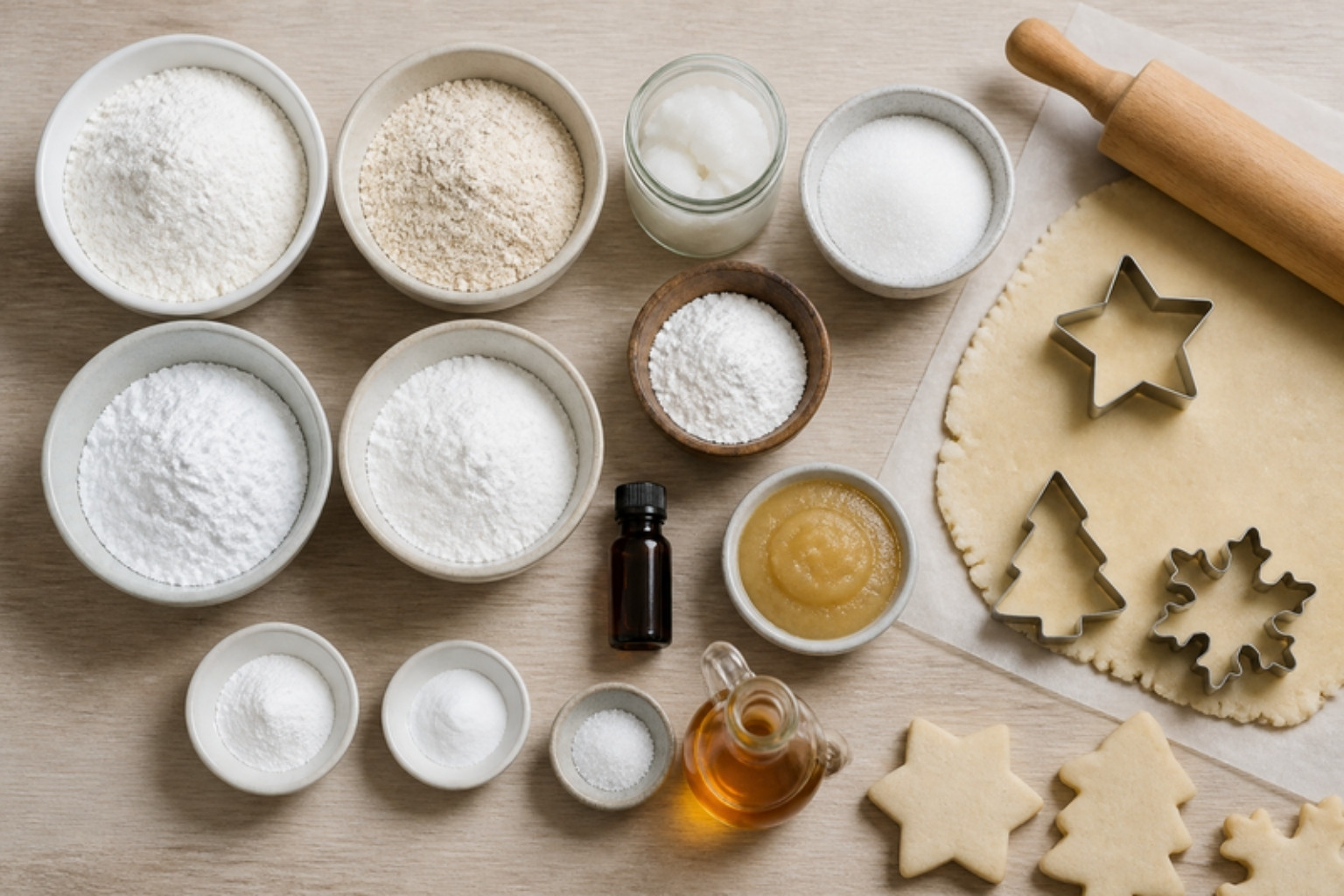
If you’ve tried to make Christmas cut-out cookies without eggs, butter, or wheat, you know how it usually goes: the dough crumbles when you roll it, the stars spread into blobs, or the cookies bake up hard and sandy instead of soft. These soft cut-out sugar cookies are designed around those problems. The dough rolls between sheets of parchment, cuts cleanly, and bakes into thick, tender cookies with flat tops that are ready for icing, sprinkles, or nothing at all.
The flavor is classic sugar cookie: sweet, buttery-tasting from refined coconut oil, and full of vanilla. Pair them with the royal icing without egg whites or meringue powder for decorating, add a crisp contrast with the shortbread cookies without butter, and find more cookie-tray ideas on our Christmas recipes page.
Made without: peanuts, tree nuts, milk, eggs, wheat, soy, fish, shellfish, sesame. (Contains coconut from refined coconut oil.)
Why You’ll Love These Cookies
- Soft and thick, not crisp or crumbly, with sharp edges that hold their shape.
- No egg replacer, flax, or aquafaba: the structure comes from the flour and starch balance.
- The dough chills right in rolled sheets, so there’s no wrestling with a cold, hard disk.
- Freezer-friendly at every stage, which makes holiday baking easier to spread out.
How Gluten-Free Cut-Out Cookies Hold Together Without Eggs
In a standard sugar cookie, eggs bind the dough and wheat gluten gives it stretch. Here each job is handed to a different ingredient. White rice flour provides the bulk and a clean, neutral flavor. Oat flour adds tenderness and a little stickiness. Tapioca starch is the key binder: it gives the dough a slight elasticity so it rolls without cracking and bakes up chewy-soft. Cornstarch keeps the crumb fine and stops the cookies from turning gritty.
A spoonful of applesauce stands in for the moisture an egg would bring, and a teaspoon of cider vinegar reacts with the baking soda for gentle lift (you won’t taste it). Refined coconut oil is solid at room temperature, much like butter, so it creams with sugar and keeps cut shapes sharp in the oven. Chilling the rolled dough for an hour firms that fat and lets the flours hydrate, which is what keeps the edges crisp and the centers soft.
Ingredients & Swap Ideas
- White rice flour, 1 1/4 cups (200 g): look for a finely ground flour; coarse rice flour makes gritty cookies.
- Oat flour, 1/2 cup (60 g): choose certified gluten-free oat flour (regular oats can carry wheat and barley cross-contact). You can grind certified GF rolled oats in a blender until powdery.
- Tapioca starch, 1/2 cup (60 g), and cornstarch, 1/4 cup (32 g): both are needed; don’t swap one for the other entirely.
- Refined coconut oil, 1/2 cup (100 g): use it soft-solid, about 68–72°F (20–22°C), like softened butter. If you avoid coconut, pure leaf lard is the closer swap for cut-outs. Light-tasting olive oil makes a soft, sticky dough that spreads, so it isn’t a good fit here. Skip shortening, margarine, and plant butters, which are typically made with seed oils.
- Sugars: granulated sugar for structure and powdered sugar for a finer crumb.
- Unsweetened applesauce, 1/3 cup (80 g): pumpkin purée works in a pinch, but it tints and flavors the cookies.
- Baking powder (gluten-free), baking soda, salt, cider vinegar, and vanilla.
Kitchen Equipment
- Stand or hand mixer
- Rolling pin and parchment paper
- Cookie cutters, about 3 inches
- Two rimmed baking sheets and a thin metal spatula
Step-by-Step Tips
- Cream until fluffy. Beat the soft coconut oil with both sugars for a full 2 minutes, until it looks pale and like wet sand.
- Do the squeeze test. After mixing in the dry ingredients, squeeze a small piece. If it holds without cracking, it’s ready; if it crumbles, add cold water a teaspoon at a time.
- Roll, then chill. Roll the dough to 1/4 inch (6 mm) between parchment while it’s soft, then chill the flat sheets. Cold sheets cut far more cleanly than rolled-out cold dough.
- Move shapes with a spatula. These are tender doughs. Lift cut shapes with a thin metal spatula and space them 1 inch apart.
- Bake for set, not color. Pull the cookies when the tops look matte and set and the bottoms are just pale gold, usually 9 to 11 minutes. Browned edges mean they’ve gone too long.
- Let them cool on the pan. Ten minutes on the sheet firms them enough to move. Ice only when completely cool.
Soft Cut-Out Sugar Cookies
Ingredients
Equipment
Method
- Whisk the rice flour, oat flour, tapioca starch, cornstarch, baking powder, baking soda, and salt in a bowl.
- Beat the soft coconut oil with the granulated and powdered sugar for 2 minutes, until fluffy and pale like wet sand. Beat in the applesauce, vinegar, and vanilla until smooth.
- Mix in the dry ingredients on low until a soft dough forms. Squeeze a piece: it should hold together without cracking. If it crumbles, add cold water 1 tsp at a time.
- Divide the dough in half, flatten each into a disk between two sheets of parchment, and roll to 1/4 inch (6 mm) thick. Slide onto a baking sheet and chill 1 hour (or up to 2 days), until firm.
- Heat the oven to 350°F (175°C) and line baking sheets with parchment. Peel off the top parchment, cut shapes, and move them 1 inch apart with a thin spatula. Re-roll scraps between parchment and chill 10 minutes before cutting again.
- Bake one sheet at a time for 9 to 11 minutes, until the tops look matte and set and the bottoms are just pale gold. The edges should not brown.
- Cool on the baking sheet for 10 minutes (the cookies are fragile while hot), then move to a rack. Cool completely before icing.
Notes
Troubleshooting & Tips
- Dough cracks when rolling: it’s a little dry or too cold. Let it sit 5 minutes, or knead in a teaspoon of water.
- Dough sticks to the cutter: dip the cutter in rice flour between cuts, and make sure the dough sheet is fully chilled.
- Cookies spread: the coconut oil was too warm or melted. Chill cut shapes on the baking sheet for 10 minutes before baking.
- Cookies taste gritty: the rice flour was coarse. A finely milled white rice flour makes a big difference.
Make-Ahead, Freezing & Gifting
- Dough: refrigerate rolled sheets up to 2 days, or freeze them (stacked with parchment, wrapped well) up to 2 months. Thaw in the fridge until just bendable, then cut.
- Baked cookies: keep plain cookies airtight at room temperature up to 5 days, or freeze un-iced cookies up to 2 months. Thaw at room temperature in the closed container.
- Cookie tins: once the icing is completely dry (overnight), pack decorated cookies in a tin in single layers separated by parchment. Keep them away from heat and humidity, which can soften icing.
- Cookie exchanges: label the tin with what the cookies are made without and the ingredients you used, including brands of sprinkles or colors, so others can check for themselves.
More Christmas Cookies
Decorate these with the egg-free royal icing, roll out a second batch of cut-out gingerbread cookies, or add crisp shortbread cookies made without butter to the tray. Browse the whole cookie aisle on the Christmas recipes page.
FAQ
Can I make sugar cookies without eggs?
Yes. This recipe uses tapioca starch for binding, applesauce for moisture, and baking soda with cider vinegar for lift, so no egg or egg replacer is needed.
Will these cookies taste like coconut?
Refined coconut oil is processed to be neutral in flavor and aroma, unlike virgin or unrefined coconut oil. With vanilla in the dough, the cookies read as classic sugar cookies.
Can I use a store-bought gluten-free flour blend?
Blends vary widely, and many include ingredients such as xanthan gum, potato starch, or bean flours in different amounts. This recipe was developed for the specific flours listed, so a blend may change the texture and the made-without profile. Check the blend’s label.
How thick should I roll sugar cookies?
Roll to 1/4 inch (6 mm) for soft, sturdy cookies. Thinner cookies bake faster and turn crisper and more fragile.
A note before you cook: These recipes are ideas and suggestions, not medical or dietary advice. As with any recipe or ingredient, it is each reader’s responsibility to confirm what they can and cannot eat, read every ingredient label, and source quality ingredients that fit their own needs. Ingredient formulations change, so always check the package you’re using.