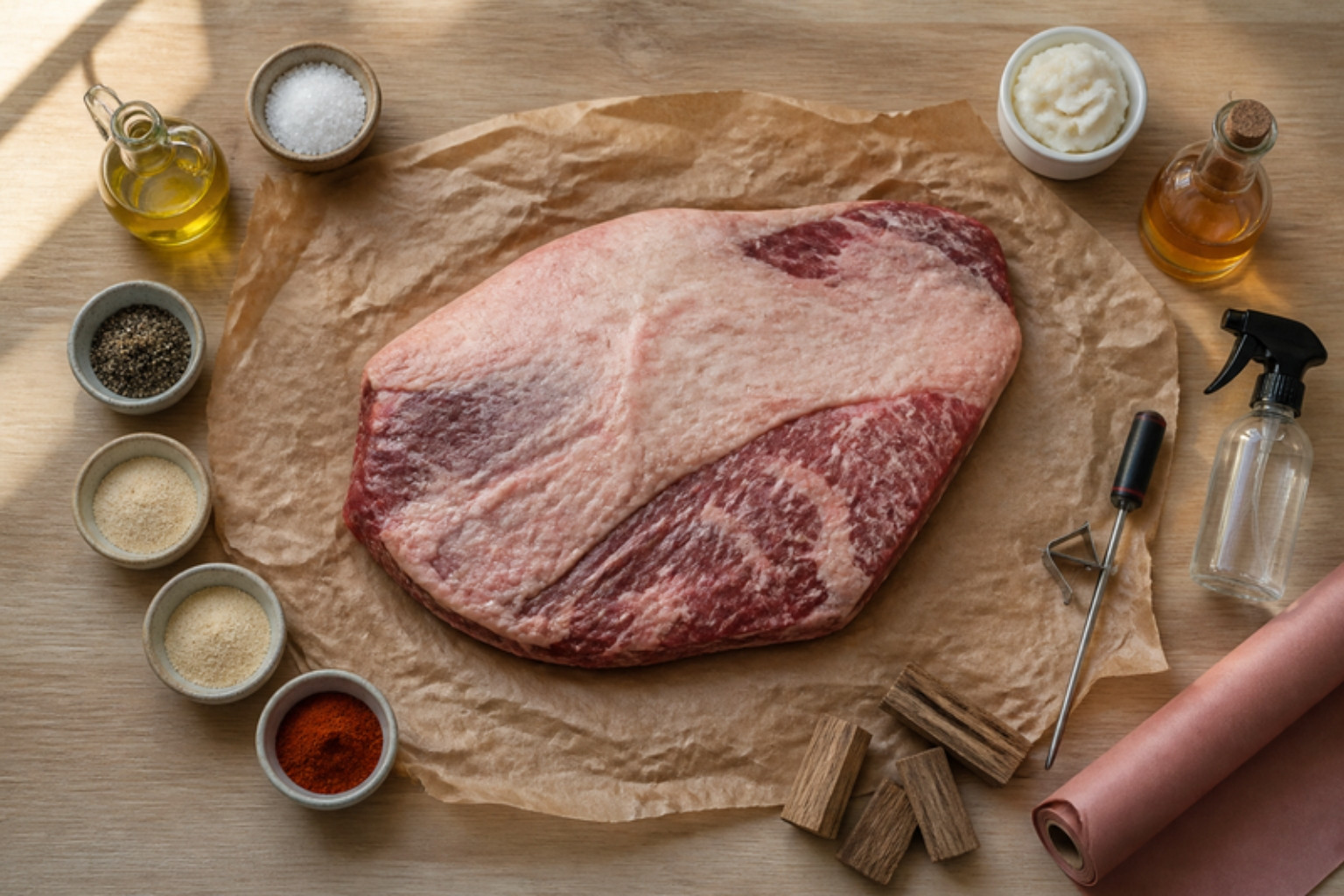
Ingredients
Equipment
Method
- The night before, trim the brisket while cold: leave about 1/4 inch of fat on the fat cap, remove hard fat and silver skin from the meat side, and round off thin, ragged edges so they don't burn. Save the trimmings to render into tallow if you like.
- Mix the salt, pepper, garlic powder, and onion powder and paprika if using. Rub the brisket lightly with olive oil (optional), then season every side evenly. Refrigerate uncovered overnight, or at least 1 hour.
- Heat the smoker to 250°F (120°C) with oak, hickory, or cherry wood, and wait for thin, clean blue smoke rather than thick white smoke.
- Set the brisket fat side up (or toward the heat source on an offset), with the thicker point end toward the hotter side. Insert a probe into the thickest part of the flat. Smoke until the bark is deep mahogany and set (it doesn't smear when touched) and the internal temperature reaches about 165°F (74°C), 6 to 8 hours. Spritz with the vinegar-water every hour after the first 3 hours if the edges look dry.
- Lay two overlapping sheets of butcher paper on the counter, brush the center with half the melted tallow, set the brisket on it, and drizzle the rest of the tallow over the top. Wrap tightly, folding the paper like a package, and return it to the smoker seam side down.
- Cook until the brisket reaches 200 to 205°F (93 to 96°C) and, more importantly, a probe slides into the flat with almost no resistance, like soft butter, 3 to 5 more hours. The whole brisket should jiggle when you nudge it.
- Rest the wrapped brisket at least 1 hour and ideally 2 to 4 hours, either in a dry cooler packed with towels or in a 150 to 170°F (65 to 77°C) oven. Hold above 140°F (60°C) during the rest.
- Unwrap over a board, saving the juices. Separate the point from the flat along the fat seam. Slice the flat against the grain about the thickness of a pencil. Turn the point 90 degrees and slice it slightly thicker, or cube it for burnt ends. Spoon the reserved juices over the slices and serve.
Notes
Made without: milk, eggs, wheat, soy, peanuts, tree nuts, fish, shellfish, sesame.
Label check: brisket (plain, not injected or pre-seasoned), garlic and onion powder (single spices, not blends with anti-caking agents or seasoning mixes), smoked paprika, beef tallow (pure, not blended with seed oils), store-bought BBQ sauce and rubs (may contain soy, wheat, mustard, or anchovy-based Worcestershire), buns (often contain wheat, eggs, milk, soy, or sesame).
Fat: beef tallow in the wrap; light-tasting olive oil as an optional binder instead of mustard. No butter, seed oils, or cooking spray.
Food safety: brisket is cooked well past the USDA minimum for whole cuts of beef (145°F with a 3-minute rest). Reheat leftovers to 165°F. See the USDA safe temperature chart.
Storage: refrigerate unsliced portions in their juices up to 4 days; freeze vacuum-sealed or tightly wrapped up to 3 months. Reheat covered at 300°F with a splash of beef broth or reserved juices until 165°F.
Yield: a 13-lb packer yields roughly 6 to 7 lb cooked meat; servings are about 5 oz cooked.
Nutrition is an automated estimate.
