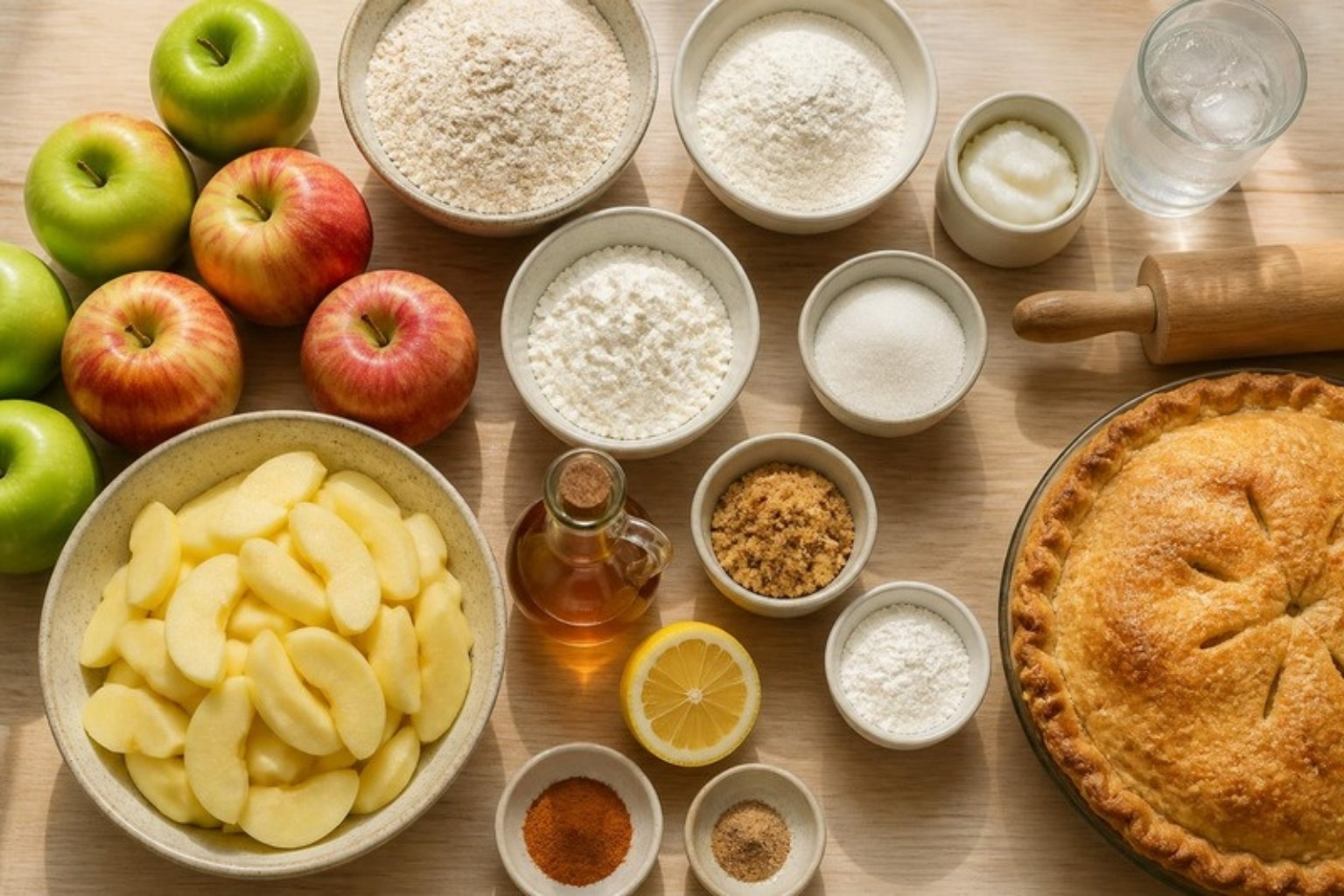
Ingredients
Equipment
Method
Make the crust
- Pulse the oat flour, rice flour, tapioca starch, sugar, and salt in a food processor. Add the cold lard or coconut oil and pulse 8 to 10 times, until the mixture looks like coarse meal with some pea-sized pieces of fat.
- Add the vinegar and 1/2 cup (120 ml) ice water. Pulse just until the dough starts to clump. Pinch a handful: it should hold together and feel like soft, slightly tacky modeling clay. Add more ice water 1 tablespoon at a time if it crumbles.
- Divide the dough in two, one piece slightly larger. Press each into a 1-inch-thick disk, wrap, and refrigerate at least 1 hour (up to 2 days).
Make the filling and assemble
- Heat the oven to 425°F (220°C) with a rack in the lower third. Set a rimmed baking sheet on the rack below to catch drips.
- Toss the apple slices with the sugars, cornstarch, lemon juice, cinnamon, nutmeg, allspice, salt, and vanilla until evenly coated. Let stand 10 minutes while you roll the crust.
- Roll the larger disk between two sheets of parchment to a 12-inch (30 cm) circle about 1/8 inch (3 mm) thick. Peel off the top sheet, flip the dough into the pie plate, and peel away the second sheet. Press any cracks together with your fingers; this dough patches easily.
- Pile the apples into the crust, mounding them higher in the center, and pour in any juices left in the bowl.
- Roll the second disk the same way to an 11-inch (28 cm) circle. For a vented top, lay it over the apples, trim to a 1/2-inch overhang, fold the edge under, and crimp. Cut five 2-inch slits. For a lattice, cut the round into 1-inch strips, chill the strips 10 minutes on their parchment, then weave them over the filling, sliding each strip off the parchment with a thin spatula.
- Brush the top lightly with water and sprinkle with the coarse sugar. Chill the assembled pie 15 minutes so the fat firms up again.
Bake and cool
- Bake 20 minutes at 425°F (220°C). Reduce the oven to 375°F (190°C) and bake 40 to 50 minutes more, until the crust is deep golden and the juices bubble thickly through the vents or lattice. Thin, watery juice means the cornstarch hasn't fully cooked; keep baking. Cover the edges with foil if they brown too fast.
- Cool the pie on a rack at least 3 to 4 hours before slicing so the filling sets.
Notes
Made without: peanuts, tree nuts, milk, eggs, wheat, soy, fish, shellfish, sesame.
Fat: lard gives the flakiest crust. Refined coconut oil works the same way (chill it firm). If you avoid coconut, use lard, or light-tasting olive oil ("light" means refined and mild, not fewer calories) for a more tender, crumbly oil-pastry crust; chill that dough 2 hours.
Label check: oat flour (certified gluten-free; oats can carry barley and wheat cross-contact), rice flour, tapioca starch, lard (pure, not hydrogenated or blended with seed oils), refined coconut oil (100%), cinnamon and spices, vanilla extract, coarse sugar.
Make ahead and storage: refrigerate dough disks up to 2 days or freeze up to 3 months. Freeze the whole unbaked pie (wrapped well) up to 3 months and bake from frozen at 425°F for 25 minutes, then 375°F for 50–60 minutes. Baked pie keeps loosely covered at room temperature 1 day or refrigerated 4 days. Baked slices freeze up to 2 months.
Nutrition is an automated estimate.
