
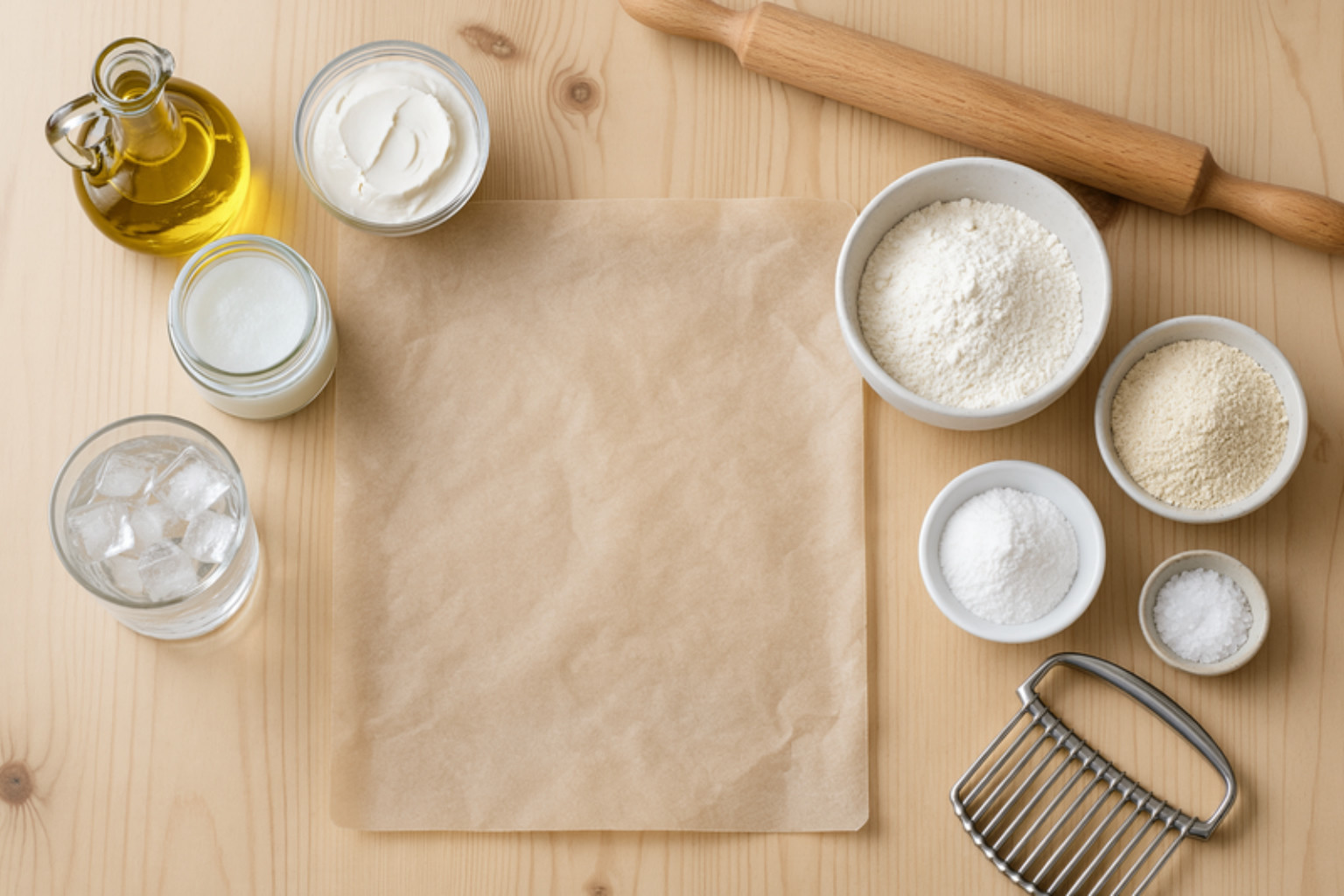
What’s It Doing There? · Episode 4 · A weekly look at what ingredients actually do, and how to cook without the top 9 allergens
Pie crust has a famously short ingredient list: flour, fat, water, a pinch of salt. With so few players on the field, each one carries a lot of weight, and none carries more than the fat. Swap it and the whole crust changes personality. The same flour and water can bake up flaky and shattering, sandy and crumbly, or tough enough to use as a frisbee, depending on which fat went in and how it was handled.
Most pie advice assumes butter, so anyone baking without it is left guessing. Is lard just a stand-in? Why does a coconut oil crust go from rock-hard to greasy in the time it takes to answer the phone? And why does olive oil make a lovely tart shell but never a flaky top crust? The answers come down to three jobs fat does in pastry, and to one simple physical fact: whether the fat is solid or liquid at the moment it meets the flour.
The two-minute version
- Fat has three jobs in pie crust: tenderness (it coats the flour so the dough can’t bind too tightly), flakiness (solid pieces of fat hold layers of dough apart) and flavor.
- Flakiness needs a fat that’s solid but workable. Cold lard and cold refined coconut oil can make layers; olive oil stays liquid, so it makes a tender, crumbly press-in crust instead.
- Lard is the most forgiving solid fat. It stays firm across a wide temperature range, so it’s easy to roll and bakes up flaky. Leaf lard is the mildest.
- Coconut oil melts around 76°F. It goes from brittle to greasy quickly, so keep it cool but not rock-hard, and handle the dough as little as possible.
- Size matters: fat worked into small crumbs makes a firmer, mealy crust that stands up to wet pumpkin and custard fillings; bigger flattened pieces make the flaky crust that suits fruit pies.
Job 1: Tenderness, or keeping the flour from holding hands
Flour plus water, kneaded and baked, makes something closer to a cracker than a pie crust. The particles hydrate, bond to each other and set into a hard, continuous sheet. Fat’s first job is to get in the way of that.
In a wheat dough, the main bonding happens through gluten, the stretchy protein network covered in Episode 2. When fat coats the flour before the water arrives, water can’t reach the proteins as easily, and the gluten strands that do form stay short. That’s where the old baking word “shortening” comes from: a fat that shortens gluten strands and makes pastry tender and “short.” (The word is older than the seed-oil product sold under that name, and you don’t need the product to get the effect.)
A wheat-free crust has no gluten to shorten, so the job shifts. Rice flour, oat flour and starches still hydrate and stick together, especially sweet rice flour, which gets slightly tacky when wet. Fat coats those particles and keeps them from fusing into a hard sheet as they bake. The difference is that in a wheat-free dough the risk runs the other way: there’s no gluten to hold things together, so too much fat, or fat worked in too thoroughly, makes a crust that’s tender right up to the point of falling apart. The flour blend and a little water provide the cohesion; the fat keeps it from turning tough.
Covering it without butter: any of the approved fats will tenderize, because tenderness comes from coating, and every fat coats. Lard, refined coconut oil, beef tallow and olive oil all do this job. Olive oil, being liquid, actually coats flour the most thoroughly of all, which is why oil crusts are so tender and why they lean crumbly rather than flaky.
Job 2: Flakiness, or building the layers
A flaky crust is really a stack of thin dough sheets with gaps between them. Those gaps don’t happen by accident. They come from pieces of solid fat that are rolled flat inside the dough, each one acting like a spacer between two layers.
Here’s how the layers form in the oven:
- Before baking, flattened pieces of cold fat separate the dough into thin sheets.
- As the crust heats, the dough around the fat starts to set while the fat softens and melts, leaving a pocket where each piece was.
- Water in the dough turns to steam and puffs those pockets open, pushing the layers apart.
- The layers set and dry into crisp, separate flakes.
Butter brings some of its own steam, because it’s roughly 15 to 18 percent water. Lard and coconut oil are essentially pure fat, so they rely on the water in the dough to do the puffing. That’s fine: the ice water you add to pie dough supplies plenty. What really matters is that the fat stays in distinct solid pieces until the dough is in a hot oven. If the fat melts into the flour while you’re mixing or rolling, the spacers disappear and so do the layers.
This is where wheat-free dough needs a little extra help. Wheat dough stretches around the fat pieces; rice and oat flour dough is more likely to crack. Rolling between sheets of parchment, using a flour blend with some sweet rice flour, and giving the dough one or two simple folds (roll, fold in thirds like a letter, roll again) all help the layers survive.
Covering it without butter: flakiness needs a fat that’s solid at kitchen temperature but soft enough to flatten, not shatter. Lard and refined coconut oil both qualify, with different personalities (more on that below). Beef tallow is firmer still and can work in savory crusts. Olive oil can’t do this job at all, because a liquid can’t hold a layer apart.
Job 3: Flavor (and a little color)
Many aroma compounds dissolve in fat rather than water, so fat carries flavor of its own and helps carry the flavors around it. It also helps a crust brown: fat conducts heat into the surface of the dough better than air does, which feeds the browning reactions from Episode 3.
- Lard ranges from mild to distinctly porky. Leaf lard, from the fat around the kidneys, is the mildest. Lard from back fat, and some shelf-stable brands, taste more of pork.
- Beef tallow tastes beefy, which is wonderful under a pot pie or meat pie and odd under cherries.
- Refined coconut oil is neutral. Unrefined (virgin) coconut oil tastes clearly of coconut, which can be lovely in a coconut cream pie and distracting in an apple pie.
- Extra-virgin olive oil is fruity and sometimes peppery, a natural fit for savory tarts. Light-tasting olive oil is much milder (“light” means refined and mild in flavor, not fewer calories), so it works for sweet press-in crusts.
Covering it without butter: butter’s flavor comes largely from its milk solids, so no butter-free crust will taste exactly like a butter crust. A pinch more salt, a spoonful of sugar in sweet crusts, and a wash of oat milk with no added oil (stirred with a little maple syrup) go a long way toward a rich-tasting, golden crust.
Why lard, coconut oil and olive oil act so differently
All three are close to 100 percent fat. The difference is how they behave as the temperature changes, which comes down to the mix of fatty acids in each and how those fats crystallize.
Lard: the wide comfort zone
Lard is a blend of many different fats that melt at different temperatures, so instead of flipping from solid to liquid all at once, it softens gradually over a wide range, roughly from the mid-80s into the 110s °F depending on the cut. In practice that means cold lard stays plastic: firm enough to hold its shape, soft enough to flatten under a rolling pin without cracking. Bakers also credit lard’s relatively large, coarse fat crystals for its flaky reputation. Leaf lard has a higher melting point than other lard, which is part of why it’s prized for pastry.
The one trade-off is flavor, which depends on the lard you buy. Check the ingredient list too: some shelf-stable lard is hydrogenated or blended with other fats.
Coconut oil: the narrow window
Coconut oil is dominated by a few saturated fats that melt within a narrow band, so it behaves very differently. Refined coconut oil melts at around 76°F. Below that it’s solid, and straight from the fridge it’s hard and brittle; just above it, it’s liquid. There’s very little middle ground.
That narrow window explains every coconut oil crust complaint. Use it fridge-cold and it shatters into hard chips instead of flattening into sheets. Use it at a warm room temperature and it melts into the flour, giving a mealy crust. The sweet spot is coconut oil that’s solid but scoopable, about the texture of chilled butter. Once the dough is made, a short chill is enough; a long one can leave it too hard to roll without cracking. Warm hands melt it fast, so handle the dough as little as possible. Coconut oil crusts tend to bake up crisp and tender, a little less flaky and more delicate than lard. If you avoid coconut, lard is the flaky choice, and light-tasting olive oil makes a good press-in crust.
Olive oil: the tender coat
Olive oil is liquid at room temperature. It mixes into flour instantly and coats every particle evenly, which makes an exceptionally tender dough but leaves nothing solid to hold layers apart. The result is a crumbly, sandy, cookie-like crust that’s best pressed into the pan rather than rolled. That’s a feature for savory tarts, quiche-style pies made without eggs, and crumb-style bottoms, and a limitation for lattice tops and double-crust fruit pies.
Flaky or mealy? Choosing on purpose
Even with one fat, you can steer the texture by how far you work it into the flour.
- Mealy crust: work the fat in until the mix looks like coarse crumbs with nothing bigger than a small pea. More flour gets coated, the crust bakes up tighter and firmer, and it absorbs less liquid. That makes it the better bottom crust for wet fillings like pumpkin, sweet potato and cream pies, which tend to turn flaky crusts soggy.
- Flaky crust: leave some fat in bigger pieces, from large peas up to flattened nickel-size bits, and press them flat. The bigger pieces become the layers. This suits fruit pies, galettes and top crusts, where the flakes show off.
- Both at once: many bakers work half the fat in finely for tenderness and leave the other half in larger pieces for flake.
The cheat sheet
| Job | What fat does | Top 9 Free stand-in | Trade-off |
|---|---|---|---|
| Tenderness | Coats flour so it can’t bind into a hard sheet | Any approved fat: lard, refined coconut oil, tallow, olive oil | Too much, or worked in too far, makes a wheat-free crust fall apart |
| Flakiness | Solid pieces hold layers apart until steam puffs them | Cold lard (most forgiving) or cool, scoopable refined coconut oil | Coconut oil shatters when too cold and melts when too warm |
| Sog resistance | Finely worked fat makes a tighter, firmer crust | Lard or coconut oil worked to coarse crumbs; olive oil press-in crust | Less flake; can be crumbly when sliced |
| Savory flavor | Carries aroma; brings its own taste | Beef tallow, lard, extra-virgin olive oil | Tallow and back-fat lard taste out of place in fruit pies |
| Neutral or sweet flavor | Stays in the background | Leaf lard, refined coconut oil, light-tasting olive oil | Less richness than butter; add salt, sugar and a wash |
| Color | Conducts heat into the surface for browning | A brush of oat milk (no added oil) with maple syrup | Maple can scorch on long bakes; tent the edges |
Try this at home: the flake test
About 20 minutes of work plus chilling and baking. You’ll see the difference between a solid fat and a liquid one with your own eyes.
- Make two small bowls of the same dry mix: ½ cup of your usual wheat-free flour blend (or white rice flour with a spoonful of cornstarch) and a pinch of salt in each.
- Into bowl A, cut 3 tablespoons of cold lard (or cool, scoopable refined coconut oil) until you have pea-size pieces, then press a few pieces flat between your fingers. Into bowl B, stir 3 tablespoons of light-tasting olive oil.
- Add ice water to each, a teaspoon at a time, just until the dough holds together when squeezed (usually 1½ to 2 tablespoons for A, less for B).
- Chill dough A for 20 to 30 minutes. Roll it between parchment about ⅛ inch thick, fold it in thirds, and roll again. Press dough B to the same thickness on a parchment-lined sheet.
- Cut both into squares, bake at 400°F until golden at the edges (about 12 to 18 minutes), and let them cool.
- Snap one of each in half and look at the edge. Dough A shows thin, separated layers. Dough B breaks cleanly with a sandy, shortbread-like crumb. Taste both: B is the more tender of the two; A is crisper and flakier.
Same flour, same water, same oven. The only difference is whether the fat was solid enough to hold layers apart.
Common mistakes
- Letting the fat warm up. Once solid fat melts into the flour, the layers are gone. Work quickly, keep the dough cool, and chill it again if it turns greasy or shiny.
- Using coconut oil straight from a cold fridge. It breaks into hard chips that leave holes instead of layers. Let it soften to a scoopable texture first.
- Expecting olive oil to roll and flake. It makes a fine crust, just a different kind. Press it into the pan instead of rolling a lattice.
- Adding water to fix a crumbly wheat-free dough. A little helps; a lot makes a hard, tough crust. Rolling between parchment and patching cracks with scraps usually works better.
- Using a flaky crust under a wet custard filling. Work the fat in finer for pumpkin and cream pies, or blind-bake the shell first.
See it in action
Pie crust without butter (a flaky lard crust with rice and oat flour), classic apple pie (lard or coconut oil, double crust), tart cherry pie (flaky cut-out top), pear cranberry galette (a free-form crust that shows off its layers), pumpkin pie (a custard-style filling over the crust) and chicken pot pie (a savory lard crust).
FAQ
What does fat do in pie crust?
It does three jobs. It coats the flour so the dough stays tender instead of tough, solid pieces of it hold thin layers of dough apart so the crust bakes up flaky, and it adds flavor and helps the crust brown.
Is lard or butter better for pie crust?
They’re different rather than better or worse. Lard stays firm over a wide temperature range and is known for a very flaky, tender crust; butter brings its own flavor from milk solids. For a crust made without milk, lard is the classic choice, and leaf lard is the mildest.
Can you make pie crust with coconut oil?
Yes. Use refined coconut oil that’s solid but scoopable, not fridge-hard or melted, and handle the dough as little as possible, because it melts around 76°F. Expect a crisp, tender crust that’s a little more delicate and less flaky than one made with lard.
Why is my oil pie crust crumbly instead of flaky?
Liquid oil coats the flour completely and can’t form the solid pieces that create layers. That makes a tender, crumbly, press-in style crust. It’s ideal for savory tarts and custard-style pies; for a flaky rolled crust, use a solid fat like lard.
What’s the difference between a flaky and a mealy pie crust?
It’s about how far the fat is worked in. Fat left in larger, flattened pieces makes a flaky crust, good for fruit pies and top crusts. Fat worked into fine crumbs makes a firmer, mealy crust that holds up better under wet fillings like pumpkin and cream.
Next week
Episode 5: what milk actually does in baking and sauces, and why oat milk and coconut milk behave so differently when you swap them in.
Further reading: Food52: pie fats, butter vs. oil vs. shortening vs. lard · America’s Test Kitchen: a love letter to lard · Popular Science: the science of pie crust
A note before you cook: These recipes are ideas and suggestions, not medical or dietary advice. As with any recipe or ingredient, it is each reader’s responsibility to confirm what they can and cannot eat, read every ingredient label, and source quality ingredients that fit their own needs. Ingredient formulations change, so always check the package you’re using.
Leave a Reply