
Thumbprint cookies look like the friendliest cookie on the Christmas tray: a small round cookie with a bright drop of jam in the middle. But classic thumbprints are often rolled in chopped walnuts or pecans, or made with almond flour or almond extract, and the dough itself is mostly butter, egg yolk, and wheat flour. For families avoiding nuts, eggs, milk, or wheat, they’re one of the first cookies to come off the list.
These thumbprint cookies keep the look and the tender, melt-in-your-mouth bite. The dough is a shortbread-style mix of white rice flour, certified gluten-free oat flour, cornstarch, and powdered sugar, held together with refined coconut oil and a spoonful of applesauce. Instead of nuts, the balls are rolled in sparkling sugar for crunch and a festive shine, then filled with strawberry or raspberry jam. They’re sturdier than they look, which makes them good for cookie exchanges and gift tins. This is an AI-developed recipe.
Made without: peanuts, tree nuts, milk, eggs, wheat, soy, fish, shellfish, sesame.
Why You’ll Love These Thumbprint Cookies
- Tender and sandy-soft, like a classic butter thumbprint.
- No nuts anywhere: sparkling sugar replaces the chopped-nut coating.
- No eggs, butter, or wheat, and no egg replacer.
- Colorful and easy to vary with whichever jam you like.
- Freezer-friendly dough for baking ahead.
How They Work Without Nuts, Eggs, or Butter
A classic thumbprint dough is basically shortbread with an egg yolk added for richness and to help the dough hold its shape when you press the well. Rice flour has a long history in shortbread because it gives that fine, sandy texture. Here it’s paired with oat flour for a softer, slightly wheaty flavor and cornstarch for tenderness. Powdered sugar dissolves into the dough easily and keeps the crumb fine.
Refined coconut oil stands in for butter. Like butter, it’s firm at room temperature, so the cookies hold their round shape. Two tablespoons of applesauce replace the yolk, adding just enough moisture and binding that the dough presses into a well without crumbling. A short chill before baking keeps the wells from flattening, and pressing the jam in before baking lets it set into a glossy, slightly chewy center.
Ingredients & Swap Ideas
- White rice flour (1 cup / 150 g): finely ground for the smoothest texture.
- Certified gluten-free oat flour (3/4 cup / 90 g): certified gluten-free because oats often pick up barley or wheat during processing.
- Cornstarch (1/4 cup / 30 g): or tapioca starch.
- Powdered sugar (1/2 cup / 60 g): check the label; most contain a little cornstarch or tapioca.
- Refined coconut oil (1/2 cup / 100 g), softened: neutral in flavor. If you avoid coconut, use pure leaf lard, or 1/3 cup light-tasting olive oil and chill the dough 1 hour (the cookies will be softer and less sandy). Skip plant butters and shortening, which are made from seed oils.
- Unsweetened applesauce (2 tbsp / 30 g): replaces the egg yolk.
- Strawberry or raspberry jam (1/3 cup / about 100 g): look for fruit, sugar, pectin, and acid on the label. Seedless raspberry jam gives the smoothest center. Apricot or cherry jam also work.
- Sparkling or coarse sugar (optional): plain sugar crystals, not sprinkles, which can contain milk, soy, wheat, or seed oils.
Swaps that would change the made-without profile: rolling the cookies in chopped nuts, using almond flour or almond extract, or using butter.
Kitchen Equipment
- Two baking sheets lined with parchment
- Large bowl and spatula
- 1-tablespoon cookie scoop
- 1/2-teaspoon measuring spoon for pressing wells
- Small zip-top bag with a corner snipped, for neat jam filling
Step-by-Step Tips
- Mix by hand. The dough comes together best when you knead it briefly in the bowl. It should feel like soft play dough and hold together when squeezed.
- Roll smooth balls. Cracks on the outside become bigger cracks in the oven. Roll each portion between your palms for a few seconds.
- Press deep wells. Use the back of a 1/2-teaspoon measure and press about halfway down. Pinch any cracked edges closed.
- Chill before filling. 20 minutes in the fridge keeps the shape sharp.
- Fill level, not heaped. Overfilled jam bubbles over and burns on the pan.
- Bake until pale and dry on top. The bottoms should be lightly golden. Brown tops mean a hard cookie.
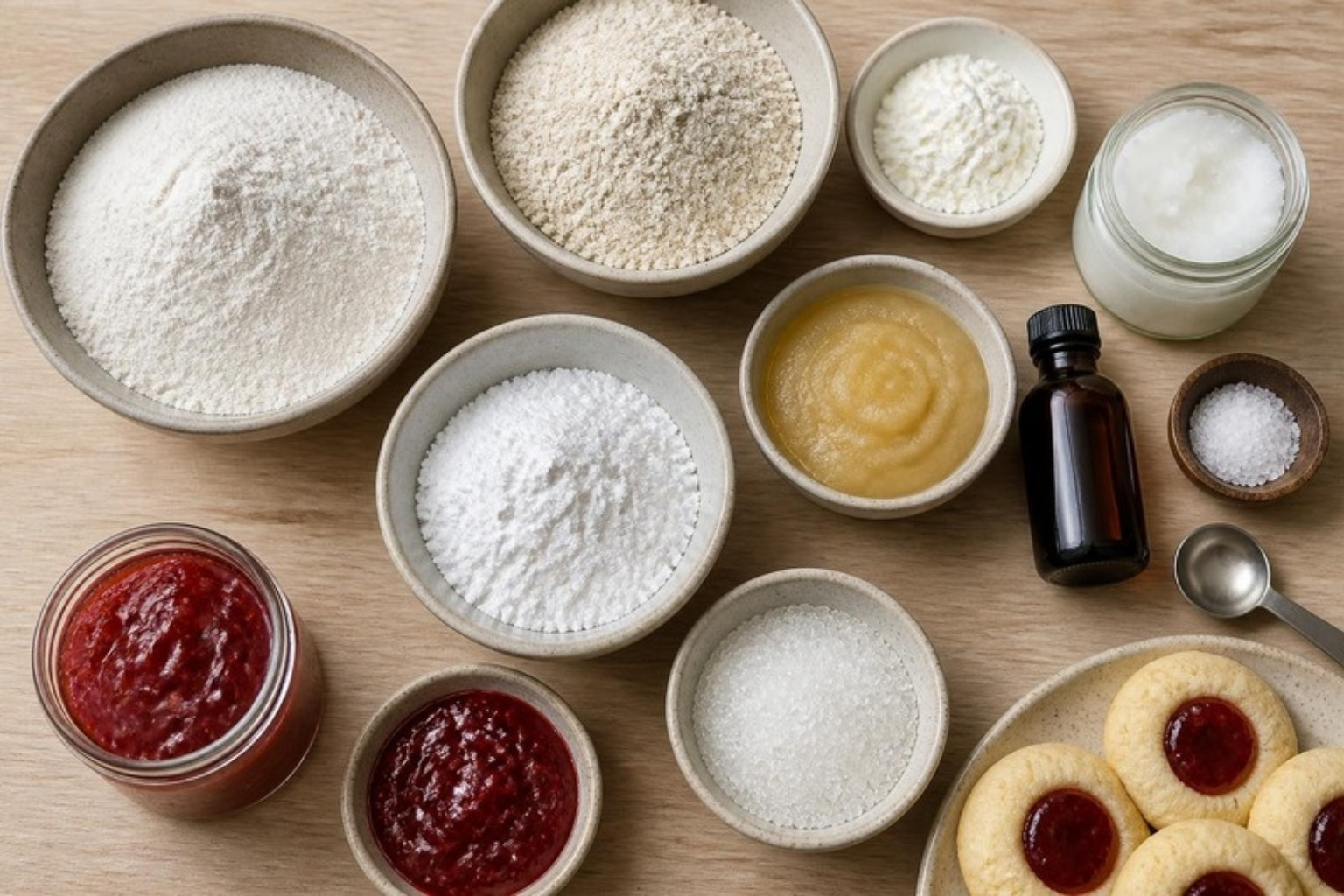
Jam Thumbprint Cookies, No Nuts (Top 9 Free)
Ingredients
Equipment
Method
- Heat the oven to 350°F (175°C) and line two baking sheets with parchment.
- Whisk the rice flour, oat flour, cornstarch, powdered sugar, and salt in a large bowl. Add the softened coconut oil, applesauce, and vanilla and mix with a spatula, then your hands, until it forms a smooth dough that holds together when squeezed. If it is crumbly, add cold water 1 teaspoon at a time.
- Scoop level 1-tablespoon portions and roll into smooth balls. Roll each ball in the sparkling sugar, if using, and set them 1 1/2 inches apart on the pans.
- Press the back of a 1/2-teaspoon measure (or your thumb) into the center of each ball to make a deep well. If the edges crack, pinch them back together.
- Chill the shaped cookies for 20 minutes so they hold their shape. Stir the jam until loose, then fill each well with about 3/4 teaspoon, keeping the jam level with the top.
- Bake 12 to 14 minutes, until the bottoms are lightly golden, the tops look dry and pale, and the jam is bubbling at the edges. Do not wait for the tops to brown, or the cookies will be hard.
- Cool on the pan for 10 minutes, then move to a rack. Top up any sunken wells with a little more jam while the cookies are still warm. Cool completely before stacking so the jam sets.
Notes
Troubleshooting & Tips
- Dough cracks when pressed: add cold water a teaspoon at a time, or let a chilled dough warm up for a few minutes.
- Cookies spread and the wells disappear: the coconut oil was too soft. Chill the shaped cookies longer, and re-press the wells gently with the measuring spoon halfway through baking.
- Jam ran over: use a thicker jam or less of it, and stir it smooth before filling.
- Jam sank after baking: top up with a little more jam while the cookies are warm.
Make-Ahead, Freezing & Gift Tins
Make ahead: shape the dough balls and freeze them unfilled on a tray, then bag them for up to 2 months. Thaw 15 minutes, press the wells, fill, and bake.
Freezing baked cookies: freeze in a single layer in an airtight container for up to 1 month. The jam may soften slightly after thawing.
Tins and gifting: let the jam set completely, at least 2 hours, before stacking. Store in a tin in a single layer or with parchment between layers for up to 5 days at room temperature. Mini paper cups keep each cookie neat in a gift box.
Fill out the tray with our classic shortbread cookies and chocolate chip cookies, and browse every holiday cookie and candy in our Christmas recipes collection.
FAQ
Are thumbprint cookies usually made with nuts?
Often, yes. Many traditional recipes roll the dough in chopped walnuts or pecans, and some use almond flour or almond extract. This version uses sparkling sugar for the coating and no nut ingredients.
Should I fill thumbprint cookies before or after baking?
Before. Baking the jam in the well sets it into a glossy, slightly chewy center that doesn’t smear in a tin. Top up any wells that sink while the cookies are warm.
How are these different from your shortbread cookies?
The shortbread is a rolled, cut-out cookie made with rice flour and sweet rice flour. These use oat flour too, plus applesauce for a softer dough that holds a jam-filled well.
Can I use a different filling?
Any thick jam or fruit preserve works. You can also fill baked, cooled cookies with melted dairy-free chocolate after checking its label for milk, soy lecithin, and added oils.
A note before you cook: These recipes are ideas and suggestions, not medical or dietary advice. As with any recipe or ingredient, it is each reader’s responsibility to confirm what they can and cannot eat, read every ingredient label, and source quality ingredients that fit their own needs. Ingredient formulations change, so always check the package you’re using.