
Holiday roasts are often where allergens sneak in: butter basting, flour-dredged gravies, bread stuffing in the middle, and seasoning blends with wheat or soy. If you cook for allergies, the centerpiece can feel like the riskiest part of Christmas dinner. A crown roast of pork keeps it simple. It’s a pork rib roast tied into a circle with the bones standing up like a crown, so it looks like a celebration, yet it needs nothing more than olive oil, garlic, fresh herbs, salt, and pepper.
The meat roasts slowly until it’s juicy and tender, with a browned garlic-herb crust. Apples and onions roast in the pan alongside it and fill the center of the crown at serving time, and the pan drippings turn into a quick apple cider sauce thickened with cornstarch instead of flour. Each rib becomes a thick chop, so carving at the table is easy.
Made without: peanuts, tree nuts, milk, eggs, wheat, soy, fish, shellfish, sesame.
Why You’ll Love This Crown Roast
- A dramatic Christmas centerpiece that’s mostly hands-off oven time.
- No butter, flour, bread stuffing, or bottled sauces.
- Garlic, rosemary, thyme, and sage give classic holiday flavor.
- Roasted apples and onions fill the crown, so the garnish is also a side dish.
- Serves 10 to 12, one rib chop each.
How It Works Without Butter, Flour, or Stuffing
Pork rib roasts have their own fat cap and marbling, so they don’t need butter basting to stay juicy. An olive oil and herb paste helps the outside brown and carries the garlic flavor into the meat. An optional dry brine, salting the roast a day ahead, seasons it all the way through and helps it hold onto its juices.
Many crown roast recipes cook bread stuffing in the center, which adds wheat and often egg and butter, and it slows the roast. Here, the center stays empty during cooking (a ball of foil holds the shape), so the heat circulates and the pork cooks evenly. For the sauce, cornstarch thickens the cider and pan juices into a glossy gravy without flour.
Ingredients and Swap Ideas
- Crown roast: order it from a butcher a week or two ahead in December, and ask for it frenched and tied. A 10- to 12-rib crown weighs about 8 to 10 pounds. Ask whether the pork is “enhanced” (injected with a salt solution that can include broth or flavorings); unenhanced pork is best for dry-brining.
- Extra-virgin olive oil: for the rub and the vegetables. Lard or bacon fat also work. Skip butter substitutes and cooking spray.
- Fresh herbs: rosemary, thyme, and sage. Use one-third the amount if dried.
- Apples and onions: firm apples such as Honeycrisp or Braeburn hold their shape. Pears work too.
- Broth and cider: check the broth label for wheat, soy, and added oils. Pure apple cider or unsweetened apple juice both work.
Equipment
- Large roasting pan or half-sheet pan with a rack
- Leave-in probe or instant-read thermometer (essential)
- Aluminum foil for the bone tips and center
- Large cutting board and a sharp carving knife
Step-by-Step Tips
- Dry-brine if you can. Salt the roast up to 24 hours ahead and refrigerate it uncovered for better seasoning and browning.
- Temper for an hour. A roast that starts closer to room temperature cooks more evenly.
- Protect the bones. Small foil caps keep the frenched tips from blackening.
- Sear, then roast low. Fifteen minutes at 450°F starts the crust; 325°F cooks the meat gently.
- Cook to temperature, not time. Pull the roast at 140°F in the thickest part of the meat, away from bone. It climbs to at least 145°F while resting, which is the USDA safe minimum for whole cuts of pork with a 3-minute rest.
- Rest 20 minutes. The juices settle back into the meat, and you have time to make the sauce.
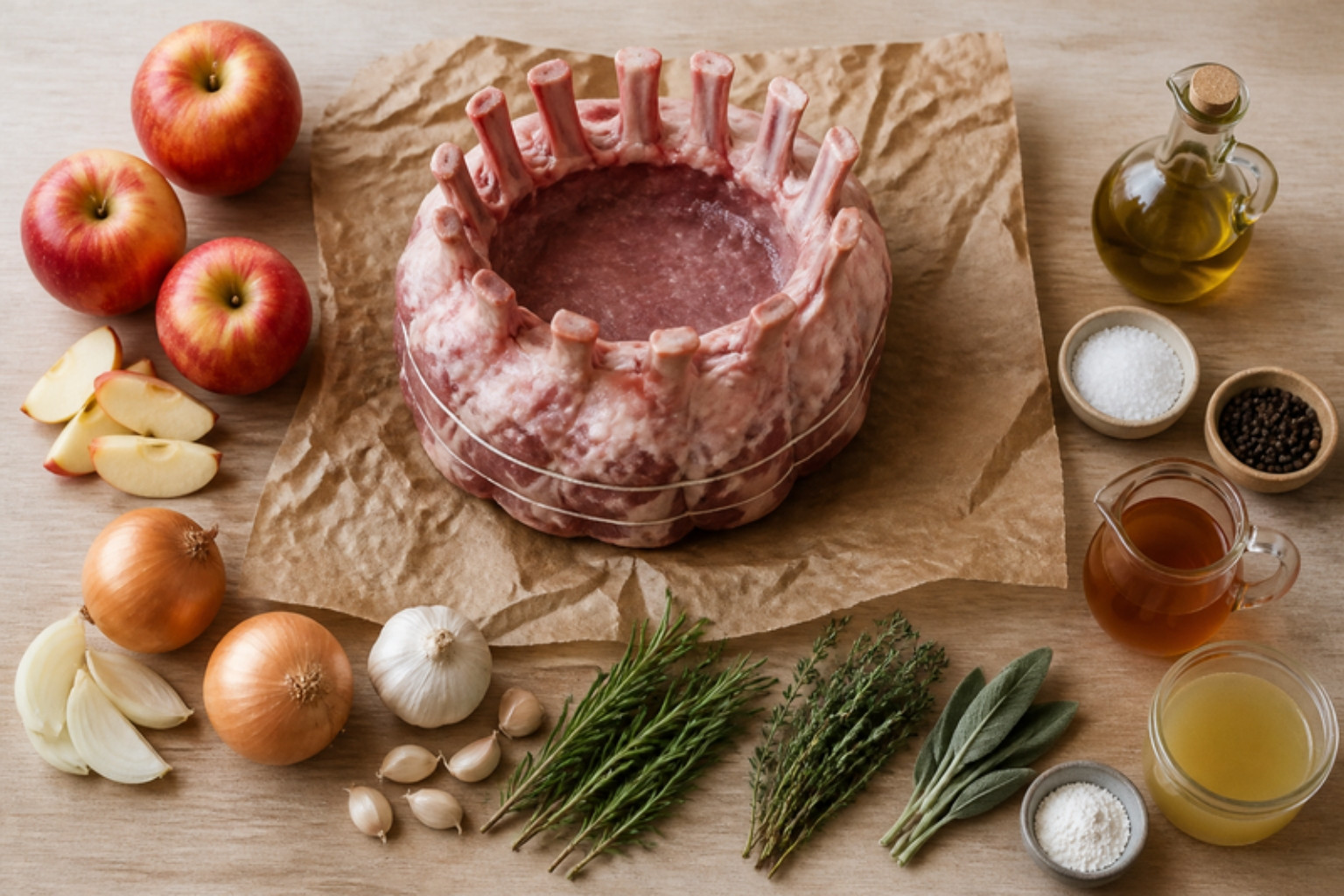
Crown Roast of Pork with Garlic Herb Rub and Cider Pan Sauce
Ingredients
Equipment
Method
- Optional dry brine: up to 24 hours ahead, pat the roast dry, sprinkle the salt all over, and refrigerate uncovered on a rack. Otherwise salt it right before rubbing.
- One hour before roasting, take the roast out of the fridge. Heat the oven to 450°F (230°C) with a rack in the lower third.
- Stir the olive oil, garlic, rosemary, thyme, sage, and pepper (and the salt, if you didn’t dry-brine). Pat the roast dry and rub the paste over all the meat, inside and out. Wrap the exposed bone tips in small pieces of foil so they don’t burn.
- Set the roast on the rack in the pan, bones up. Toss the apples and onions with 1 tbsp olive oil and scatter them around the roast. Stuff a ball of foil in the center to help it keep its shape.
- Roast 15 minutes at 450°F, then lower the oven to 325°F (165°C). Roast 2 to 2 3/4 hours more (about 15 to 18 minutes per pound), until a thermometer in the thickest part of the meat, not touching bone, reads 140°F (60°C). Start checking at 1 1/2 hours. Stir the apples and onions once; if they brown too fast, add 1/2 cup water to the pan.
- Transfer the roast to a board, tent loosely with foil, and rest 20 minutes. The temperature will rise to at least 145°F (63°C). Move the apples and onions to a bowl.
- Pour off all but 2 tablespoons of fat from the pan. Set the pan over medium heat, add the cider and broth, and scrape up the browned bits. Simmer 5 minutes, until reduced by about a third.
- Whisk in the cornstarch slurry and simmer 1 minute, until glossy and lightly thickened. Season with vinegar, salt, and pepper.
- Remove the foil from the bones and the center. Fill the center with the roasted apples and onions, then carve between the ribs into chops. Serve with the sauce.
Notes
Troubleshooting
- Outside browning too fast: tent the top loosely with foil and keep roasting.
- Done early: tent with foil and rest up to 45 minutes; it stays warm. Don’t hold it in a hot oven.
- Uneven doneness: check the temperature in two or three spots between the ribs and go by the lowest reading.
- Thin sauce: simmer another minute after adding the slurry; cornstarch thickens fully only at a bubble.
Make-Ahead, Storage, and Freezing
Mix the herb paste up to 2 days ahead and keep it in the fridge. The roast can be dry-brined the day before. Refrigerate leftovers within 2 hours, sliced off the bone, for up to 4 days. To freeze, pack sliced pork with a spoonful of sauce in freezer containers for up to 3 months; thaw in the refrigerator and reheat covered at 325°F until hot. Leftover chops are great sliced thin for sandwiches or diced into a breakfast hash.
More for Christmas Dinner
Browse the Dinner and Sides aisle on our Christmas recipes page. Serve the roast with hasselback potatoes and sweet potato biscuits. For a smaller pork dinner, try the pork tenderloin with apples and onions.
FAQ
How big a crown roast do I need?
Plan on one rib per person. A 10- to 12-rib roast serves 10 to 12, or fewer with leftovers.
How long does a crown roast take?
About 15 to 18 minutes per pound at 325°F after the initial sear, so 2 to 2 3/4 hours for an 8- to 10-pound roast. Always confirm with a thermometer.
Can I put stuffing in the center?
You can, but it slows cooking and the stuffing must reach 165°F. Baking it separately and spooning it in at serving time is easier.
Is pork safe at 145°F if it’s a little pink?
The USDA lists 145°F with a 3-minute rest as the minimum for whole cuts of pork. The center may look slightly pink at that temperature.
A note before you cook: These recipes are ideas and suggestions, not medical or dietary advice. As with any recipe or ingredient, it is each reader’s responsibility to confirm what they can and cannot eat, read every ingredient label, and source quality ingredients that fit their own needs. Ingredient formulations change, so always check the package you’re using.