
Most pork tenderloin with apples recipes lean on two things allergy families often skip: a spoonful of Dijon mustard in the sauce and a knob of butter to finish it. Take both out and the sauce can turn thin and flat. This version builds flavor another way. The tenderloins get a hard sear in a skillet, roast on a bed of apples and onions, and then the pan juices become a glossy apple cider sauce thickened with a little cornstarch.
The result is juicy, blush-pink pork, soft caramelized apples, sweet onions, and a tangy-sweet sauce that tastes like fall. It all happens in one oven-safe skillet in about an hour, with most of that time hands-off. It’s a fit for a weeknight, and polished enough for company.
Made without: peanuts, tree nuts, milk, eggs, wheat, soy, fish, shellfish, sesame.
Why You’ll Love This Pork Tenderloin with Apples
- One skillet from stovetop to oven and back to the stovetop for the sauce.
- Pork tenderloin is lean, tender, and quick-cooking, so dinner is done in under an hour.
- A real pan sauce with no butter, cream, flour, or mustard.
- Apples and onions roast in the pork juices, so the side dish is built in.
- Feeds six, and leftovers make great sandwiches or rice bowls.
How the Sauce Works Without Mustard or Butter
In a classic French-style pan sauce, Dijon helps emulsify the liquid and adds sharpness, and cold butter whisked in at the end gives body and shine. Here, apple cider vinegar brings the sharpness and cornstarch brings the body. A cornstarch slurry needs to boil for about a minute to reach full thickness, and it leaves a clear, glossy sauce that clings to the sliced pork. The browned bits left from searing the pork and cooking the onions (the fond) do the rest, adding the deep, savory flavor that keeps the sauce from tasting only of apple.
Ingredients and Swap Ideas
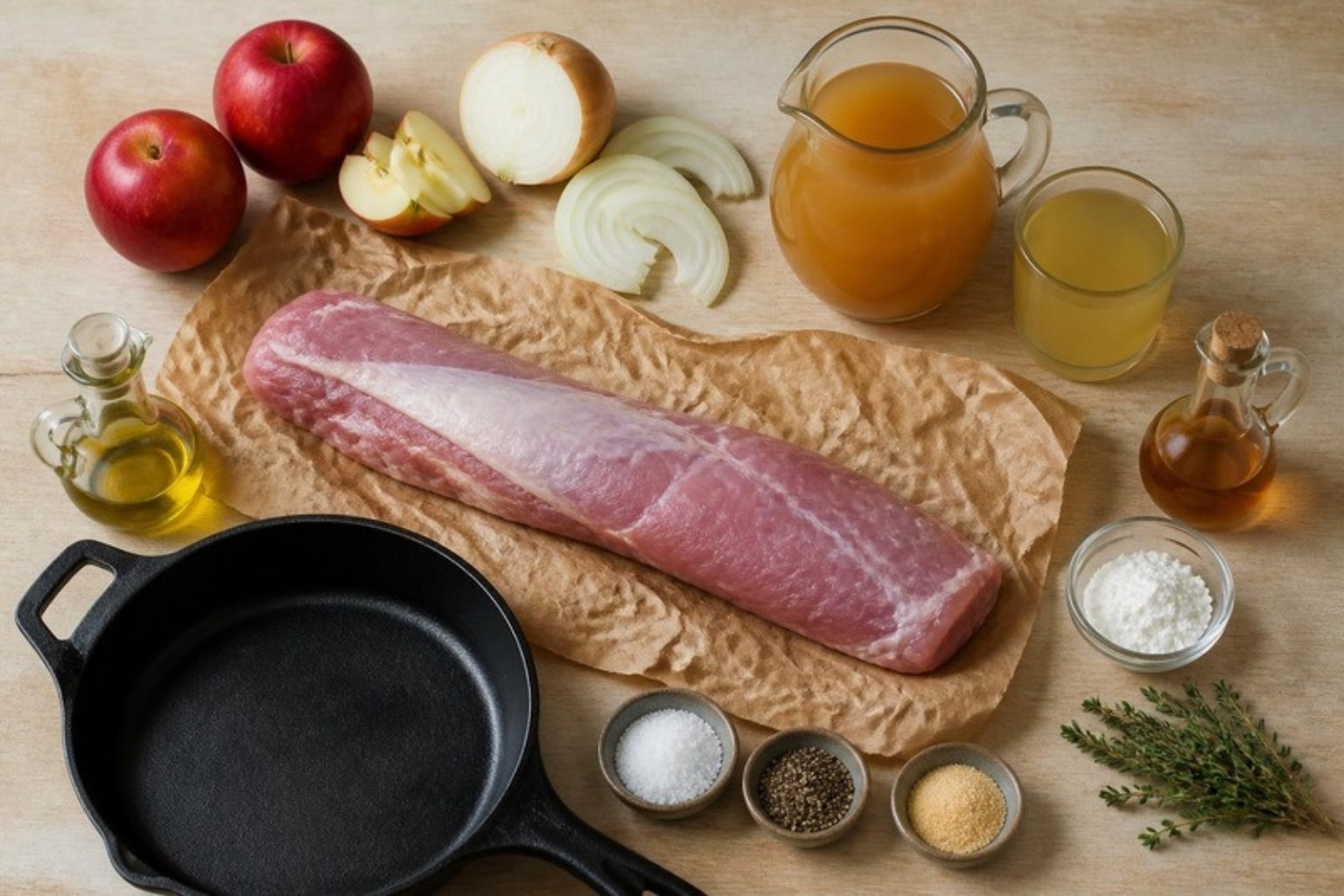
- Pork tenderloins (2, about 2 1/2 lb / 1.1 kg total): buy plain tenderloins. Many are sold pre-marinated or “enhanced” with a salt solution that can contain flavorings, so check the label.
- Seasoning: kosher salt, dried thyme, garlic powder, and black pepper (single-ingredient spices).
- Light-tasting olive oil (3 tbsp / 40 g): its higher smoke point suits searing. “Light” means refined and mild-flavored, not fewer calories. Lard or bacon fat are good swaps.
- Apples (2 medium, about 400 g): firm varieties like Honeycrisp, Braeburn, or Granny Smith hold their shape. Softer apples like McIntosh collapse into a sauce.
- Yellow onion (1 large, 250 g): shallots work too.
- Apple cider (1 cup / 240 ml): sweet cider or 100% apple juice. Not hard cider.
- Chicken broth (1/2 cup / 120 ml): read the label for wheat, soy, yeast extract, and added oils.
- Apple cider vinegar, cornstarch, water, fresh thyme. Use cider vinegar rather than malt vinegar, which is made from barley.
Kitchen Equipment
- 12-inch oven-safe skillet: cast iron or stainless steel. Nonstick pans don’t build fond and many aren’t oven-safe at 400°F.
- Instant-read thermometer. It’s the most reliable way to keep tenderloin juicy.
- An oven mitt. Keep it on the skillet handle after it leaves the oven; the handle stays dangerously hot.
Step-by-Step Tips
- Trim the silver skin. Slide a thin knife under the shiny membrane and cut it away; it turns chewy when cooked.
- Season and rest. Ten to fifteen minutes lets the salt start working while you slice the apples and onion.
- Sear hard. Get the oil shimmering and leave the pork alone for about 2 minutes per side. A deep golden crust means flavor in the pan.
- Brown the apples and onions in the drippings, scraping as they release moisture.
- Roast to temperature, not time. Pull the pork at 145°F (63°C) in the thickest part. The thinner tenderloin may be ready a few minutes sooner.
- Rest, then make the sauce. While the pork rests, reduce the cider, broth, and vinegar, then whisk in the slurry and boil 1 minute until glossy.
The USDA recommends cooking whole cuts of pork to 145°F with a rest of at least 3 minutes; see the USDA safe temperature chart. At that temperature, tenderloin is slightly pink in the center and very juicy.
Pork Tenderloin with Apples and Onions
Ingredients
Equipment
Method
- Pat the tenderloins dry and trim off the shiny silver skin. Mix the salt, thyme, garlic powder, and pepper and rub it all over the pork. Let stand 10 to 15 minutes while you slice the apples and onion. Heat the oven to 400°F (200°C).
- Heat 2 tablespoons of the light-tasting olive oil in a 12-inch oven-safe skillet over medium-high heat until it shimmers. Add the tenderloins and sear without moving for about 2 minutes per side, turning to brown all sides, 8 to 10 minutes total, until a deep golden crust forms. Move the pork to a plate.
- Lower the heat to medium. Add the remaining 1 tablespoon oil, the onion, and the apples. Cook, stirring now and then, 5 to 6 minutes, until the onion softens and the apple edges turn golden. Scrape up the browned bits as the onion releases moisture.
- Nestle the pork and any juices on top of the apples and onions and tuck in the thyme sprigs. Transfer the skillet to the oven and roast 12 to 18 minutes, until an instant-read thermometer in the thickest part of each tenderloin reads 145°F (63°C). Check the thinner one early.
- Using an oven mitt (the handle is very hot), take out the skillet. Move the pork to a cutting board, tent loosely with foil, and rest at least 3 minutes. Spoon the apples and onions onto a platter, leaving the juices in the pan.
- Set the skillet over medium-high heat (keep the mitt on the handle). Add the cider, broth, and vinegar and simmer 3 to 4 minutes, scraping the pan, until reduced by about a third. Stir the cornstarch into the cold water, whisk it into the simmering liquid, and boil 1 minute, until the sauce turns glossy and coats a spoon. Taste and add salt if needed.
- Slice the pork 1/2 inch thick. It should be blush pink in the center and juicy. Arrange over the apples and onions, pour the pan sauce over, and finish with thyme leaves.
Notes
Troubleshooting and Tips
- Pork is dry: it went past 145°F. Start checking at 12 minutes. Tenderloin goes from perfect to overcooked quickly.
- Sauce is thin: it didn’t fully boil after the slurry went in. Bring it back to a bubble for another 30 to 60 seconds.
- Sauce is too sweet: add another teaspoon of cider vinegar and a pinch of salt.
- Fond burned while searing: lower the heat slightly before adding the onions; their moisture will lift the darker bits. Discard anything black and bitter.
Storage, Freezing, and Reheating
Refrigerate the sliced pork with the apples, onions, and sauce in an airtight container up to 3 days. Reheat gently in a covered skillet over medium-low with a splash of cider or broth until it reaches 165°F (74°C). High heat dries out tenderloin. To freeze, pack the sliced pork in the sauce for up to 2 months and thaw overnight in the fridge; the apples will be softer after thawing.
For sides, spoon it over creamy dairy-free mashed potatoes or serve with sweet and sour braised red cabbage with apples. If you like the cider-and-pork pairing on the grill, try our grilled apple cider brined pork chops.
FAQ
Is it OK for pork tenderloin to be pink?
The USDA guideline for whole cuts of pork is 145°F followed by a rest of at least 3 minutes. Pork cooked to that temperature is often slightly pink in the center. Go by the thermometer, not the color.
Can I use pork loin instead of tenderloin?
Yes, but a pork loin roast is much thicker. Sear it the same way and expect 35 to 50 minutes in the oven to reach 145°F. Add the apples and onions partway through so they don’t overcook.
What can I use instead of cornstarch?
Arrowroot or tapioca starch thicken the sauce similarly. Use the same amount, and add it at the very end, since they thin if boiled too long. Wheat flour would change the made-without list.
Why no mustard?
Mustard is a seed and a common allergen in some countries, and many families avoid it. Cider vinegar gives the sauce the same bright, tangy edge.
A note before you cook: These recipes are ideas and suggestions, not medical or dietary advice. As with any recipe or ingredient, it is each reader’s responsibility to confirm what they can and cannot eat, read every ingredient label, and source quality ingredients that fit their own needs. Ingredient formulations change, so always check the package you’re using.