
If you’ve searched for stuffing balls and found that nearly every recipe starts with a bag of wheat bread cubes, two beaten eggs, and a stick of butter, this one takes a different route. These bite-size stuffing balls are made from day-old wheat-free cornbread, browned pork sausage, onion, celery, sage, and thyme, then rolled and baked until the outsides are deep golden and crisp while the centers stay soft and savory. Instead of eggs, a quick potato-starch broth gel holds them together. They are a party-friendly way to serve stuffing before the main meal, and they’re made without peanuts, tree nuts, milk, eggs, wheat, soy, fish, shellfish, and sesame.
Shape them a day ahead, bake them while the turkey rests, and set them out on picks with a bowl of cranberry sauce for dipping.
Made without: peanuts, tree nuts, milk, eggs, wheat, soy, fish, shellfish, sesame.
Why You’ll Love These Stuffing Balls
- All the stuffing flavor in one bite: sage, thyme, sausage, onion, and celery.
- Crisp outside, tender inside, like the best corner pieces of the casserole.
- No eggs and no commercial egg replacer: a simple starch gel does the binding.
- Make-ahead and freezer-friendly, which frees up the oven on the big day.
- Easy to serve: no spoons, no casserole dish, just a platter and picks.
How Stuffing Balls Hold Together Without Eggs
In most stuffing ball recipes, eggs do one job: they coat the crumbs and set in the oven, gluing everything into a ball. Here, potato starch whisked into cold broth and heated for a minute or two turns into a translucent, gravy-thick gel. Folded into the crumbs while warm, it coats every piece the way beaten egg would, then firms up as the balls bake and cool. Cornbread helps too: its fine crumb packs together more readily than dry bread cubes.
The other key is pressure. Squeeze the mixture with your hands before scooping, and press each ball firmly as you roll it. If a pressed handful holds its shape, it will hold in the oven.
Ingredients & Swap Ideas
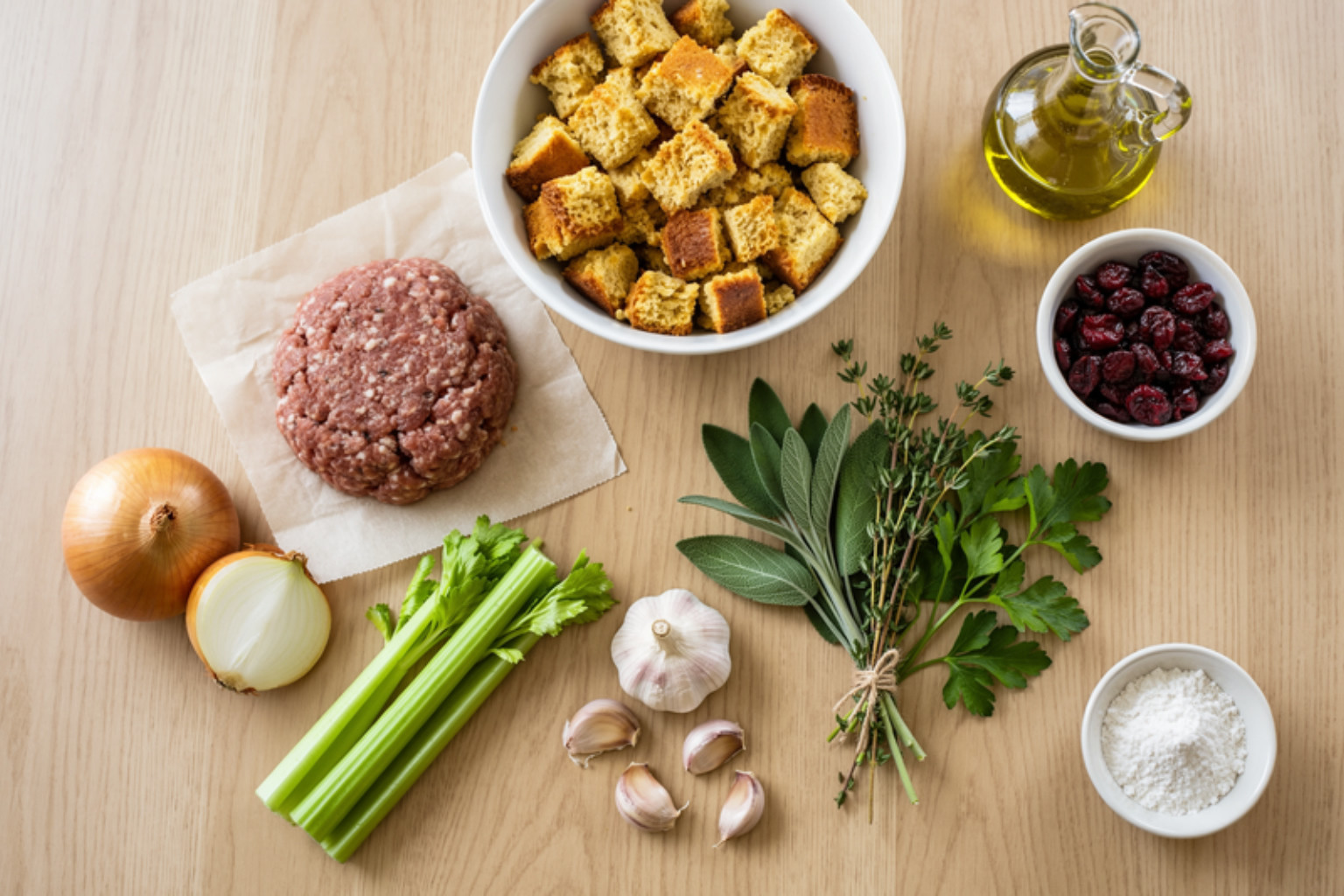
- Day-old cornbread (8 cups / 680 g crumbled): one batch of our skillet cornbread with no eggs, milk, or wheat is exactly right. Boxed mixes and bakery cornbread usually contain wheat, milk, or eggs. The cornbread uses oat milk, so pick oat milk with no added oil and certified gluten-free oats.
- Pork sausage (1 lb / 450 g): our homemade maple sage sausage mixture works raw and crumbled. Store-bought sausage can contain milk powder, soy, wheat fillers, or seed oils; read the label. Ground turkey seasoned with extra sage is a leaner swap.
- Extra-virgin olive oil (3 tablespoons): for browning the sausage and coating the pans. Bacon fat or lard can stand in. Skip butter, plant butters, and cooking spray.
- Onion, celery, garlic, sage, thyme, parsley: the classic stuffing aromatics. Use dried herbs at about one-third the amount.
- Low-sodium chicken broth (1 1/4 cups / 300 ml): check for added oils, soy, or wheat. Turkey broth works too.
- Potato starch (3 tablespoons / 27 g): the binder. Tapioca starch or cornstarch also gel, though cornstarch sets a little softer.
- Dried cranberries (optional, 1/3 cup): many brands coat them in sunflower oil, so look for ones without added oil, or skip them.
Kitchen Equipment
- 2 rimmed sheet pans
- Large skillet
- Small saucepan and whisk
- Large mixing bowl
- 2-tablespoon cookie scoop
- Instant-read thermometer
Step-by-Step Tips
- Dry the crumbs. Fresh cornbread turns pasty. Bake the crumbs at 300°F until they feel dry and the edges barely crisp, or use cornbread that’s 1–2 days old.
- Crumble the sausage small. Pea-size bits spread through every ball; big chunks make them fall apart. Cook until no pink remains (160°F for ground pork, per the USDA safe temperature chart).
- Soften the vegetables fully. Raw celery stays crunchy inside a ball and pushes it apart.
- Watch the binder change. It starts milky and turns glossy and translucent as it thickens. Pull it as soon as it looks like gravy.
- Do the squeeze test. A pressed handful should hold. Add broth by the tablespoon if it crumbles.
- Roll in the oil on the pan. It coats the outside evenly without a brush and gives the crisp, golden crust.
- Bake to 165°F in the center, the USDA guideline for stuffing, until deep golden. Rest 5 minutes before moving them.
Cornbread Stuffing Balls (No Eggs, No Wheat)
Ingredients
Equipment
Method
- Dry the crumbs: spread the crumbled cornbread on a sheet pan and bake at 300°F (150°C) for 15–20 minutes, until the crumbs feel dry and the edges just start to crisp. Cool. (Skip if the cornbread is already 1–2 days old and dry.) Raise the oven to 400°F (200°C).
- Brown the sausage in 1 tablespoon olive oil in a large skillet over medium-high heat, breaking it into very small crumbles, 7–9 minutes, until no pink remains and the bits are browned (160°F / 71°C). Lift it out with a slotted spoon, leaving about 2 tablespoons of fat in the pan.
- Lower the heat to medium. Cook the onion and celery in the fat for 6–8 minutes, until soft and translucent. Stir in the garlic, sage, and thyme and cook 1 minute, until fragrant.
- Make the binder: whisk the potato starch into the cold broth in a small saucepan until smooth. Cook over medium heat, whisking constantly, 1–2 minutes, until it turns from milky to translucent and thickens like gravy. Take it off the heat.
- In a large bowl, combine the crumbs, sausage, vegetables, parsley, cranberries, salt, and pepper. Pour the warm binder over and fold, then squeeze with your hands until a handful holds together when pressed. If it still crumbles, add broth 1 tablespoon at a time.
- Brush two sheet pans with the remaining 2 tablespoons olive oil. Scoop 2-tablespoon portions, press firmly, and roll into 1 1/2-inch balls (about 30). Set them 1 inch apart and roll each in the oil on the pan so the tops are lightly coated.
- Bake 20–25 minutes, turning once halfway, until deep golden and crisp outside and 165°F (74°C) in the center. Rest 5 minutes so they firm up before serving.
Notes
Troubleshooting & Tips
- Balls crumbling as you roll: the crumbs are too dry or the binder went in cold. Add 1–2 tablespoons warm broth and squeeze again.
- Balls flattening in the oven: the mixture is too wet. Fold in another cup of dried crumbs, or chill the shaped balls 20 minutes before baking.
- Pale outsides: make sure each ball is rolled in oil, and bake on the upper-middle rack for the last 5 minutes.
- Too salty: sausage and broth vary widely. Taste the mixture before adding the salt; you may not need it.
Storage, Freezing & Reheating
Make ahead: shape the balls up to 24 hours ahead, cover, and refrigerate on the oiled pans; add 3–5 minutes to the bake. Refrigerate baked balls up to 4 days and reheat at 375°F for 8–10 minutes, until hot (165°F) in the center. Freeze baked, cooled balls on a tray, then bag them for up to 2 months; reheat from frozen at 375°F for 15–18 minutes.
More Thanksgiving Appetizers and Sides
Prefer stuffing by the scoop? Our old-fashioned Thanksgiving stuffing uses the same cornbread base in a casserole. For more bites, try sausage stuffed mushrooms or the cranberry meatballs with no eggs or breadcrumbs, and find the whole menu on our Thanksgiving recipes page.
FAQ
How do you make stuffing balls without eggs?
Heat potato starch with broth until it thickens into a gel, fold it into the crumbs while warm, and press the balls firmly. The gel coats the crumbs the way beaten egg would and sets as the balls bake.
Can I make stuffing balls ahead of time?
Yes. Shape them up to a day ahead and refrigerate, or bake and freeze them for up to 2 months. Reheat until the centers reach 165°F.
Can I use leftover stuffing?
Yes. Leftover cornbread stuffing usually needs only a few tablespoons of the potato-starch binder to roll. Bake as directed until hot in the center.
What do you serve with stuffing balls?
Cranberry sauce or warm turkey gravy for dipping. They also fit on a Thanksgiving snack board next to cured meats and fruit.
A note before you cook: These recipes are ideas and suggestions, not medical or dietary advice. As with any recipe or ingredient, it is each reader’s responsibility to confirm what they can and cannot eat, read every ingredient label, and source quality ingredients that fit their own needs. Ingredient formulations change, so always check the package you’re using.
Leave a Reply