
Holiday candy is one of the hardest things to find without milk, nuts, soy, or wheat. Store-bought boxes are full of milk chocolate, nut clusters, and “may contain” statements. Candied orange peel is the opposite: an old-fashioned Christmas candy made from oranges, sugar, and water. Grandmothers made it so nothing from the holiday fruit bowl went to waste, and it’s still one of the prettiest edible gifts you can pack in a tin.
The peel is blanched three times to tame its bitterness, simmered slowly in syrup until it turns glossy and translucent, then rolled in sugar and left to dry. You end up with chewy, jewel-like strips that taste intensely of orange, with a pleasant bittersweet edge, plus a jar of orange syrup as a bonus. It’s made without milk, eggs, wheat, soy, peanuts, tree nuts, fish, shellfish, and sesame, and there’s no added fat at all.
Made without: peanuts, tree nuts, milk, eggs, wheat, soy, fish, shellfish, sesame.
Why You’ll Love Candied Orange Peel
- Three ingredients (plus an optional spoonful of corn syrup and a cinnamon stick).
- A real edible gift that keeps for weeks at room temperature and months in the fridge or freezer.
- Uses what you’d throw away. Eat the oranges, candy the peels.
- Hands-off. Most of the time is gentle simmering and air-drying.
- Versatile: eat it as candy, chop it into cookies and quick breads, or use it to decorate cakes.
How Candied Peel Works
Orange peel has two layers: the colorful zest, full of fragrant oils, and the white pith, which is spongy and bitter. Blanching the peel in fresh water three times pulls out much of that bitterness and softens the pith so it can absorb sugar. Then a long, gentle simmer in syrup slowly replaces the water in the peel with sugar. That’s what turns the pith translucent and makes the candy shelf-stable. Rushing it with a hard boil makes the outside tough before the inside is candied.
A thermometer is helpful but not essential. When the syrup reaches about 225 to 230°F (107 to 110°C), it’s thick enough to coat a spoon, and the strips look glossy and see-through. That’s your cue they’re ready.
Ingredients & Swap Ideas
- Navel oranges (4 large, about 900 g): thick-skinned oranges give meatier strips. Many store oranges are waxed, so scrub them well in warm water or look for unwaxed fruit.
- Other citrus: lemons, tangelos, and grapefruit all work. Grapefruit is more bitter, so give it a fourth blanch.
- Granulated sugar (400 g for syrup, 200 g for coating): plain white sugar gives the clearest, brightest color.
- Light corn syrup (optional): a tablespoon helps keep the syrup from crystallizing. Check the label.
- Cinnamon stick (optional): or a few cloves or a strip of fresh ginger for a spiced version.
- Chocolate-dipped variation: if you’d like to dip the ends in dark chocolate, read the label carefully. Many dark chocolates contain milk or soy lecithin or are made on shared lines, and some candy coatings and “melting wafers” use seed oils.
Kitchen Equipment
- A sharp paring knife.
- A heavy 3- to 4-quart saucepan.
- A candy or instant-read thermometer (helpful).
- A wire rack set over a parchment-lined baking sheet, a slotted spoon, and a strainer.
Step-by-Step Tips
- Peel in quarters. Score the peel top to bottom and pull it off in big pieces; they’re easier to slice evenly.
- Keep strips even, about 1/4 inch (6 mm) wide, so they candy at the same rate. Trim very thick pith.
- Start every blanch in cold water. Bring to a boil, boil 2 minutes, drain, and repeat twice more.
- Simmer gently. Small, lazy bubbles only. Stir now and then so the strips cook evenly.
- Watch the pith, not the clock. When the white part is fully translucent all the way through, they’re done.
- Dry before sugaring. Tacky strips hold a thin, even coat; dripping strips turn the sugar into a syrupy paste.
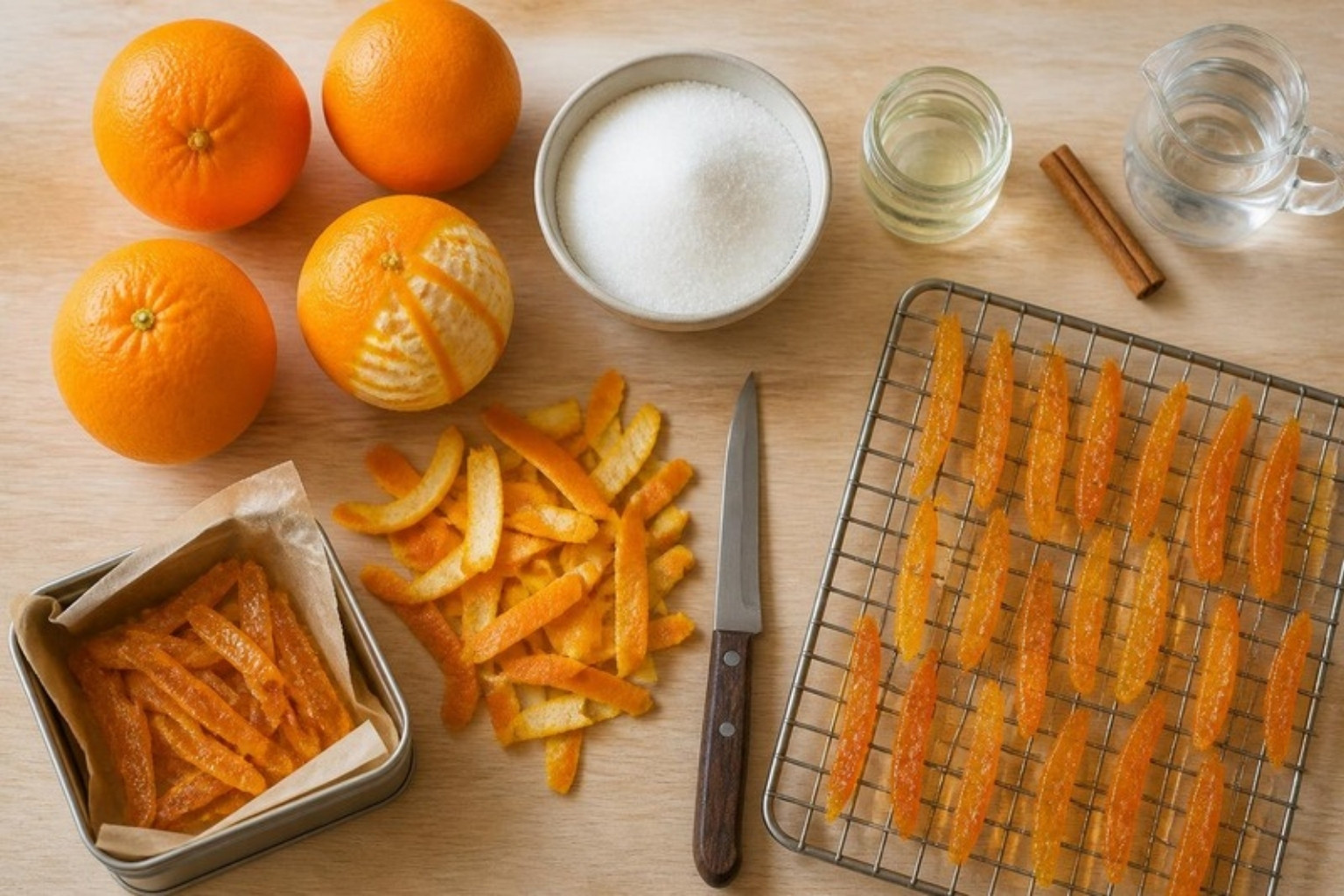
Candied Orange Peel (Top 9 Free Edible Gift)
Ingredients
Equipment
Method
- Scrub the oranges in warm water and dry. Score each peel into quarters from top to bottom and pull the peel off in large pieces (save the fruit for eating).
- Slice the peel into strips about 1/4 inch (6 mm) wide. If the white pith is thicker than about 1/4 inch, trim some away with a paring knife, leaving a thin layer.
- Put the strips in a saucepan, cover with cold water by 2 inches, and bring to a boil. Boil 2 minutes, then drain. Repeat two more times with fresh cold water. This removes most of the bitterness; the peel should look slightly translucent at the edges and bend easily.
- In the same pan, bring the 2 cups sugar, 1 1/2 cups water, corn syrup (if using), salt, and cinnamon stick to a simmer, stirring until the sugar dissolves.
- Add the drained peel and adjust the heat to the gentlest simmer, with small bubbles only. Cook uncovered 45 to 60 minutes, stirring occasionally, until the pith is fully translucent, the strips look glossy and jewel-like, and the syrup has thickened to about 225 to 230°F (107 to 110°C).
- Lift the peel out with a slotted spoon onto a wire rack set over parchment, separating the strips. Save the syrup in a jar for drinks, pancakes, or glazing cakes.
- Let the strips drain and dry 1 to 2 hours, until tacky but no longer dripping.
- Toss the strips in the coating sugar a handful at a time, return them to the rack, and air-dry 12 to 24 hours, until the sugar crust is dry and the peel is firm but still chewy inside.
Notes
Troubleshooting
- Too bitter: blanch one or two more times next batch, and trim more of the pith.
- Tough or hard strips: the syrup boiled too hard or cooked too far past 230°F. Keep the heat low.
- Syrup crystallized: sugar stuck to the pan sides fell back in. Add the optional corn syrup, and brush the pan sides with a wet pastry brush as it simmers.
- Sugar coating dissolved: the peel was too wet or the room is humid. Let it dry longer, then toss in fresh sugar.
Storage, Freezing & Gifting
Store: keep the finished peel in an airtight container at cool room temperature for up to 1 month, or refrigerate for up to 3 months. Layer it between sheets of parchment so the strips don’t stick together.
Freeze: freeze in an airtight container for up to 6 months. Thaw with the lid on so moisture doesn’t form on the sugar.
Gift tins and bags: pack the peel in small tins or cellophane bags lined with parchment, and tie with twine. Keep it separate from soft cookies, which can pass along moisture. A small jar of the leftover orange syrup makes a nice addition to the gift, labeled with its ingredients.
More Christmas Treats
Browse every cookie, candy, and holiday dish in our Christmas recipes hub. Candied peel makes a pretty partner in a tin with classic shortbread cookies, and you can chop a few strips into the dough for an orange variation. For a soft cookie on the same tray, try the soft snickerdoodles.
FAQ
Do I have to blanch the peel three times?
For orange peel, three times gives a pleasant bittersweet flavor. If you like a sharper, more marmalade-like bite, two blanches will do. Grapefruit usually needs four.
What can I do with the leftover syrup?
Strain it into a clean jar and refrigerate for up to a month. Stir it into sparkling water or tea, drizzle it over pancakes, or brush it over a cooled cake for extra orange flavor.
How do I use candied orange peel in baking?
Chop it finely and fold it into cookie dough, quick breads, or muffins. You can also skip the sugar coating for pieces you plan to bake with; just let them dry until tacky and store them in a jar.
Why is my peel still white in the middle?
It needs more time in the syrup. Return it to the pan and keep simmering gently until the pith is translucent all the way through.
A note before you cook: These recipes are ideas and suggestions, not medical or dietary advice. As with any recipe or ingredient, it is each reader’s responsibility to confirm what they can and cannot eat, read every ingredient label, and source quality ingredients that fit their own needs. Ingredient formulations change, so always check the package you’re using.