
Snowball cookies, also known as Russian tea cakes or Mexican wedding cookies, show up on nearly every Christmas cookie tray, and nearly every recipe for them is built on butter, wheat flour, and finely chopped pecans or walnuts. If nuts are off the table in your house, these are usually the first cookies you skip at a cookie exchange.
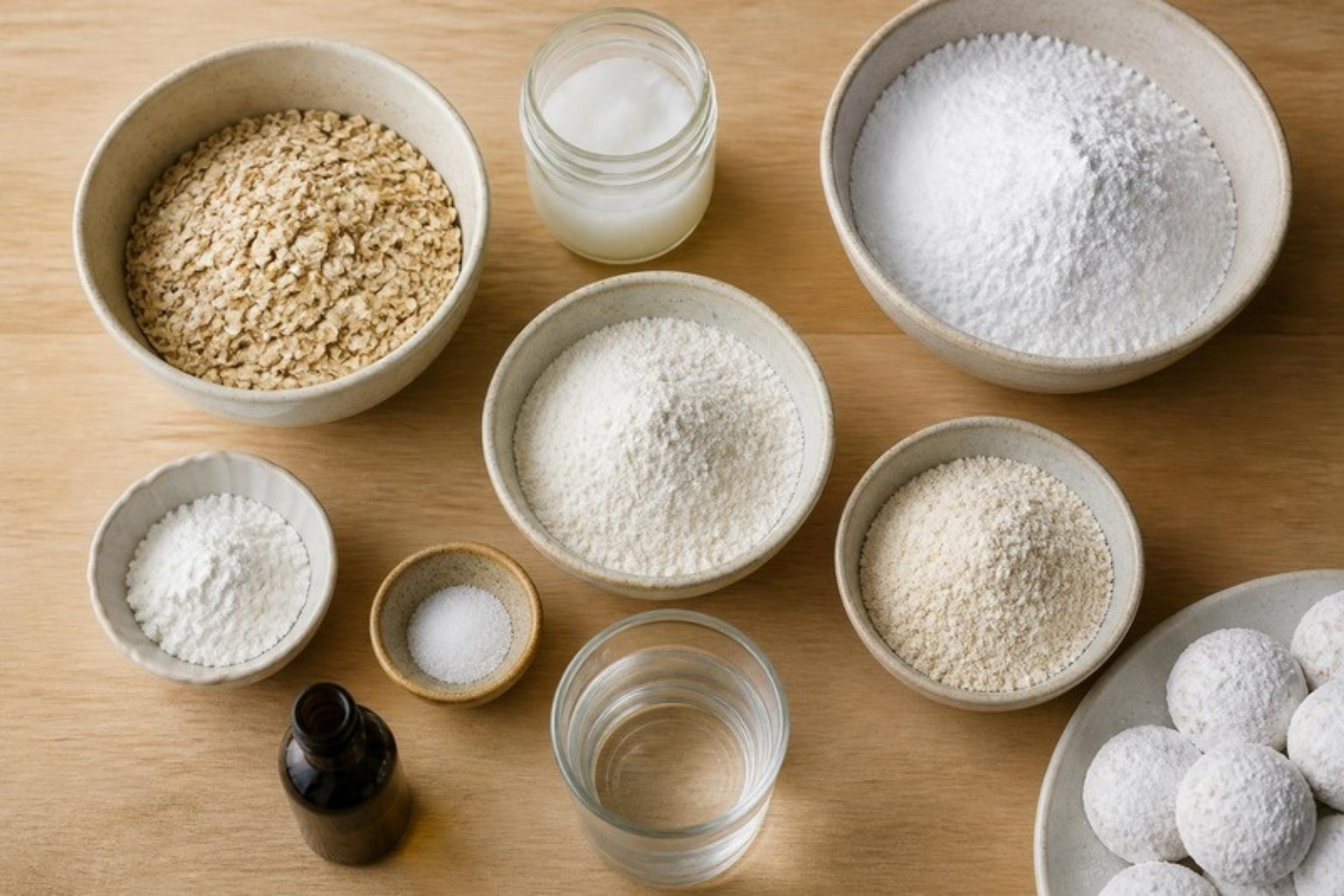
This nut-free version keeps everything people love about snowball cookies: the round, bite-sized shape, the tender, sandy crumb that melts in your mouth, and the thick snowy coat of powdered sugar. The nuts are replaced with toasted rolled oats, crushed to the size of chopped pecans, which bring the same toasty flavor and little bits of crunch. (Lightly crushed crisp rice cereal works too.) The dough is made with white rice flour, certified gluten-free oat flour, cornstarch, and refined coconut oil, and the cookies get rolled in powdered sugar twice, once warm and once cool.
Made without: peanuts, tree nuts, milk, eggs, wheat, soy, fish, shellfish, sesame. (Contains coconut; see swaps.)
Why You’ll Love These Snowball Cookies
- The classic melt-away texture and snowy look, with no pecans, walnuts, or almonds.
- Toasted oats add a nutty flavor and gentle crunch.
- Only a handful of ingredients, and no eggs, butter, wheat, or egg replacer.
- They keep for two weeks in a tin and freeze for months, which makes them great for baking ahead.
How Snowball Cookies Work Without Nuts, Butter, or Wheat
In a traditional snowball cookie, the ground nuts do two jobs: they add rich, toasty flavor, and they break up the dough so it’s short and crumbly instead of chewy. Toasting oats until golden develops a similar nutty flavor, and crushing them into coarse crumbs gives the same tender, interrupted texture. Snowball cookies already contain no eggs in most versions, so the main swaps are the fat and flour. Refined coconut oil is solid at room temperature like butter, so it creams with sugar and gives a short, sandy bite. Rice flour, oat flour, and cornstarch replace wheat flour, and a spoonful or two of cold water pulls the dough together.
Ingredients and Swap Ideas
- Old-fashioned rolled oats (70 g), toasted: Use oats labeled certified gluten-free, since oats can carry barley and wheat cross-contact. For an oat-free crunch, use 1 cup (30 g) crisp rice cereal, but check that it’s malt-free; many rice cereals contain barley malt.
- Refined coconut oil (150 g): Soft-solid, like room-temperature butter. If you avoid coconut, use the same weight of pure leaf lard, or 1/2 cup (110 g) light-tasting olive oil (“light” means refined and mild-tasting, not fewer calories) and chill the dough for an hour. Avoid shortening and plant-based butters, which are made from seed oils.
- White rice flour, oat flour, and cornstarch: Weighing them gives the most reliable dough. Fine-ground rice flour avoids a gritty texture.
- Powdered sugar: A little goes in the dough, and the rest is for rolling. Read the label, since some brands use different starches.
- Vanilla: Use pure vanilla extract. A pinch of cinnamon in the rolling sugar is a nice optional twist.
Kitchen Equipment
- Stand mixer or hand mixer
- Two parchment-lined baking sheets
- Food processor, or a zip-top bag and rolling pin, for crushing the oats
- 1-tablespoon cookie scoop and a shallow bowl for sugar
Step-by-Step Tips
- Toast the oats until golden. They’re ready when the edges are golden and the kitchen smells toasty. Cool them fully before crushing so they don’t melt the fat.
- Crush to chopped-nut size. Aim for coarse crumbs, not flour. A few larger flakes are fine.
- Add water a little at a time. The dough should roll into a smooth ball without cracking but shouldn’t feel sticky.
- Keep the balls small and even. One tablespoon (about 15 g) bakes through without browning the tops.
- Bake until the bottoms are light golden. Tops should stay pale and look dry, not shiny.
- Roll twice. A first roll while the cookies are warm makes a base layer that sticks; a second roll once cool gives the thick snowy coat.
Snowball Cookies, Nut-Free (Top 9 Free)
Ingredients
Equipment
Method
- Heat the oven to 350°F (175°C). Spread the oats on a baking sheet and toast 8 to 10 minutes, stirring once, until golden at the edges and smelling nutty. Cool completely, then pulse in a food processor (or crush in a bag) to coarse crumbs about the size of chopped nuts. (If using crisp rice cereal, skip toasting and lightly crush.)
- Line two baking sheets with parchment. Beat the coconut oil, 1/2 cup (60 g) powdered sugar, vanilla, and salt on medium speed about 2 minutes, until smooth and fluffy.
- Whisk the rice flour, oat flour, and cornstarch together. Mix into the fat on low until crumbly, then mix in the toasted oat crumbs.
- Add cold water 1 tablespoon at a time just until the dough holds together when squeezed and rolls into a smooth ball without cracking.
- Scoop 1-tablespoon portions (about 15 g), roll into balls, and place 1 inch (2.5 cm) apart on the sheets. Chill 10 minutes if the dough feels soft.
- Bake one sheet at a time for 13 to 16 minutes, until the tops look dry and matte and the bottoms are light golden. The tops should stay pale.
- Put the rolling powdered sugar in a shallow bowl. Cool the cookies 5 minutes on the sheet, then gently roll each warm cookie in powdered sugar and set on a rack. The first coat melts slightly and sets into a base.
- When the cookies are completely cool, roll them in powdered sugar again for a thick, snowy coat.
Notes
Troubleshooting
- Cookies flatten in the oven: The dough or kitchen was too warm. Chill the shaped balls for 10 to 15 minutes before baking.
- Crumbly dough that won’t roll: Add water a teaspoon at a time. Coconut oil firms quickly, so cold dough may need a few minutes to soften.
- Sugar coat looks wet or patchy: The cookies were too hot for the first roll. Wait 5 minutes, and always do the second roll once they’re completely cool.
- Gritty texture: Use finely ground rice flour and let the dough rest 10 minutes before shaping so the flour hydrates.
Make-Ahead, Freezing, and Gift Tins
- Dough: Refrigerate up to 3 days, or freeze rolled dough balls up to 3 months and bake from frozen, adding about 2 minutes.
- Baked cookies: Store in an airtight tin with parchment between layers for up to 2 weeks in a cool spot. Coconut oil softens above about 76°F (24°C), so keep the tin away from the oven.
- Freezing baked cookies: Freeze after the first sugar coat for up to 3 months. Thaw in the container, then give them a fresh roll in powdered sugar.
- Gifting: Nestle the cookies in mini paper cups inside a tin so the sugar coat stays neat, and tuck in a card listing the ingredients, including the fact that they use oats instead of nuts.
Round out a holiday cookie tin with candy cane twist cookies and classic shortbread made without butter or wheat, and browse every aisle of the Christmas recipes page for more.
Snowball Cookies FAQ
What can I use instead of nuts in snowball cookies?
Toasted, coarsely crushed rolled oats are the closest match for flavor and texture. Lightly crushed malt-free crisp rice cereal also works and gives a lighter crunch.
Are snowball cookies the same as Russian tea cakes and Mexican wedding cookies?
They’re very close relatives. All three are small, buttery, nut-studded balls rolled in powdered sugar. The traditional versions use pecans, walnuts, or almonds; this version is made without nuts.
Why roll snowball cookies in powdered sugar twice?
The first roll while warm melts slightly and acts like glue. The second roll, once cool, sticks to that base and gives the thick white coat that makes them look like snowballs.
Can I make these without coconut oil?
Yes. Pure leaf lard at the same weight gives the closest texture. Light-tasting olive oil works at a reduced amount with a longer chill, though the cookies come out slightly flatter.
A note before you cook: These recipes are ideas and suggestions, not medical or dietary advice. As with any recipe or ingredient, it is each reader’s responsibility to confirm what they can and cannot eat, read every ingredient label, and source quality ingredients that fit their own needs. Ingredient formulations change, so always check the package you’re using.