
Classic chocolate crinkle cookies lean on eggs for their fudgy middle and dramatic cracks, plus wheat flour and often butter or melted chocolate. If you’ve been searching for a version without eggs, milk, or wheat that still looks like the snowy, crackled cookie on every Christmas tray, this is the one to try.
These cookies get their deep chocolate flavor from cocoa powder, their soft, brownie-like center from applesauce and sugar, and their structure from a blend of certified gluten-free oat flour, white rice flour, and cornstarch. Refined coconut oil keeps the dough firm enough to roll after chilling. A double roll in granulated sugar, then powdered sugar, gives the bright white crackle as the cookies puff and spread in the oven. They’re made without milk, eggs, wheat, soy, peanuts, tree nuts, fish, shellfish, and sesame, and they need no egg replacer.
Made without: peanuts, tree nuts, milk, eggs, wheat, soy, fish, shellfish, sesame.
Why You’ll Love These Crinkle Cookies
- Fudgy centers, crisp edges, and those bright white cracks.
- Made with cocoa powder, so there’s no melted chocolate bar to source.
- One bowl of wet ingredients and one of dry; no mixer needed.
- The dough chills up to 2 days, and the cookies freeze well for holiday baking ahead.
- They pack beautifully into cookie exchange boxes and gift tins.
How Crinkles Crack Without Eggs
The crinkle look comes from the outside of the cookie drying and setting before the inside finishes rising. As the center keeps puffing, the dry sugar-coated surface splits into cracks. Eggs usually supply the lift and the moist, fudgy interior. In this recipe, baking powder and a little baking soda do the lifting (the soda reacts with the acidic natural cocoa and applesauce), while applesauce and plenty of sugar keep the center moist and chewy.
Rolling in granulated sugar first is the trick that makes the cracks pop. The coarse sugar layer pulls moisture from the surface so it sets faster, and it keeps the powdered sugar from melting into the dough. Chilling also matters: cold dough spreads more slowly, so the edges set while the center rises.
Ingredients and Swap Ideas
- Cocoa powder: natural unsweetened cocoa reacts with the baking soda for lift. Dutch-process cocoa gives a darker, milder cookie; if using it, skip the baking soda and add 1/4 teaspoon more baking powder. Read the cocoa label: many are made on lines shared with milk chocolate and carry “may contain milk” statements.
- Oat flour: certified gluten-free oat flour limits wheat and barley cross-contact.
- White rice flour and cornstarch: these keep the texture tender and the cookies from tasting heavy. Tapioca starch can replace the cornstarch.
- Applesauce: unsweetened, apples only, at room temperature. Pumpkin purée also works and makes the cookies a bit cakier.
- Fat: refined coconut oil is neutral and firms in the fridge, which helps with rolling. If you avoid coconut, use light-tasting olive oil (“light” means refined and mild, not lower in calories) and chill the dough for 2 hours.
- Powdered sugar: check the label; most use cornstarch as an anti-caking agent, and some use tapioca.
Kitchen Equipment
- 2 rimmed baking sheets lined with parchment
- Two mixing bowls and a whisk
- 1 1/2-tablespoon cookie scoop
- Two shallow bowls for the sugars
- Kitchen scale (recommended)
Step-by-Step Tips
- Whisk the oil and sugar well. A full minute of whisking dissolves some of the sugar and gives a shinier, more crackly top.
- Sift or whisk the cocoa. Cocoa clumps; whisk it thoroughly with the flours so there are no dry pockets.
- Chill until scoopable. The dough starts out like brownie batter and firms to a fudge-like texture after an hour in the fridge.
- Double-roll generously. Roll each ball in granulated sugar, then pile on the powdered sugar until completely white. Thin coatings disappear in the oven.
- Bake by sight. Pull them when they’ve puffed and cracked, the edges look set, and the centers still look a little soft between the cracks, usually 10 to 12 minutes.
- Let them rest. They’re fragile when hot and firm up as they cool on the sheet.
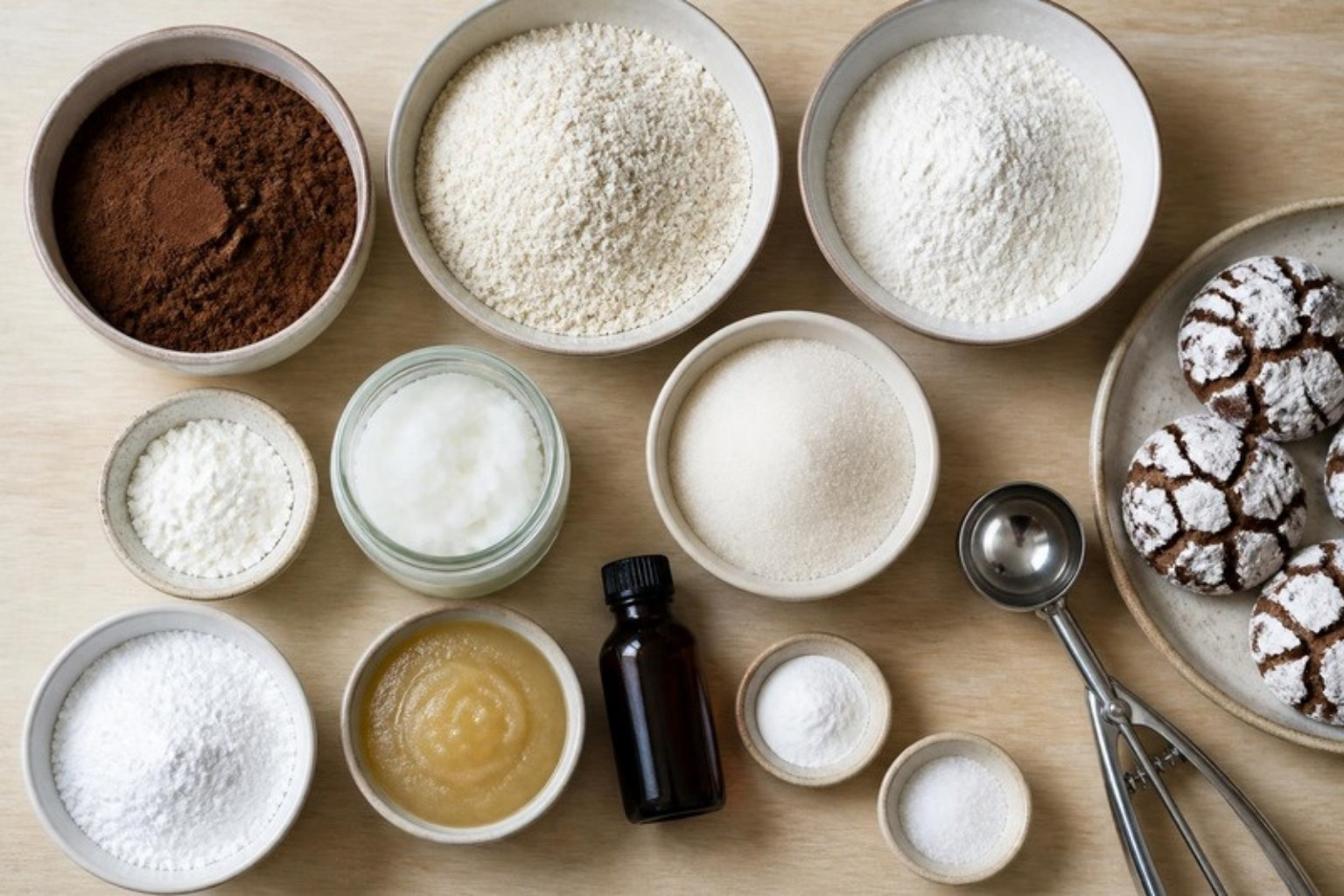
Cocoa Crinkle Cookies (Top 9 Free)
Ingredients
Equipment
Method
- Whisk the melted coconut oil and granulated sugar in a large bowl for 1 minute, until glossy and slightly thickened. Whisk in the applesauce and vanilla until smooth.
- In a second bowl, whisk the cocoa, oat flour, rice flour, cornstarch, baking powder, baking soda, and salt, breaking up any cocoa lumps.
- Stir the dry ingredients into the wet with a spatula until no dry streaks remain. The dough will look like thick, soft brownie batter.
- Cover and chill at least 1 hour (2 hours if using olive oil), until firm enough to scoop and roll without sticking. The dough can chill up to 2 days.
- Heat the oven to 350°F (175°C) and line two baking sheets with parchment. Put the granulated sugar and powdered sugar in two separate shallow bowls.
- Scoop 1 1/2-tablespoon portions (about 25 g) and roll into balls. Roll each ball in granulated sugar first, then roll generously in powdered sugar until thickly coated and completely white. Place 2 inches (5 cm) apart.
- Bake one sheet at a time for 10 to 12 minutes, until the cookies have puffed, spread, and cracked across the top, the edges look set, and the centers still look slightly soft between the cracks. They firm up as they cool.
- Cool on the sheet 5 minutes, then move to a rack to cool completely.
Notes
Troubleshooting and Tips
- Few cracks: the dough was too warm or the sugar coating was thin. Chill longer and roll in granulated sugar before the powdered sugar.
- Cookies spread flat: the dough needed more chilling, or the coconut oil was hot when mixed. Let melted oil cool until just warm.
- Powdered sugar turned gray: it soaked into the dough. Use the granulated sugar layer and bake soon after coating.
- Dry, cakey cookies: they baked too long. Take them out while the centers still look soft.
Make-Ahead, Freezing, and Gifting
- Make ahead: refrigerate the dough, covered, up to 2 days before rolling and baking.
- Storage: keep baked cookies airtight at room temperature up to 5 days.
- Freezing dough: freeze uncoated dough balls on a sheet, then bag them for up to 3 months. Roll in both sugars while still frozen and add 1 to 2 minutes to the bake.
- Freezing baked cookies: freeze up to 3 months in an airtight container with parchment between layers. Re-roll in powdered sugar after thawing if the coating has faded.
- Gift tins: pack cooled cookies snugly in a parchment-lined tin, with parchment between layers. Keep them separate from crisp cookies, which can soften next to these moist ones.
Building a cookie tray? See every holiday cookie in our Christmas recipes hub, and pair these with crisp shortbread cookies made without butter or wheat and cinnamon-sugar snickerdoodles.
Chocolate Crinkle Cookies FAQ
Why do I need to chill the dough?
Warm dough is too soft to roll and spreads too fast in the oven, which means fewer cracks. An hour in the fridge firms the coconut oil so the cookies keep their shape and crackle.
Can I use olive oil?
Yes, use the same amount of light-tasting olive oil. Because it stays liquid in the fridge, chill the dough at least 2 hours and work quickly when rolling.
Can I add chocolate chips?
You can fold in 1/2 cup of chocolate chips, but read the label carefully. Many chips contain milk or soy lecithin, are made on shared lines, or include added oils.
Can I use a gluten-free flour blend instead?
This recipe was written for the oat, rice, and cornstarch combination. Many blends include other flours or gums and could change both the texture and the made-without profile, so check the blend’s ingredients first.
A note before you cook: These recipes are ideas and suggestions, not medical or dietary advice. As with any recipe or ingredient, it is each reader’s responsibility to confirm what they can and cannot eat, read every ingredient label, and source quality ingredients that fit their own needs. Ingredient formulations change, so always check the package you’re using.