
Holiday turkey sounds simple until you start reading labels. Many turkeys are “enhanced” or “self-basting,” which means they’ve been injected with a solution that can include broth, soy, or flavorings, and the classic method of rubbing herb butter under the skin brings milk into the picture. Add a store-bought gravy and the main course can end up with more allergens than the sides.
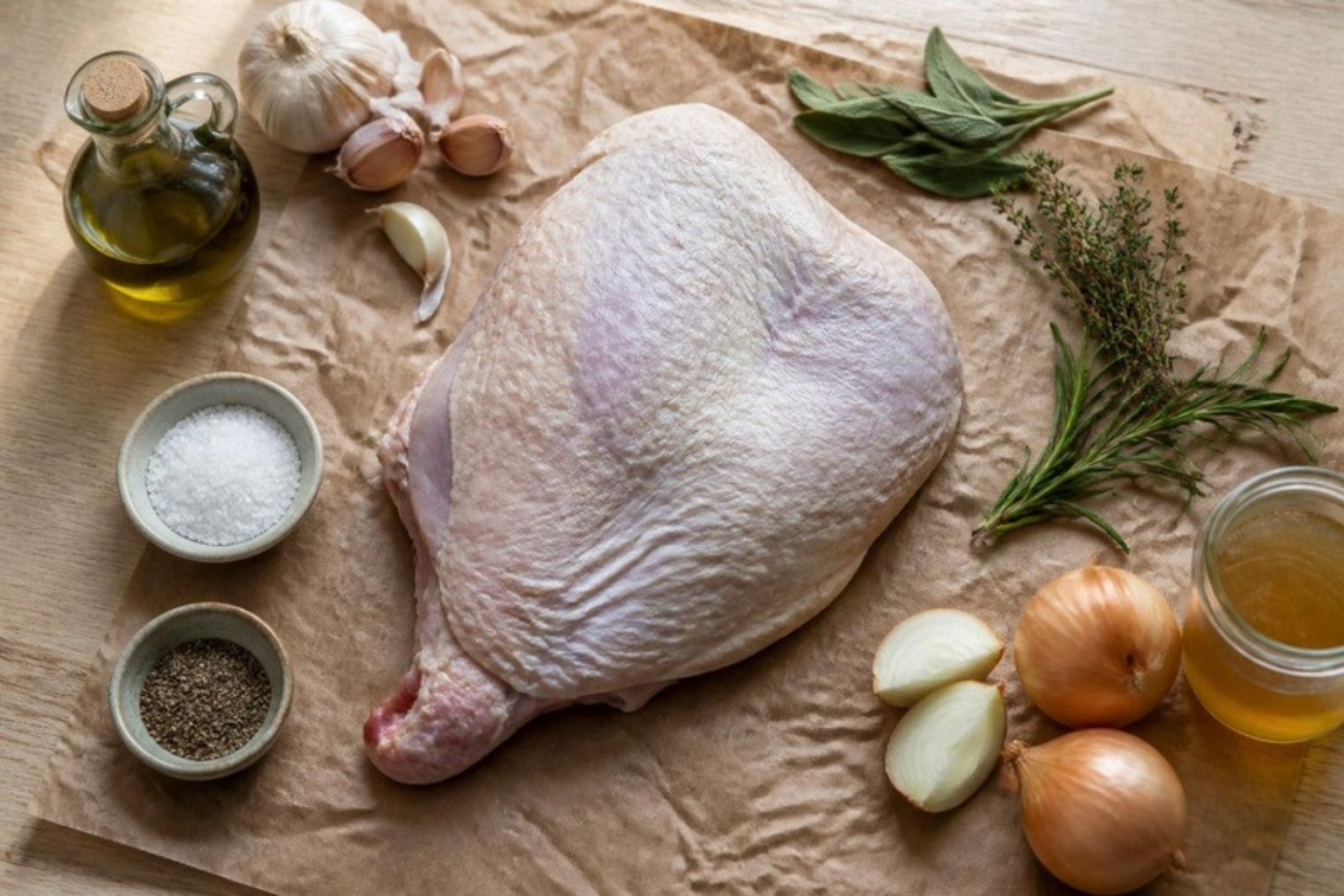
This roasted turkey breast skips all of that. A plain bone-in, skin-on breast gets a paste of extra-virgin olive oil, garlic, fresh sage, thyme, and rosemary, both under the skin and on top. It roasts on a bed of onion wedges with a little broth, which keeps the meat moist and leaves you with savory pan juices to spoon over the slices. A turkey breast is also easier to handle than a whole bird: it fits in a 9×13 pan, roasts in about two hours, and serves eight to ten, which makes it a good fit for a smaller Thanksgiving or a Christmas dinner. This is an AI-developed recipe.
Made without: peanuts, tree nuts, milk, eggs, wheat, soy, fish, shellfish, sesame.
Why You’ll Love This Turkey Breast
- Juicy, flavorful meat from herbs and garlic rubbed right on the meat under the skin.
- Crisp, golden skin with no butter, thanks to a dry surface and a hot start.
- Built-in pan juices from onions and broth, with an optional cornstarch thickener.
- Smaller and faster than a whole turkey, with less risk of dry breast meat.
- Pantry-simple: olive oil, garlic, three herbs, salt, and pepper.
How It Gets Rich Flavor Without Butter
Herb butter does two jobs in a classic turkey: it carries the flavor of the herbs into the meat and it helps the skin brown. Extra-virgin olive oil does both. Fat-soluble flavors from garlic, sage, and rosemary dissolve into the oil, so a paste of oil and herbs spread under the skin seasons the meat directly. On the outside, a thin layer of oil on well-dried skin browns and crisps in a hot oven just as well.
The onions and broth in the pan add gentle moisture to the oven and catch the drippings. Starting at 425°F sets and browns the skin, and finishing at 325°F lets the thick breast cook evenly so the outside doesn’t dry out before the center is done. The most important tool is an instant-read thermometer: pull the turkey when the thickest part reads 165°F.
Ingredients & Swap Ideas
- Bone-in, skin-on turkey breast (6 to 7 lb / 2.7 to 3.2 kg): the label check that matters most here. Choose plain turkey, not one labeled “enhanced,” “self-basting,” “basted,” or “contains up to X% of a solution.” Fresh or fully thawed. A boneless breast works too; see the FAQ.
- Extra-virgin olive oil (3 tbsp / 45 ml): no butter needed. Rendered duck fat or bacon fat also work if you have them.
- Garlic (4 cloves): finely minced so it doesn’t scorch on the skin.
- Fresh sage, thyme, and rosemary: dried herbs work at about one-third the amount. Use single herbs instead of a poultry seasoning blend, or check the blend’s label.
- Kosher salt and black pepper: 2 teaspoons Diamond Crystal or 1 1/4 teaspoons Morton.
- Yellow onions (2): shallots or a mix of onion and carrot also work.
- Low-sodium chicken or turkey broth (1 1/2 cups / 360 ml): check for wheat, soy, yeast extract, and added oil. Water works in a pinch.
- Cornstarch (optional): for lightly thickening the pan juices.
Kitchen Equipment
- Roasting pan or 9×13 baking dish (a rack is optional; the onions act as one)
- Instant-read thermometer
- Cutting board with a juice groove and a sharp carving knife
- Fine-mesh strainer and a small saucepan
Step-by-Step Tips
- Dry the skin. If you can, pat the turkey dry and leave it uncovered in the fridge for 8 to 24 hours. Dry skin browns and crisps; wet skin steams.
- Season under the skin. Slide your fingers between the skin and meat, starting at the wide end, without tearing the skin. Spread half the herb paste on the meat.
- Start hot, finish low. 20 minutes at 425°F, then 325°F until done, about 15 to 20 minutes per pound in total.
- Temp in the right spot. Insert the thermometer into the thickest part of the breast, not touching the bone. 165°F (74°C) is the target. The USDA safe temperature chart lists poultry at 165°F.
- Rest before carving. 20 minutes under loose foil keeps the juices in the meat instead of on the board.
- Carve off the bone first. Remove each breast half in one piece, then slice across the grain.
Herb Roasted Turkey Breast (Top 9 Free)
Ingredients
Equipment
Method
- If you have time, pat the turkey breast very dry and refrigerate it uncovered for 8 to 24 hours to dry the skin. Take it out of the fridge 45 minutes before roasting.
- Heat the oven to 425°F (220°C). Stir the olive oil, garlic, sage, thyme, rosemary, salt, and pepper into a loose paste.
- Pat the turkey dry again. Gently loosen the skin from the meat with your fingers and rub about half of the herb paste directly on the meat under the skin. Rub the rest over the outside of the skin.
- Scatter the onion wedges in the roasting pan, pour in 1 cup (240 ml) of the broth, and set the turkey on top, skin side up.
- Roast at 425°F for 20 minutes, until the skin starts to turn golden and sizzle.
- Lower the oven to 325°F (165°C) and keep roasting, about 15 to 20 minutes per pound in total, adding the remaining broth if the pan looks dry. Start checking at 1 1/2 hours.
- The turkey is done when an instant-read thermometer in the thickest part of the breast, not touching bone, reads 165°F (74°C), the juices run clear, and the skin is deep golden and crisp. Tent loosely with foil if the skin browns too fast.
- Move the turkey to a cutting board and rest 20 minutes before carving so the juices settle back into the meat.
- Strain the pan juices into a small saucepan, pressing on the onions, and spoon off excess fat. Simmer for 3 to 5 minutes. For a lightly thickened sauce, whisk in the cornstarch slurry and simmer 1 minute more, until glossy and slightly thick. Taste for salt.
- Carve the breast meat off the bone in one piece by running a knife along the breastbone and ribs, then slice it across the grain about 1/2 inch thick. Serve with the warm pan juices.
Notes
Troubleshooting & Tips
- Skin isn’t browning: the skin was probably damp. For the last 10 minutes, raise the oven to 425°F and watch closely.
- Skin is browning too fast: tent loosely with foil and keep roasting.
- Pan is dry and juices are scorching: add the remaining broth or a splash of water. A dark fond is good; a black, smoking pan is not.
- Meat is dry: it likely went well past 165°F. Start checking early, and next time try the dry-brine step. Spooning warm pan juices over slices helps leftovers too.
Make-Ahead, Storage & Freezing
Make ahead: stir together the herb paste up to 2 days ahead and refrigerate. You can season the turkey under the skin the night before, which doubles as a dry brine.
Storage: refrigerate carved turkey within 2 hours of cooking, with a spoonful of pan juices to keep it moist, for up to 4 days. Reheat covered at 325°F with a splash of broth until it reaches 165°F.
Freezing: freeze sliced turkey with some juices in airtight bags for up to 3 months. Thaw in the refrigerator overnight. Leftovers are good in soups, sandwiches on bread you’ve checked, or over rice.
Round out the plate with our mashed potatoes without milk or butter and the sweet potato casserole without pecans or candied yams without butter. You’ll find more mains, sides, and pies in our Thanksgiving recipes and Christmas recipes collections.
FAQ
How long does it take to roast a turkey breast?
A 6 to 7 pound bone-in breast usually takes about 1 3/4 to 2 1/4 hours with this method (20 minutes at 425°F, then 325°F). Ovens and breasts vary, so go by temperature: 165°F in the thickest part.
Can I use a boneless turkey breast?
Yes. A 3-pound boneless breast usually takes about 1 to 1 1/4 hours. Tie it into an even shape with kitchen twine, check the label for added solutions, and start checking the temperature at 50 minutes.
What does “enhanced” turkey mean?
It means the turkey has been injected or soaked in a solution, usually water, salt, and other ingredients that can include broth, flavorings, or soy-based ingredients. The label lists the solution. For this recipe, look for a plain turkey breast with no added solution.
Can I make gravy from the drippings?
The recipe card includes simple pan juices with an optional cornstarch thickener. For a larger batch, simmer the strained juices with more broth and thicken with 1 tablespoon cornstarch per cup of liquid.
A note before you cook: These recipes are ideas and suggestions, not medical or dietary advice. As with any recipe or ingredient, it is each reader’s responsibility to confirm what they can and cannot eat, read every ingredient label, and source quality ingredients that fit their own needs. Ingredient formulations change, so always check the package you’re using.