
If you’ve searched for an apple pie recipe without eggs, milk, or wheat, you’ve probably found plenty of fillings and very few crusts. The filling is the easy part. It’s the flaky, golden double crust, the one that usually depends on wheat flour, butter, and an egg wash, that makes an apple pie feel like the real thing on the Thanksgiving or Christmas table.
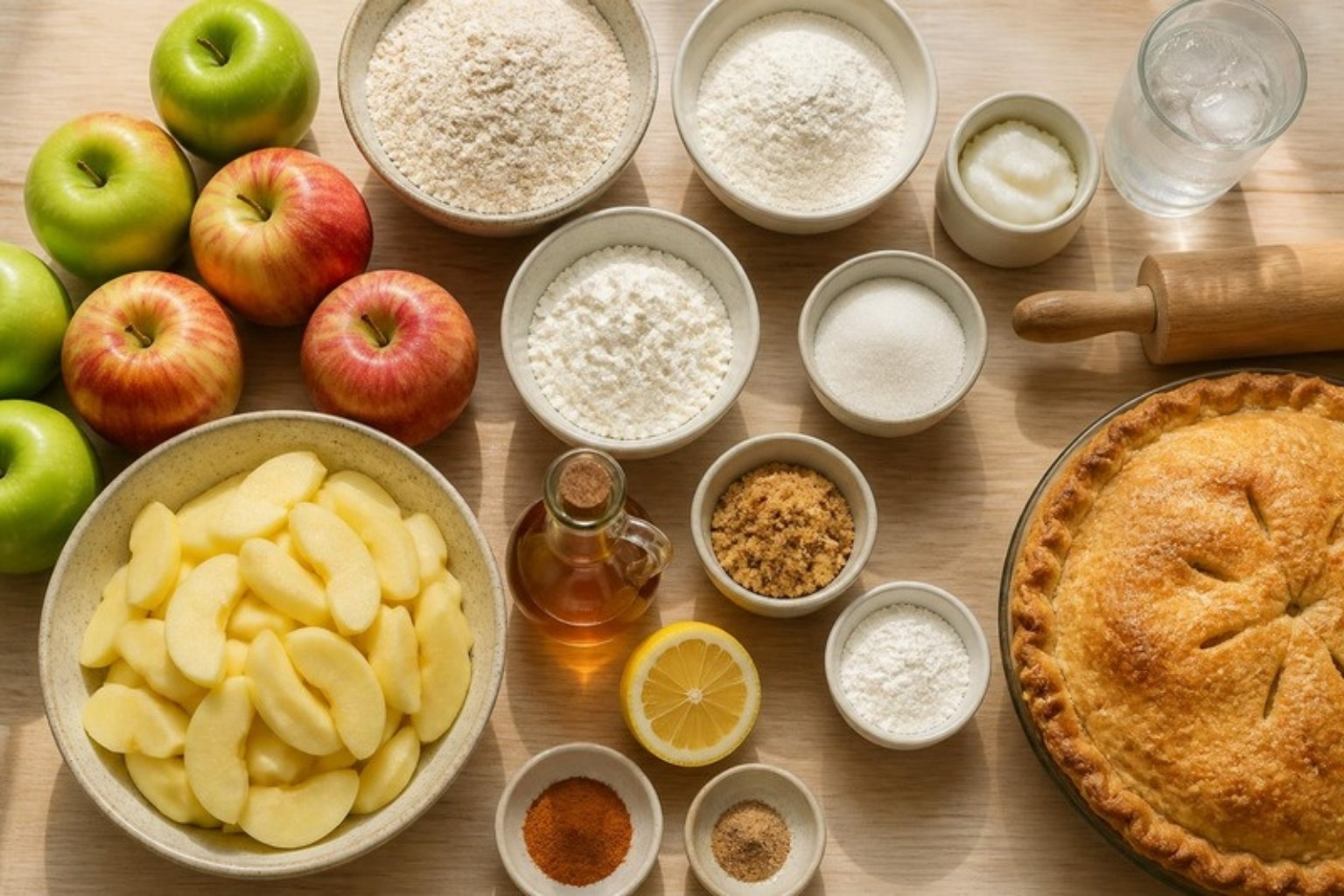
This classic apple pie is built around a crust made from certified gluten-free oat flour, white rice flour, and tapioca starch, cut together with cold lard or refined coconut oil and ice water. It rolls between sheets of parchment, patches easily, and bakes up crisp and flaky with a sugar-sparkled top. Inside, about eight cups of sliced apples are tossed with brown sugar, cinnamon, nutmeg, and cornstarch, so the juices bake into a thick, glossy filling instead of a puddle.
Made without: peanuts, tree nuts, milk, eggs, wheat, soy, fish, shellfish, sesame.
Why You’ll Love This Apple Pie
- A true double-crust pie, with either a vented top or a lattice.
- No butter, no egg wash, no wheat flour, and no egg replacer.
- A filling that slices cleanly once cooled, thanks to cornstarch and a long bake.
- Both the dough and the whole unbaked pie freeze well, which makes holiday baking easier.
How This Crust Works Without Wheat, Eggs, or Butter
Wheat flour gives a classic crust its stretch, and butter gives it flaky layers. Here the job is split up. Oat flour brings a mild, toasty flavor and some tenderness. Rice flour adds crispness. Tapioca starch helps the dough hold together and roll out instead of crumbling. Cold lard or refined coconut oil stays in small solid pieces in the dough, and as the pie bakes, those pieces melt and leave behind pockets of steam, which is where the flakes come from. A spoonful of cider vinegar keeps the dough tender.
The dough has no gluten, so it won’t stretch. That’s why it’s rolled between parchment and flipped into the pan. Any cracks press closed with your fingertips.
Ingredients and Swap Ideas
- Certified gluten-free oat flour (150 g) and white rice flour (160 g): Weighing gives the most consistent dough. Choose oat flour labeled certified gluten-free, because oats can pick up barley and wheat during growing and milling.
- Tapioca starch (60 g): Cornstarch can stand in, though the dough will be a little more fragile.
- Lard or refined coconut oil (150 g), very cold: Pure leaf lard (not hydrogenated or blended with other fats) gives the flakiest result. Refined coconut oil has no coconut flavor and works the same way when chilled firm. If you avoid coconut, use lard, or light-tasting olive oil for a more tender, crumbly crust. (“Light” means refined and mild-tasting, not lower in calories.) Skip shortening, margarine, and plant-based butters, which are usually made from seed oils.
- Apples: A mix works best. Granny Smith keeps its shape and adds tartness, while Honeycrisp or Braeburn adds sweetness. Very soft apples like McIntosh can turn to sauce.
- Cornstarch (24 g): Thickens the juices. Tapioca starch works too, at the same amount.
- Top: A brush of water and a sprinkle of sugar replace the usual egg wash. Check coarse or sanding sugar labels.
Kitchen Equipment
- 9-inch (23 cm) standard pie plate (glass lets you check the bottom crust)
- Food processor or pastry blender
- Rolling pin and parchment paper
- Rimmed baking sheet on a lower rack to catch drips
Step-by-Step Tips
- Keep everything cold. Chill the fat until firm and use ice water. When you pinch the dough, it should feel like soft modeling clay with visible flecks of fat.
- Rest the dough. At least an hour in the fridge lets the flours absorb water so the dough rolls without cracking.
- Roll between parchment. Roll to about 1/8 inch (3 mm), then peel and flip. If it cracks while you lift it, simply press it together in the pan.
- Mound the apples. Apples shrink as they bake, so pile them high in the center.
- Vent or lattice. A vented top is the easiest. For a lattice, chill the cut strips briefly so they move without breaking.
- Bake until it bubbles thickly. The pie is done when the crust is deep golden and the juices bubble slowly through the vents. Thin, fast-bubbling juice means the cornstarch needs more time.
- Cool fully. Three to four hours on a rack lets the filling set so slices hold their shape.
Classic Apple Pie Recipe, No Eggs or Milk (Top 9 Free)
Ingredients
Equipment
Method
- Pulse the oat flour, rice flour, tapioca starch, sugar, and salt in a food processor. Add the cold lard or coconut oil and pulse 8 to 10 times, until the mixture looks like coarse meal with some pea-sized pieces of fat.
- Add the vinegar and 1/2 cup (120 ml) ice water. Pulse just until the dough starts to clump. Pinch a handful: it should hold together and feel like soft, slightly tacky modeling clay. Add more ice water 1 tablespoon at a time if it crumbles.
- Divide the dough in two, one piece slightly larger. Press each into a 1-inch-thick disk, wrap, and refrigerate at least 1 hour (up to 2 days).
- Heat the oven to 425°F (220°C) with a rack in the lower third. Set a rimmed baking sheet on the rack below to catch drips.
- Toss the apple slices with the sugars, cornstarch, lemon juice, cinnamon, nutmeg, allspice, salt, and vanilla until evenly coated. Let stand 10 minutes while you roll the crust.
- Roll the larger disk between two sheets of parchment to a 12-inch (30 cm) circle about 1/8 inch (3 mm) thick. Peel off the top sheet, flip the dough into the pie plate, and peel away the second sheet. Press any cracks together with your fingers; this dough patches easily.
- Pile the apples into the crust, mounding them higher in the center, and pour in any juices left in the bowl.
- Roll the second disk the same way to an 11-inch (28 cm) circle. For a vented top, lay it over the apples, trim to a 1/2-inch overhang, fold the edge under, and crimp. Cut five 2-inch slits. For a lattice, cut the round into 1-inch strips, chill the strips 10 minutes on their parchment, then weave them over the filling, sliding each strip off the parchment with a thin spatula.
- Brush the top lightly with water and sprinkle with the coarse sugar. Chill the assembled pie 15 minutes so the fat firms up again.
- Bake 20 minutes at 425°F (220°C). Reduce the oven to 375°F (190°C) and bake 40 to 50 minutes more, until the crust is deep golden and the juices bubble thickly through the vents or lattice. Thin, watery juice means the cornstarch hasn’t fully cooked; keep baking. Cover the edges with foil if they brown too fast.
- Cool the pie on a rack at least 3 to 4 hours before slicing so the filling sets.
Notes
Troubleshooting
- Dough crumbles when rolled: It needs a little more water. Sprinkle in a teaspoon at a time, knead briefly, and rest it for 10 minutes.
- Dough is sticky: Chill it for 15 minutes and dust the parchment lightly with rice flour.
- Runny filling: The pie was either cut while still warm or pulled from the oven before the juices bubbled thickly. Next time, bake 10 minutes longer.
- Gap under the top crust: Slice the apples evenly and no thicker than 1/4 inch, and press the top crust gently onto the mound before crimping.
- Pale bottom crust: Bake on the lower rack, and use a glass or metal pan rather than ceramic.
Make-Ahead, Storage, and Freezing
- Dough: Refrigerate the wrapped disks for up to 2 days, or freeze them for up to 3 months and thaw overnight in the fridge.
- Unbaked pie: Assemble it in a metal or freezer-safe pan, freeze until solid, then wrap tightly and freeze up to 3 months. Bake from frozen at 425°F for 25 minutes, then at 375°F for 50 to 60 minutes, until the juices bubble thickly.
- Baked pie: Keep it loosely covered at room temperature for 1 day, or refrigerate for up to 4 days. Warm slices at 325°F for 10 to 15 minutes to re-crisp the crust.
- For gifting or travel: Bake the pie a day ahead, cool it completely, and carry it in a pie carrier or a sturdy box. Tape the ingredient list to the lid so hosts know exactly what’s in it.
Building a holiday dessert table? Browse the Thanksgiving recipes and Christmas recipes hubs, bake a crustless pumpkin pie made without eggs or milk for a second pie, or try the easier, no-roll Michigan apple crisp when you want apples without making a crust.
Apple Pie FAQ
What are the best apples for apple pie?
A mix of firm apples works best. Granny Smith brings tartness and keeps its shape, while Honeycrisp, Braeburn, Jonagold, or Pink Lady add sweetness. Avoid using only soft apples such as McIntosh, which break down into applesauce.
How do you make pie crust without butter or eggs?
Classic pie crust doesn’t really need eggs, and butter can be replaced with another fat that stays solid when cold. Lard and refined coconut oil both do that job. Cut them into the flour in small pieces, add ice water, and chill the dough well.
Can I use regular all-purpose flour?
You can, using about 2 1/2 cups (315 g) of all-purpose flour in place of the oat flour, rice flour, and tapioca. Note that wheat flour changes what the pie is made without, so the pie would no longer be wheat-free or gluten-free.
Why is my apple pie watery?
Usually it was either underbaked or cut too soon. Cornstarch needs to boil to thicken, so bake until the juices bubble slowly through the vents, then let the pie cool for at least three hours before you slice it.
A note before you cook: These recipes are ideas and suggestions, not medical or dietary advice. As with any recipe or ingredient, it is each reader’s responsibility to confirm what they can and cannot eat, read every ingredient label, and source quality ingredients that fit their own needs. Ingredient formulations change, so always check the package you’re using.