
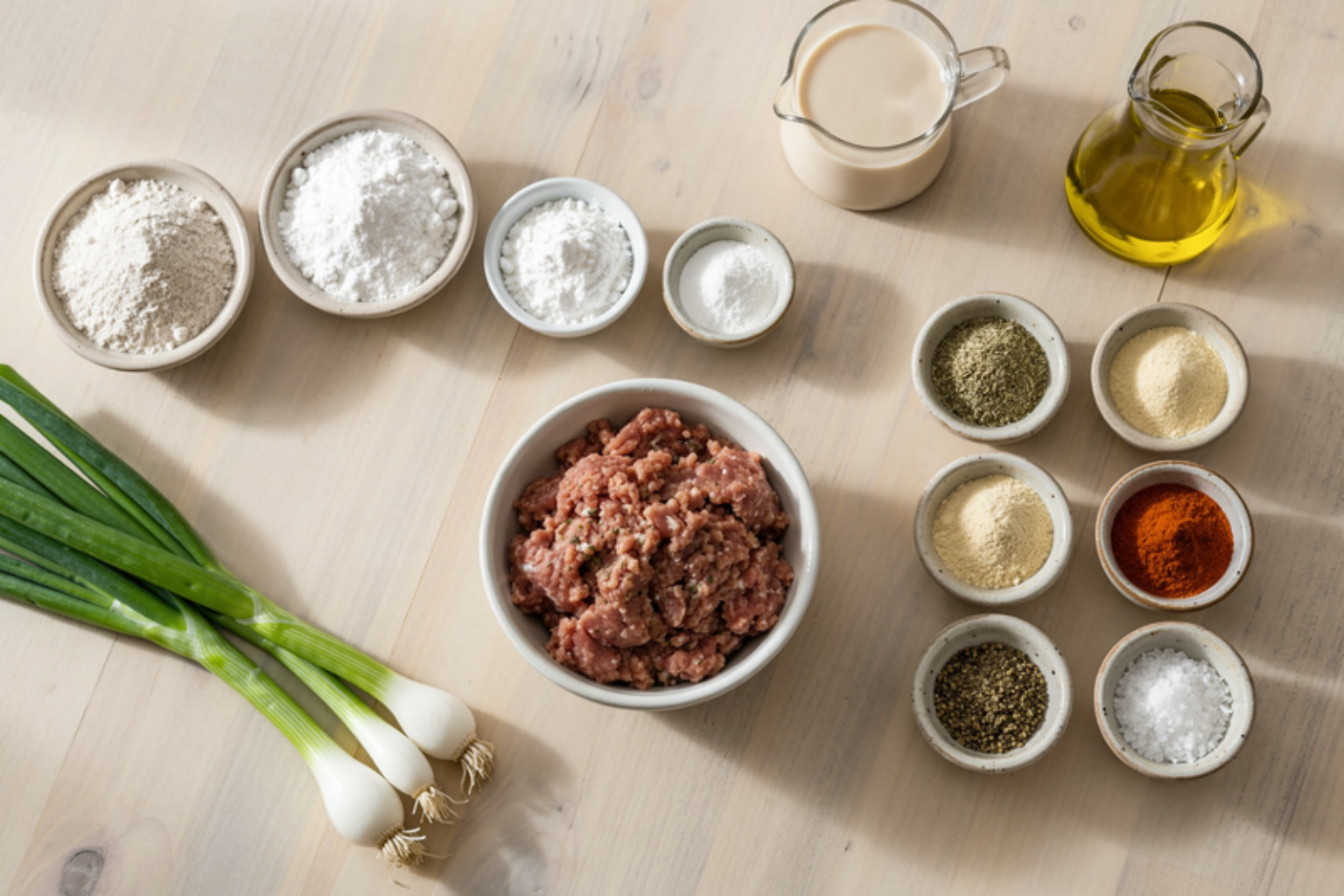
If you’ve searched for sausage balls and found that every recipe is just three things (sausage, shredded cheddar and a box of baking mix), you already know the problem. Two of those three ingredients are off the table when you’re cooking without milk and wheat. These sausage balls keep the part everyone loves: browned, savory, sage-scented bites you can pop off a toothpick. Instead of cheese and biscuit mix, the dough is built from white rice flour, sweet rice flour, potato starch and baking powder, moistened with olive oil and a splash of oat milk. The sausage supplies most of the fat and flavor, so the balls bake up crisp at the edges and tender inside.
They are a classic make-ahead party appetizer, which makes them a natural for Thanksgiving week: roll them days ahead, freeze them on a tray, and bake straight from the freezer while the turkey rests.
Made without: peanuts, tree nuts, milk, eggs, wheat, soy, fish, shellfish, sesame.
Why You’ll Love These Sausage Balls
- No cheese, no dairy-free cheese and no boxed baking mix, just pantry flours and starch.
- Ten minutes of hands-on mixing; your hands do the work, no mixer needed.
- Freezer-friendly before or after baking.
- Easy to scale up for a crowd: the recipe doubles cleanly on two sheet pans.
- Mild enough for kids, or spicy if you use hot sausage and a pinch of cayenne.
How Sausage Balls Hold Together Without Cheese
In the classic version, melted cheddar is the glue and the baking mix brings flour, fat and leavening. Here the jobs are split up. Sweet rice flour (a sticky, starchy flour made from glutinous rice, with no gluten despite the name) gives the dough a soft, cohesive bind. Superfine white rice flour adds body without grit, and a little potato starch keeps the inside tender. Light-tasting olive oil replaces the fat the cheese would have melted into the dough, and baking powder gives a gentle puff so the balls aren’t dense.
The 10-minute rest is not optional. Rice flours absorb liquid more slowly than wheat flour, so the dough feels a little sticky at first and firms up as it sits. Rolled right away, the balls can spread; rested, they hold their shape.
Ingredients & Swap Ideas
- Pork sausage (1 lb / 454 g): raw bulk sausage, cold from the fridge. Mild breakfast sausage tastes the most like the classic; hot sausage gives a kick. Read the label: some sausages contain milk powder, soy protein, wheat fillers or seasoning blends. You can also use the homemade maple sage breakfast sausage mixture.
- Superfine white rice flour (3/4 cup / 100 g) and sweet rice flour (1/2 cup / 75 g): both are needed. Regular (not superfine) rice flour works but can taste slightly sandy.
- Potato starch (2 tbsp / 16 g): cornstarch or tapioca starch can stand in.
- Baking powder (2 tsp): check that yours doesn’t use wheat starch.
- Light-tasting olive oil (3 tbsp / 45 ml): “light” means refined and mild in flavor, not fewer calories. Melted refined coconut oil also works; if you avoid coconut, stay with light-tasting olive oil.
- Oat milk with no added oil (1/3 cup / 80 ml): many oat milks contain canola or sunflower oil, so read the label and choose a certified gluten-free one. Chicken broth works too.
- Seasonings: dried sage, garlic powder, onion powder, smoked paprika, black pepper and a pinch of cayenne. Fresh thyme or rosemary are nice additions.
Kitchen Equipment
- Rimmed half-sheet pan lined with parchment
- Large mixing bowl
- Instant-read thermometer
- A 1-tablespoon cookie scoop (optional, for even balls)
Step-by-Step Tips
- Whisk the dry ingredients first so the baking powder and spices are evenly spread before the sausage goes in.
- Use cold sausage and knead by hand. Squeeze the dough through your fingers for 2 to 3 minutes. It’s ready when no dry flour shows and a squeezed handful holds together.
- Rest 10 minutes, covered, before rolling.
- Roll 1-inch balls (about 25 g each) with lightly oiled or damp hands. You’ll get about 32.
- Bake at 375°F (190°C) for 20 to 25 minutes, until deep golden with browned, sizzling bottoms and 160°F (71°C) in the center, the safe temperature for ground pork on the USDA safe temperature chart.
Sausage Balls, No Cheese or Baking Mix (Top 9 Free)
Ingredients
Equipment
Method
- Heat the oven to 375°F (190°C) with a rack in the upper-middle position. Line a rimmed sheet pan with parchment.
- In a large bowl, whisk the rice flour, sweet rice flour, potato starch, baking powder, sage, garlic powder, onion powder, smoked paprika, pepper, salt and cayenne until evenly colored.
- Add the cold sausage in small pinches, then the olive oil, oat milk and green onions. Knead with your hands for 2 to 3 minutes, squeezing the dough through your fingers, until no dry flour remains and a squeezed handful holds together without crumbling. If it still crumbles, add oat milk 1 tablespoon at a time.
- Cover the bowl and let the dough rest 10 minutes so the rice flours absorb the liquid. The dough will feel firmer and less sticky.
- Roll the dough into 1-inch (about 25 g) balls, about 32 in all, and set them 1 inch apart on the pan. Lightly oiled or damp hands keep the dough from sticking.
- Bake 20 to 25 minutes, until the balls are deep golden, the bottoms are browned and sizzling, and an instant-read thermometer in the center of one reads 160°F (71°C).
- Rest 5 minutes on the pan so the bottoms firm up, then serve warm with toothpicks and a dip such as cranberry sauce or grainy mustard (mustard is a seed; label check).
Notes
Troubleshooting
- Dough is crumbly: add oat milk 1 tablespoon at a time and knead again. Lean sausage needs more liquid.
- Balls spread flat: the dough was too wet or didn’t rest. Chill the rolled balls 15 minutes before baking.
- Pale tops: move the pan to the upper rack for the last 5 minutes, or broil for 1 minute while watching closely.
- Taste is flat without cheese: use a well-seasoned sausage, add 1/4 teaspoon more salt or a pinch more smoked paprika, and serve with a punchy dip like cranberry sauce.
Make-Ahead, Freezing & Storage
Freeze unbaked: set the rolled balls on a parchment-lined pan, freeze until solid (about 2 hours), then move them to a freezer bag for up to 2 months. Bake from frozen at 375°F (190°C), adding 5 to 8 minutes, and check for 160°F (71°C).
Baked: refrigerate up to 4 days or freeze up to 2 months. Reheat on a sheet pan at 350°F (175°C) for 8 to 10 minutes (from frozen, 12 to 15). Keep cooked sausage balls at room temperature no longer than 2 hours on a buffet; a low slow cooker set to Warm holds them well.
More Thanksgiving Appetizers
Browse every Thanksgiving appetizer, side and pie on our Thanksgiving recipes hub. If you like these, try the cornbread stuffing balls made with the same sausage-and-sage flavors, or the maple bacon-wrapped smokies. The full list is in our Thanksgiving appetizers roundup.
FAQ
Can you make sausage balls without cheese?
Yes. Cheese binds and enriches the classic version, so this recipe replaces it with sweet rice flour for binding and light-tasting olive oil for richness. The result is closer to a savory biscuit bite than a cheesy one, with the sausage flavor front and center.
What can I use instead of biscuit baking mix in sausage balls?
A homemade mix of rice flour, sweet rice flour, potato starch, baking powder and salt does the same job as boxed biscuit mix, without wheat. Measure by weight if you can for the most consistent dough.
Can I use turkey sausage?
You can, but turkey sausage is leaner, so add 1 more tablespoon of olive oil and a little extra oat milk. Cook ground poultry to 165°F (74°C).
How far ahead can I make sausage balls for Thanksgiving?
Roll and freeze them unbaked up to 2 months ahead, or refrigerate the unbaked balls covered for up to 1 day. Bake shortly before guests arrive so they’re hot and crisp.
A note before you cook: These recipes are ideas and suggestions, not medical or dietary advice. As with any recipe or ingredient, it is each reader’s responsibility to confirm what they can and cannot eat, read every ingredient label, and source quality ingredients that fit their own needs. Ingredient formulations change, so always check the package you’re using.
Leave a Reply