
Kolaczki are the folded jam cookies that show up on Polish-American Christmas cookie trays from Chicago to Cleveland: little squares of flaky pastry pinched around a stripe of apricot or raspberry, then buried in powdered sugar. If you’ve looked for a version you can make without dairy, you’ve probably found the catch right away. The classic dough is built almost entirely on cream cheese and butter, with wheat flour holding it together. This kolaczki recipe keeps the shape, the jam, and the tender, flaky bite, and rebuilds the dough from scratch.
Rice flour and sweet rice flour replace the wheat, cold refined coconut oil (or lard) stands in for the butter, and a little applesauce with a splash of vinegar brings the moisture and gentle tang that cream cheese usually adds. It’s made without peanuts, tree nuts, milk, eggs, wheat, soy, fish, shellfish, and sesame.
Made without: peanuts, tree nuts, milk, eggs, wheat, soy, fish, shellfish, sesame. Contains coconut (lard option).
Why You’ll Love These Kolaczki
- Old-world look with jewel-bright jam peeking out of each folded square.
- Not too sweet: the dough has just 2 tablespoons of sugar, so the jam and powdered sugar shine.
- Make-ahead dough that keeps 2 days in the fridge or 2 months in the freezer.
- Cookie-tray friendly: they freeze well and add a different shape next to round cookies and cut-outs.
How It Works Without Cream Cheese, Butter, or Eggs
Traditional kolaczki dough doesn’t usually contain egg, but it depends on cream cheese for moisture, tang, and a soft, almost pastry-like richness, and on butter for flakiness. Here, cold solid coconut oil is cut into the flour in pea-sized pieces, just like a pie crust, so it melts in the oven and leaves thin, flaky layers. Applesauce adds moisture without making the dough wet, and apple cider vinegar brings back a bit of the cream cheese tang while keeping the dough tender.
The hardest part of a wheat-free kolaczki is the fold, because the dough has to bend over the jam without snapping. Sweet rice flour (glutinous rice flour, which contains no gluten) is the key. It becomes slightly sticky and stretchy when hydrated, so the corners can be lifted and pressed together. Chilling the shaped cookies before baking firms the fat so the seams hold.
Ingredients & Swap Ideas
- Fat: cold, solid refined coconut oil has no coconut flavor. For a coconut-free dough, use cold pure lard. Light-tasting olive oil won’t work here because the dough has to stay firm enough to roll and fold.
- Jam: use thick preserves or a bakery-style fruit filling so it doesn’t run. Apricot and raspberry are traditional; prune butter (lekvar) is the old-country favorite. Nut pastes, also traditional, are left out here.
- Powdered sugar: most contains cornstarch; some brands use tapioca starch. Check the label if either matters to you.
- Baking powder: look for one without wheat starch.
Kitchen Equipment
A large bowl, a pastry cutter or fork, a rolling pin and parchment paper, a sharp knife or fluted pastry wheel, two rimmed baking sheets lined with parchment, and a fine-mesh sieve for dusting. Bake at 350°F (175°C).
Step-by-Step Tips
- Chill the dough in squares, not discs. Squares roll out into squares, so you waste less dough.
- Use less jam than you think. A scant 1/2 teaspoon is plenty; extra jam bubbles out and pushes the corners open.
- Overlap the corners generously and seal with a dab of water, pressing firmly.
- Chill before baking. Fifteen minutes on the sheet keeps the seams closed.
- Bake until the bottoms are golden and the tops look dry; they should stay pale on top.
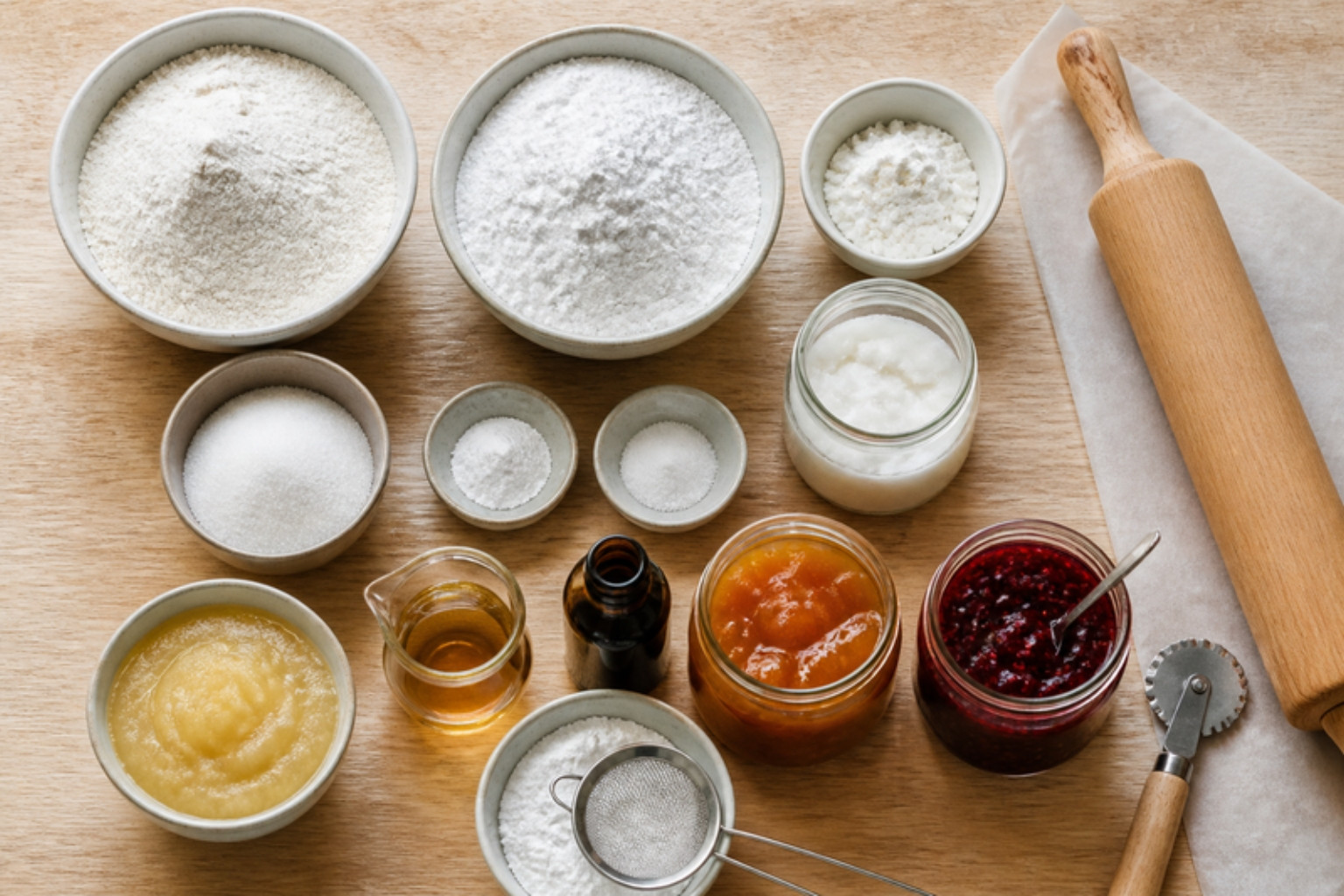
Kolaczki (Polish Christmas Jam Cookies), No Eggs, Dairy-Free
Ingredients
Equipment
Method
- Whisk the rice flour, sweet rice flour, cornstarch, sugar, baking powder, and salt in a large bowl.
- Add the cold coconut oil in small pieces and cut it in with a pastry cutter or fork until the pieces are the size of small peas.
- Stir the applesauce, vinegar, and vanilla together and pour over the flour mixture. Toss with a fork, then add ice water a teaspoon at a time until the dough holds together in a smooth ball when squeezed. It should feel like soft play dough, not sticky.
- Divide in half, flatten into two squares about 1 inch thick, wrap, and chill 1 hour (or up to 2 days).
- Heat the oven to 350°F (175°C) and line two baking sheets with parchment.
- Roll one square of dough between two sheets of parchment lightly dusted with cornstarch to a 10-inch square about 1/8 inch thick. Trim the edges and cut into 2-inch squares with a knife or fluted pastry wheel.
- Spoon a scant 1/2 teaspoon of preserves in a diagonal line across the center of each square, from one corner toward the opposite corner.
- Lift two opposite corners over the jam so they overlap by about 1/2 inch. Dab the overlap with a drop of water and press firmly to seal. If a corner cracks, pinch it back together. Transfer to the baking sheet 1 inch apart. Repeat with the second square of dough, re-rolling scraps once.
- Chill the shaped cookies on their sheets for 15 minutes. This helps the corners stay closed in the oven.
- Bake one sheet at a time for 14 to 17 minutes, until the cookies look dry and matte, the bottoms are light golden, and the jam is bubbling at the open ends. The tops should stay pale.
- Cool 5 minutes on the sheet, then move to a rack. Re-press any corners that opened while the cookies are still warm. Cool completely and dust with powdered sugar just before serving.
Notes
Troubleshooting
- Corners popped open: the overlap was too small or the dough was warm. Press them closed again while the cookies are still warm from the oven.
- Dough cracks when folding: it’s a little dry or too cold. Let it sit 5 minutes, or knead in a teaspoon of water before re-rolling.
- Jam ran onto the pan: the preserves were thin. Simmer them for a few minutes to thicken, then cool before filling.
- Powdered sugar disappeared: it melts into the jam over time. Dust just before serving.
Make-Ahead, Freezing & Gifting
Make the dough up to 2 days ahead and keep it wrapped in the fridge, or freeze it for up to 2 months and thaw overnight in the fridge. Baked cookies keep in an airtight tin at room temperature for up to 4 days. To freeze, leave them undusted, freeze in a single layer, then stack in a container with parchment between layers for up to 2 months. For cookie tins and exchanges, pack kolaczki in a single layer on top of sturdier cookies, separated by parchment, and tuck a small bag of powdered sugar into the tin so the recipient can dust them fresh.
More Christmas Cookies
Browse the full cookie aisle on our Christmas recipes page. If you love jam cookies, try the nut-free Linzer cookies with raspberry jam or the simple jam thumbprint cookies, and for another old-world tradition, bake a batch of biscochitos.
FAQ
How do you pronounce kolaczki?
Usually “koh-WATCH-kee.” You’ll also see the spellings kolachki, kolacky, and kołaczki. They’re related to, but different from, Czech kolache, which are yeast buns.
Do kolaczki have eggs?
Many traditional recipes don’t put egg in the dough, but they do rely on cream cheese and butter, and some versions add an egg yolk or egg wash. This version uses no egg, milk, or butter at all.
Can I make them without coconut oil?
Yes. Cold pure lard works in the same amount and gives an especially flaky pastry. Liquid oils won’t hold the folded shape.
What other fillings can I use?
Any thick fruit preserves work: cherry, strawberry, or plum. Very thin jams and jellies tend to run out of the cookie.
A note before you cook: These recipes are ideas and suggestions, not medical or dietary advice. As with any recipe or ingredient, it is each reader’s responsibility to confirm what they can and cannot eat, read every ingredient label, and source quality ingredients that fit their own needs. Ingredient formulations change, so always check the package you’re using.
Leave a Reply