
Holiday candy is full of milk chocolate, butter, nuts, and egg whites, which makes the candy tin one of the hardest parts of Christmas when you cook around food allergies. Maple sugar candy is the exception. It’s made from a single ingredient, pure maple syrup, so there’s nothing to swap out. Sugarhouses across Michigan, Vermont, and Quebec have sold it for generations, usually pressed into little maple leaf shapes.
The method is simple but precise: boil the syrup to a set temperature, let it cool without touching it, then stir until it turns from glossy amber syrup into a pale, creamy paste that sets firm. The finished candy has a fine, fudge-like grain that melts on your tongue with pure maple flavor. A batch takes under two hours, most of it waiting, and makes a great gift.
Made without: peanuts, tree nuts, milk, eggs, wheat, soy, fish, shellfish, sesame.
Why You’ll Love Maple Sugar Candy
- One ingredient, with an optional drop of oil to calm the foam.
- No butter, cream, chocolate, or corn syrup.
- A classic Northern sugarhouse treat that’s easy to make at home.
- Keeps for weeks, so it’s ideal for gift tins and cookie trays.
- A small piece goes a long way; the flavor is rich and concentrated.
How Syrup Turns Into Candy
Maple syrup is about two-thirds sugar and one-third water. Boiling drives off water until the syrup is concentrated enough to crystallize. The target is roughly 23 to 25°F above the temperature at which water boils where you live, about 235 to 237°F at sea level. Because boiling points shift with altitude and weather, it helps to check your thermometer in boiling water first and add to that number.
The cooling step is what gives the candy its smooth texture. If you stir hot syrup, sugar crystallizes into big, grainy crystals. Letting it cool undisturbed to about 175°F and then stirring hard creates millions of tiny crystals at once, which is why the candy turns pale and creamy rather than sandy. The same science gives fudge its texture.
Ingredients and Swap Ideas
- Pure maple syrup: it must say “pure maple syrup.” Pancake syrup is mostly corn syrup and flavorings and won’t crystallize the same way. Dark or amber grades give the strongest flavor; golden syrup makes paler, milder candy.
- A drop of oil (optional): 1/4 teaspoon of light-tasting olive oil or refined coconut oil keeps the foam from climbing the pan. “Light” means refined and mild, not lower in calories. If you avoid coconut, use the olive oil. Old recipes call for butter here; skip it, along with butter substitutes and cooking spray.
- About the syrup source: some sugarhouses add a drop of defoamer while boiling sap, which can be a vegetable oil or cream. If that matters to you, ask the producer.
- No swaps for the syrup: honey, agave, and other syrups don’t crystallize the same way, so they won’t make this candy.
Kitchen Equipment
- Heavy 3- to 4-quart saucepan; the syrup foams up to several times its volume
- Candy thermometer or a reliable instant-read thermometer
- Wooden spoon
- Rubber or silicone candy molds (maple leaves, stars, or any small shape), or a parchment-lined loaf pan to cut squares
Step-by-Step Tips
- Calibrate first. Put the thermometer in boiling water, note the reading, and add 23 to 25°F. That’s your target.
- Boil without stirring. Keep the heat at medium and lower it if the foam rises toward the rim. The last 10 degrees go fast, so stay close.
- Don’t scrape the pan when you move it off the heat. Stray crystals on the sides can make the candy grainy.
- Cool to about 175°F. This usually takes 10 to 20 minutes. The surface will look slightly thickened.
- Stir steadily. Within a few minutes the syrup lightens, turns opaque and matte, and starts holding the spoon’s path. That’s the moment to stop.
- Fill the molds quickly. It sets fast. If it firms up in the pan, add a teaspoon of water and warm it gently while stirring.
- Dry before packing. After unmolding, let the candies sit on a rack for a few hours so the outsides firm up.
Safety: boiling sugar syrup is far hotter than boiling water and can cause serious burns. Keep children and pets away from the stove, use a tall pan, and never taste the syrup from the spoon.
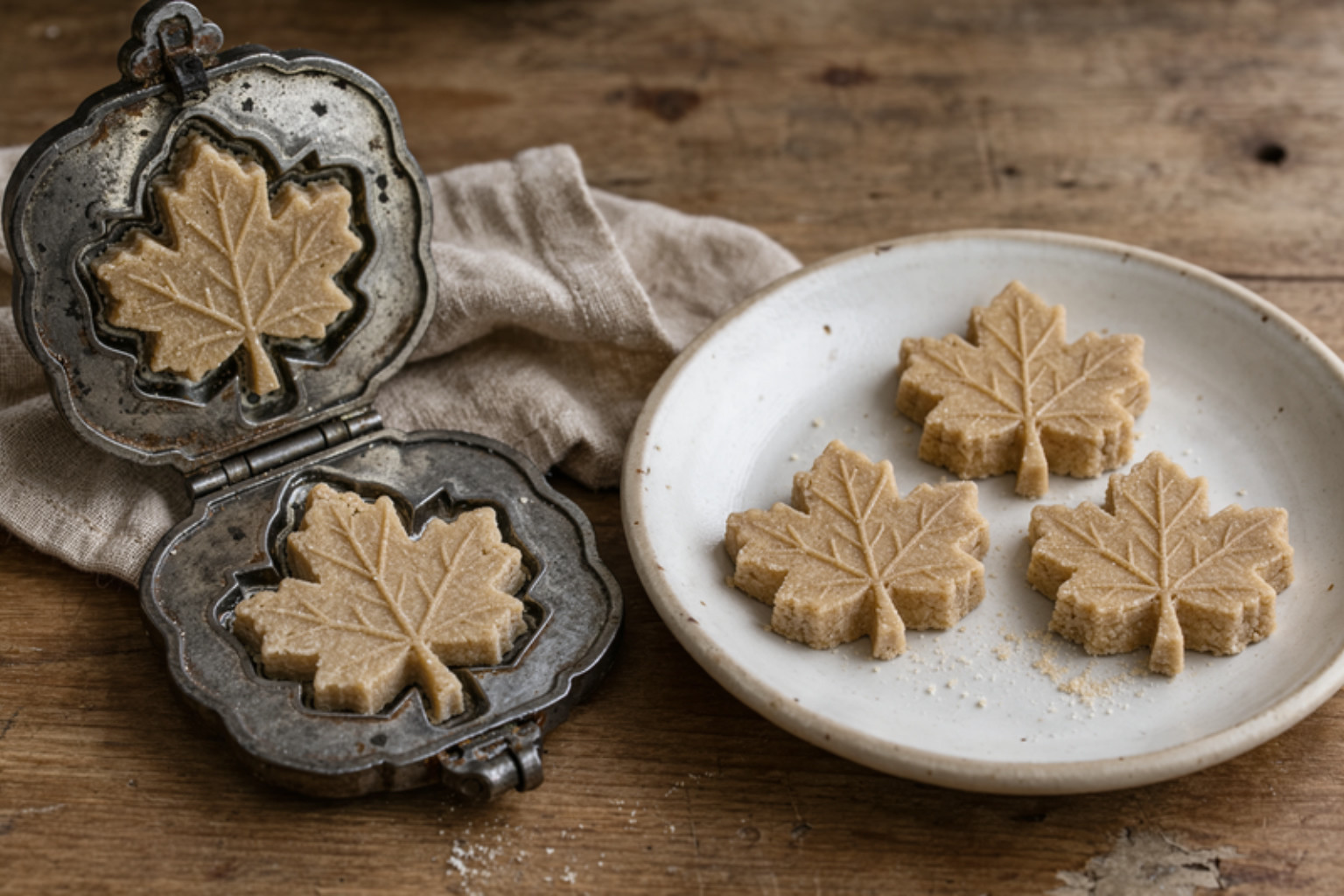
Maple Sugar Candy (Maple Leaf Candy)
Ingredients
Equipment
Method
- Check your thermometer in boiling water and note the reading. Your target is 23 to 25°F (13 to 14°C) above that number, about 235 to 237°F (113 to 114°C) at sea level.
- Pour the maple syrup into the heavy saucepan and add the optional drop of oil. Clip on the thermometer. Bring to a boil over medium heat.
- Boil without stirring until the syrup reaches the target temperature, 15 to 25 minutes. Watch closely: it foams high, and the last few degrees come quickly. Lower the heat if the foam climbs toward the rim.
- Remove from the heat and set the pan on a rack or folded towel. Do not stir or scrape. Let it cool undisturbed to about 175°F (80°C), 10 to 20 minutes.
- Stir steadily with a wooden spoon. After 3 to 8 minutes the syrup will turn lighter in color, lose its shine, and thicken like soft fudge. Stop as soon as it turns opaque and creamy and starts to hold the spoon’s track.
- Working quickly, spoon it into the molds and press it level. If it sets in the pan, warm it over very low heat with a teaspoon of water, stirring, until spoonable again.
- Let the candies set at room temperature about 1 hour, then unmold. Dry on a rack, uncovered, for 2 to 3 hours before packing so the outsides firm up.
Notes
Troubleshooting
- Candy never sets: the syrup didn’t get hot enough. Scrape it back into the pan with a splash of water and boil again to the target.
- Grainy or sandy candy: it was stirred too hot or crystals from the pan sides got in. Let it cool fully next time before stirring.
- Set in the pan before molding: it was stirred too long. Warm gently with a teaspoon of water until spoonable.
- Candies crumble when unmolded: the syrup went a few degrees too high. Aim for the lower end of the range next time.
Storage, Freezing, and Gifting
Store maple candy in a tin or airtight container with parchment or wax paper between layers, at cool room temperature, for up to 3 weeks. Humidity makes it sticky, so keep it away from the stove and dishwasher. To freeze, pack it in a sealed container and freeze up to 2 months; thaw without opening the container so condensation forms on the outside, not on the candy. For gifts, set each piece in a mini paper candy cup and pack them snugly in a small tin or box.
More Christmas Candy
Browse the Desserts and Candy aisle on our Christmas recipes page. If you like cooked-sugar candy, try the glassy hard tack candy. For more maple, bake the maple cookies with maple glaze or the maple syrup pie.
FAQ
Can I make maple candy without a thermometer?
It’s possible with the soft-ball test (a drop in cold water forms a soft ball), but the window is narrow. A thermometer makes it much more reliable.
Is maple candy the same as maple cream?
They use the same idea. Maple cream (maple butter) is cooked to a lower temperature and stirred into a spread. Maple candy goes a few degrees higher so it sets firm.
How much candy does 2 cups of syrup make?
About 1 pound, or roughly 24 small leaf-shaped pieces, depending on your molds.
Can I double the batch?
Use a larger pan if you do, since the foam rises high. Larger batches take longer to boil and to cool, and they can set before you finish molding, so many cooks make two single batches instead.
A note before you cook: These recipes are ideas and suggestions, not medical or dietary advice. As with any recipe or ingredient, it is each reader’s responsibility to confirm what they can and cannot eat, read every ingredient label, and source quality ingredients that fit their own needs. Ingredient formulations change, so always check the package you’re using.