
Kettle corn is the smell of every county fair and fall festival in the Midwest: a big iron kettle, a paddle, and that sweet-and-salty crunch. The bagged and microwave versions are a different story for allergy families, with seed oils, “natural flavors,” and labels that change without warning. The good news is that real kettle corn needs only four ingredients, one pot, and about 10 minutes.
How do you make kettle corn at home? Heat refined coconut oil in a heavy pot, add popcorn kernels and sugar together, cover, and shake the pot constantly so the melting sugar coats each kernel as it pops. Pour it out when the pops slow to 2 to 3 seconds apart, and salt it while hot.
This version pops plain kernels in refined coconut oil with a little sugar, so each piece gets a thin, crackly glaze, then finishes with a sprinkle of salt. It’s a great after-school snack, movie-night bowl, or lunchbox treat, and it’s made without milk, butter, eggs, wheat, peanuts, tree nuts, soy, fish, shellfish, and sesame.
Made without: peanuts, tree nuts, milk, eggs, wheat, soy, fish, shellfish, sesame. Contains: coconut (refined coconut oil; light-tasting olive oil works if you avoid coconut).
Why You’ll Love This Recipe
- Four ingredients: kernels, oil, sugar, and salt.
- Ten minutes: faster than a trip to the store.
- No butter, no microwave bags: you know exactly what’s in it.
- That fair-style crunch: sugar caramelizes right on the popcorn as it pops.
- Budget-friendly: a big bowl costs a fraction of bagged kettle corn.
How Kettle Corn Works Without Butter
Classic kettle corn was never a butter recipe. Fair vendors pop the corn in oil with sugar added right at the start, so the sugar melts into the hot oil and coats each kernel as it bursts. That’s different from caramel corn, which is popped first and then tossed in a butter-and-brown-sugar caramel and baked.
Refined coconut oil is a good fit because it’s neutral in flavor (refined, not virgin, so it won’t taste like coconut) and handles the heat of popping well. Light-tasting olive oil works too if you avoid coconut. The key technique is constant shaking: it keeps the sugar moving so it coats the popcorn instead of sitting on the bottom of the pot and burning.
Ingredients & Swap Ideas
- Popcorn kernels (1/2 cup / 100 g): yellow kernels pop larger and sturdier; white kernels are smaller and more tender. Use plain kernels, not microwave popcorn, which is often made with seed oils and flavorings.
- Refined coconut oil (3 tbsp / 40 g): if you avoid coconut, use 3 tablespoons of light-tasting olive oil (“light” means refined and mild in flavor, not fewer calories). Skip vegetable, canola, and other seed oils.
- Granulated sugar (1/4 cup / 50 g): white sugar gives the classic clear, crackly coating. Brown sugar burns more easily, so it isn’t recommended here.
- Fine salt (1/2 tsp): fine salt sticks better than coarse. Add more to taste if you like it saltier.
Kitchen Equipment
- A heavy 6-quart pot with a lid, or a stovetop popcorn popper with a crank (the crank does the stirring for you).
- Oven mitts for shaking the pot.
- A parchment-lined rimmed baking sheet for cooling.
Step-by-Step Tips
- Set up first. Line the baking sheet and measure everything before turning on the heat.
- Use test kernels. Heat the oil with 3 kernels; when all three pop, the oil is ready.
- Add kernels and sugar together. Sprinkle the sugar evenly, stir once, and cover.
- Shake, shake, shake. Keep the pot moving over the burner with only brief pauses.
- Pull it early. When pops slow to 2 to 3 seconds apart, dump it onto the sheet right away. Sugar goes from caramel to burnt in seconds.
- Salt while hot, then let it cool 5 minutes so the coating turns crisp.
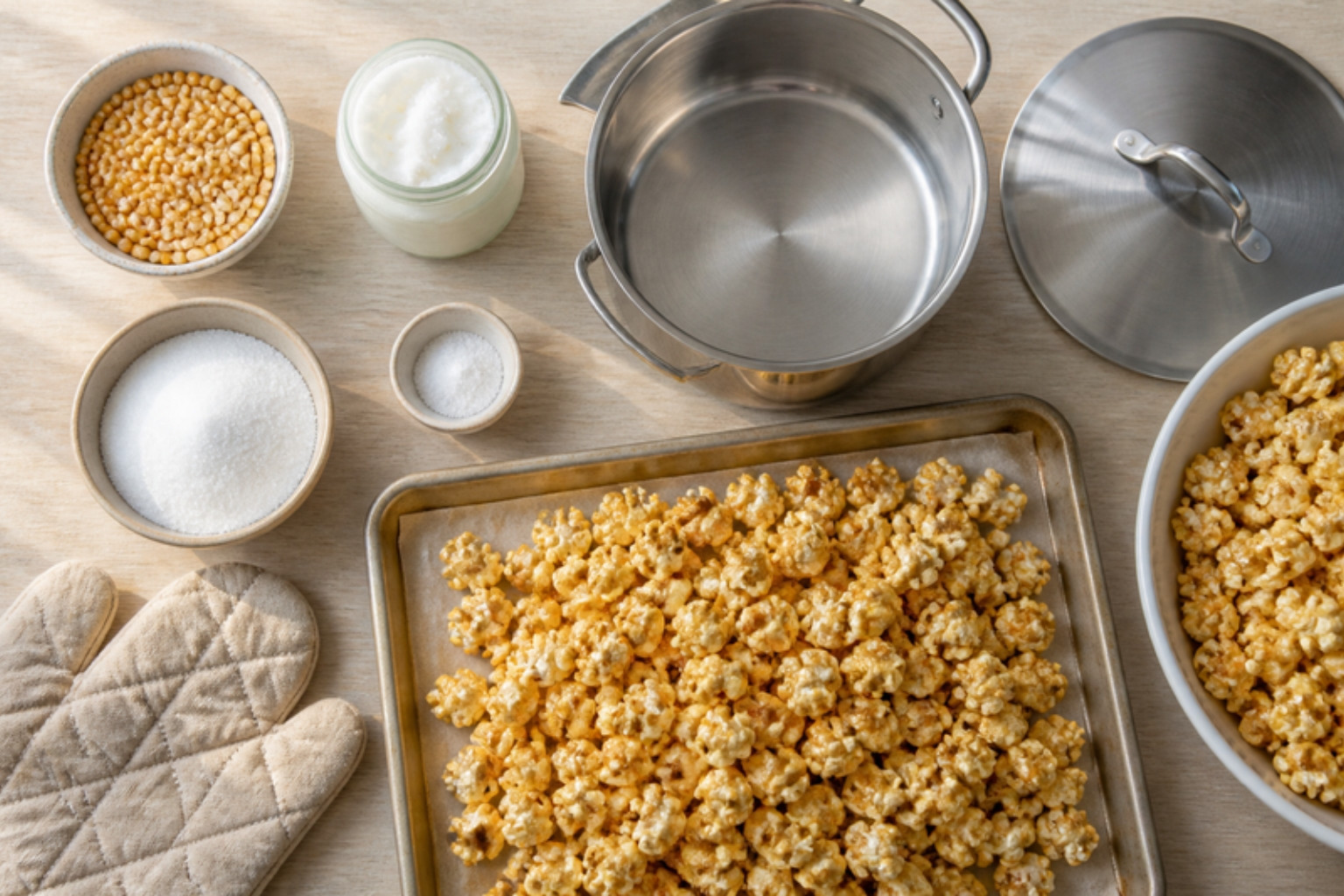
Homemade Kettle Corn on the Stovetop
Ingredients
Equipment
Method
- Line a rimmed baking sheet with parchment and set it next to the stove. Measure everything before you start; once the sugar goes in, things move fast.
- Put the coconut oil and 3 popcorn kernels in the pot over medium heat and cover. When all 3 test kernels pop, the oil is hot enough.
- Remove the lid, add the rest of the kernels and sprinkle the sugar evenly over them. Stir once so the sugar dissolves into the oil, then cover.
- Using oven mitts, shake the pot back and forth over the burner almost constantly, pausing only a second or two at a time, so the sugar keeps moving and doesn’t scorch. Popping will start within 1 to 2 minutes and become rapid.
- When popping slows to 2 to 3 seconds between pops, immediately take the pot off the heat and pour the popcorn onto the baking sheet. Don’t wait for every kernel; a few seconds too long and the sugar burns. The popcorn should look lightly glazed and smell like caramel, not bitter.
- Sprinkle with the salt right away and toss with a spatula. Let cool 5 minutes; the sugar coating crisps as it cools. Break up any clumps and pick out unpopped kernels before serving.
Notes
Troubleshooting & Tips
- Burnt taste: the heat was too high or it stayed on too long. Use medium heat, shake constantly, and pull the pot as soon as popping slows. A bitter smell means start over; burnt sugar won’t hide.
- Lots of unpopped kernels: the oil wasn’t hot enough, or the kernels are old and dried out. Fresh kernels stored airtight pop best.
- Chewy, not crisp: the popcorn steamed under the lid. Tilt the lid slightly while popping to let steam escape, and spread it out in a single layer to cool.
- Sticky pot: fill it with hot water and let it soak; the hardened sugar dissolves on its own.
A quick safety note: melted sugar and hot oil can cause serious burns. Keep the lid on while you shake, keep kids and pets away from the stove, and let the popcorn cool before tasting.
Storage
Let the kettle corn cool completely, then store it in an airtight container or zip-top bag at room temperature for up to 3 days. Humidity is the enemy of the sugar coating, so seal it well. For lunchboxes, pack a portion in a small airtight container the morning of. Kettle corn doesn’t freeze well; it’s best made fresh, and it only takes 10 minutes.
More Homemade Snacks
If you’d like a deeper caramel flavor, try the oven-baked Dairy-Free Caramel Corn. For salty snacking, there’s the Homemade Party Snack Mix and Homemade Kettle Chips Fried in Beef Tallow. For something spicy, try the spicy rolled tortilla chips, and for a party bowl, the old-fashioned popcorn balls. Find more Top Nine Free ideas in our snack recipes.
FAQ
What’s the difference between kettle corn and caramel corn?
Kettle corn is popped with sugar in the pot, giving a light, sweet-and-salty glaze. Caramel corn is popped plain, then coated in a thick cooked caramel and usually baked for a heavier, crunchier shell.
Will refined coconut oil make it taste like coconut?
Refined coconut oil is processed to be neutral in flavor, so it shouldn’t. Virgin or unrefined coconut oil does taste like coconut. If you avoid coconut altogether, light-tasting olive oil works in the same amount.
Can I make kettle corn in an air popper or microwave?
Not really. The sugar needs hot oil to melt and coat the kernels as they pop. Air poppers and plain paper-bag microwave popping don’t use enough fat for that.
Can I double the batch?
It’s best to make two separate batches. A crowded pot is harder to shake, so the sugar is more likely to burn before all the kernels pop.
Why does my kettle corn burn?
Sugar burns fast once the popping is done. Keep the heat at medium, shake the pot almost constantly so the sugar can’t settle on the bottom, and pour the popcorn out the moment pops slow to 2 to 3 seconds apart.
What oil is best for kettle corn?
A neutral fat that handles popping heat: refined coconut oil, or light-tasting olive oil if you avoid coconut. Skip butter, whose milk solids scorch at popping temperature, and skip vegetable, canola and other seed oils.
How much sugar goes in kettle corn?
This recipe uses ¼ cup (50 g) of granulated sugar for ½ cup of kernels, which gives a light, crackly coating. White sugar works better than brown sugar, which burns more easily.
Is this the same as Amish or fair-style kettle corn?
Yes, it’s the same old-fashioned style: kernels popped in oil with sugar from the start and salted while hot. Fair vendors use a big kettle and paddle; a heavy pot and steady shaking do the same job at home.
A note before you cook: These recipes are ideas and suggestions, not medical or dietary advice. As with any recipe or ingredient, it is each reader’s responsibility to confirm what they can and cannot eat, read every ingredient label, and source quality ingredients that fit their own needs. Ingredient formulations change, so always check the package you’re using.