
Brisket seems like it should be one of the easiest things to make without the big allergens: it’s just beef and smoke. Then you read the labels on store-bought rubs, injections, and barbecue sauces and find soy, wheat, mustard, anchovy-based Worcestershire, and blends of who-knows-what. This smoked brisket skips all of that. A whole packer brisket gets a coarse salt, black pepper, and garlic rub, a long, slow smoke over oak or hickory, a butcher-paper wrap with beef tallow to carry it through the stall, and a patient rest that turns tough connective tissue into tender, juicy slices.
It’s an all-day project, which makes it a good fit for a fall Saturday: start early, tend the fire, and slice it for dinner. Leftovers freeze well and turn into sandwiches, hash, and rice bowls all week.
Made without: milk, eggs, wheat, soy, peanuts, tree nuts, fish, shellfish, sesame.
Why You’ll Love This Recipe
- Five pantry ingredients in the rub and no bottled sauces or injections.
- No mustard binder: a little olive oil (or nothing at all) holds the rub.
- Beef tallow in the wrap keeps the flat moist without butter.
- Feeds a crowd and freezes beautifully.
How This Brisket Works Without the Usual Shortcuts
Many brisket recipes start with yellow mustard slathered on the meat so the rub sticks. Mustard is a seed, and it doesn’t add much flavor after twelve hours of smoke anyway. Salt draws moisture to the surface within minutes, so the rub sticks on its own; a thin film of light-tasting olive oil helps if you like. Seasoning the night before gives the salt time to work deeper into the meat.
Competition cooks often inject brisket with phosphate and beef-base blends, some of which contain soy or yeast extracts. We skip injecting entirely and rely on fat instead. Wrapping in butcher paper with melted beef tallow around 165°F protects the lean flat through the stall, keeps the bark crisp (foil steams it soft), and adds rich beefy flavor. The long rest finishes the job: the meat keeps cooking gently and reabsorbs its juices.
Ingredients and Swap Ideas
- Whole packer brisket (12 to 14 lb / 5.4 to 6.4 kg): Look for one that bends easily when you hold it in the middle, a sign of a thick, well-marbled point. Choose plain beef, not injected, enhanced, or pre-seasoned. A flat-only brisket works but dries out more easily; wrap it a little sooner.
- Coarse kosher salt and coarse black pepper: Equal parts by volume is the classic ratio. If you use Morton kosher salt, cut it to 3 tablespoons because it’s saltier by volume.
- Garlic powder, onion powder, smoked paprika: Use single spices rather than seasoning blends, which can hide wheat, soy, or added oils.
- Beef tallow (1/2 cup / 100 g): Choose pure tallow, not blended with seed oils, or render your own from the brisket trimmings. Lard or duck fat also work.
- Apple cider vinegar and water: A simple spritz for dry edges. Skip malt vinegar, which is made from barley.
Kitchen Equipment
- A smoker that holds 250°F (120°C) for 12+ hours: pellet, offset, or a kettle set up for indirect heat
- Oak, hickory, or cherry wood (pellets, chunks, or splits)
- Leave-in probe thermometer plus an instant-read thermometer
- Unwaxed pink butcher paper
- A dry cooler and old towels for resting
- A long slicing knife and a large board with a juice groove
Step-by-Step Tips
- Trim cold. Brisket fat is much easier to trim straight from the fridge. Leave about 1/4 inch on the fat cap and round off thin edges that would burn.
- Watch the smoke, not just the temperature. Thin, clean blue smoke gives good flavor. Thick white smoke tastes bitter.
- Judge the bark before you wrap. When the surface is deep mahogany and doesn’t smear when touched, it’s ready, usually around 165°F.
- Expect the stall. Somewhere between 150 and 170°F the temperature can sit still for hours as moisture evaporates. Wrapping pushes through it.
- Probe for tenderness. 200 to 205°F is a guide; the real test is a probe sliding into the flat like soft butter.
- Don’t skip the rest. One hour minimum, two to four is better. Slicing early sends the juices onto the board instead of staying in the meat.
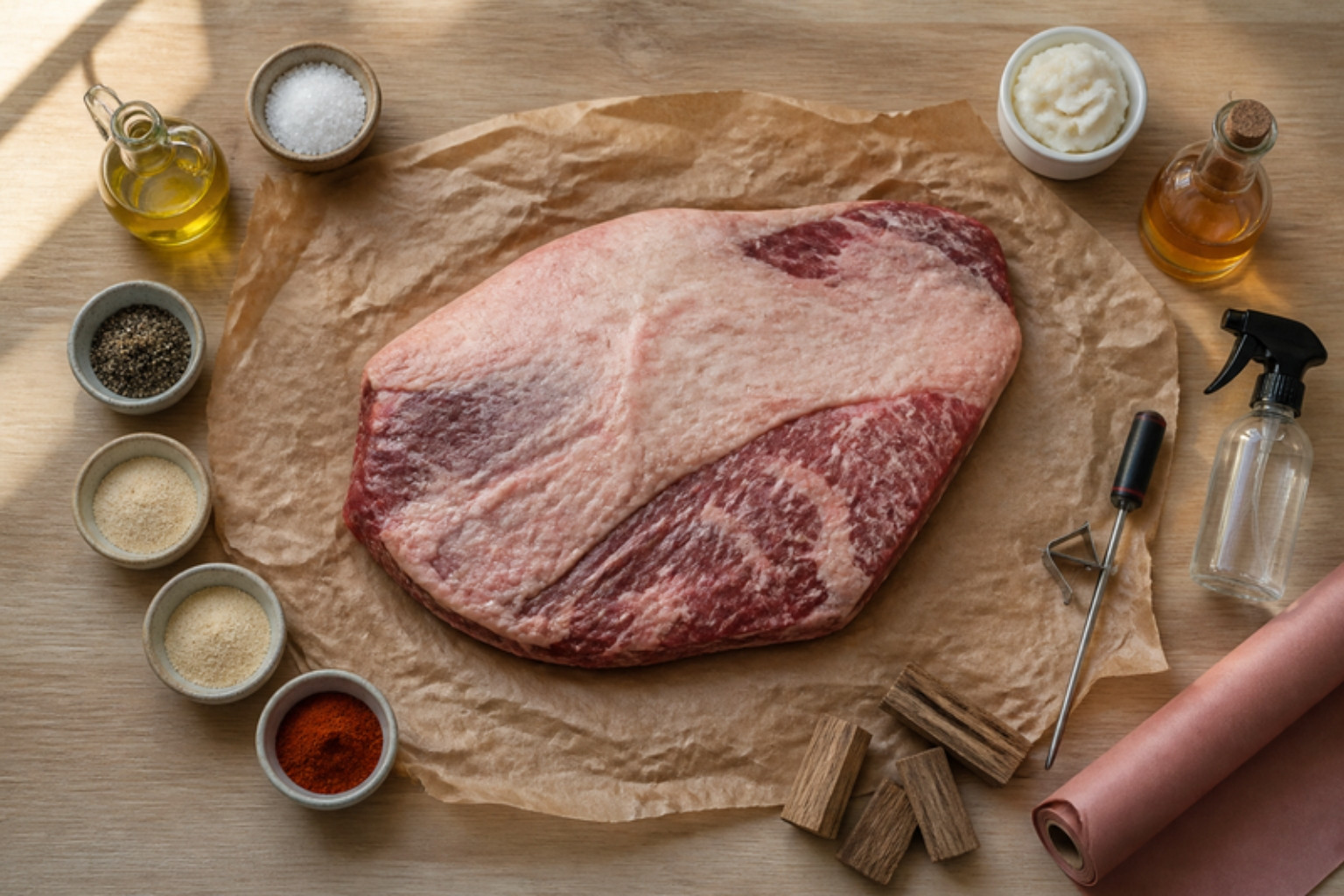
Smoked Brisket with Salt, Pepper and Garlic Rub
Ingredients
Equipment
Method
- The night before, trim the brisket while cold: leave about 1/4 inch of fat on the fat cap, remove hard fat and silver skin from the meat side, and round off thin, ragged edges so they don’t burn. Save the trimmings to render into tallow if you like.
- Mix the salt, pepper, garlic powder, and onion powder and paprika if using. Rub the brisket lightly with olive oil (optional), then season every side evenly. Refrigerate uncovered overnight, or at least 1 hour.
- Heat the smoker to 250°F (120°C) with oak, hickory, or cherry wood, and wait for thin, clean blue smoke rather than thick white smoke.
- Set the brisket fat side up (or toward the heat source on an offset), with the thicker point end toward the hotter side. Insert a probe into the thickest part of the flat. Smoke until the bark is deep mahogany and set (it doesn’t smear when touched) and the internal temperature reaches about 165°F (74°C), 6 to 8 hours. Spritz with the vinegar-water every hour after the first 3 hours if the edges look dry.
- Lay two overlapping sheets of butcher paper on the counter, brush the center with half the melted tallow, set the brisket on it, and drizzle the rest of the tallow over the top. Wrap tightly, folding the paper like a package, and return it to the smoker seam side down.
- Cook until the brisket reaches 200 to 205°F (93 to 96°C) and, more importantly, a probe slides into the flat with almost no resistance, like soft butter, 3 to 5 more hours. The whole brisket should jiggle when you nudge it.
- Rest the wrapped brisket at least 1 hour and ideally 2 to 4 hours, either in a dry cooler packed with towels or in a 150 to 170°F (65 to 77°C) oven. Hold above 140°F (60°C) during the rest.
- Unwrap over a board, saving the juices. Separate the point from the flat along the fat seam. Slice the flat against the grain about the thickness of a pencil. Turn the point 90 degrees and slice it slightly thicker, or cube it for burnt ends. Spoon the reserved juices over the slices and serve.
Notes
Brisket cooks far past the USDA minimum for whole cuts of beef (145°F with a 3-minute rest). For leftovers and other temperatures, see the USDA safe temperature chart.
Troubleshooting
- Dry flat: Usually pulled too early (still tight) or overcooked without a wrap. Wrap with tallow at 165°F and probe for tenderness, not a number.
- Tough, chewy slices: The brisket needed more time, or it was sliced with the grain. The grain runs in different directions in the point and the flat, so slice them separately.
- Bitter or acrid bark: Dirty smoke from smoldering wood. Give the fire more air and use dry, seasoned wood.
- Bark washed away: Too much spritzing or wrapping before the bark set. Spritz only dry spots and wait for a firm crust.
Storage, Freezing, and Reheating
Leftover brisket keeps best in large unsliced pieces. Refrigerate in an airtight container with any saved juices for up to 4 days, or vacuum-seal or wrap tightly and freeze up to 3 months. Thaw in the refrigerator. Reheat covered at 300°F (150°C) with a splash of the juices or a label-checked beef broth until it reaches 165°F, then slice. Chopped leftovers are great in hash or over rice.
What to Serve with Smoked Brisket
If you’d like sauce on the side, the tangy homemade sauce from our smoked pulled pork with homemade BBQ sauce is made without the top nine allergens. Round out the plate with a crisp vinegar coleslaw with no mayo and a bowl of homemade kettle chips fried in beef tallow. Buns commonly contain wheat, eggs, milk, soy, or sesame, so check the label or serve the brisket over potatoes or rice.
FAQ
How long does it take to smoke a brisket?
At 250°F, plan on roughly 50 to 60 minutes per pound for a whole packer, plus 1 to 4 hours of resting. Every brisket is different, so start early; a finished brisket holds well in a cooler for hours.
Do I need mustard to make the rub stick?
No. The salt pulls moisture to the surface and the rub sticks on its own, especially if you season the night before. A thin film of light-tasting olive oil also works as a binder.
Butcher paper or foil?
Butcher paper breathes, so the bark stays firmer. Foil traps more steam, cooks a little faster, and softens the bark. Either works; use unwaxed paper so nothing melts onto the meat.
Can I cook brisket in the oven instead?
You can follow the same temperatures in a 250°F oven for tender meat, but you won’t get smoke flavor or bark. Skip liquid smoke blends unless you’ve checked the label.
A note before you cook: These recipes are ideas and suggestions, not medical or dietary advice. As with any recipe or ingredient, it is each reader’s responsibility to confirm what they can and cannot eat, read every ingredient label, and source quality ingredients that fit their own needs. Ingredient formulations change, so always check the package you’re using.