
Some Christmas cookies are about flavor. Stained glass cookies are about that moment when you hold one up to the window and the light shines through a pane of melted red or green candy. If your family’s cookie recipes start with butter, eggs, and wheat flour, though, re-creating them can feel like a project with too many moving parts. This version keeps it simple: one sturdy, egg-free cut-out dough and a bag of crushed hard candy.
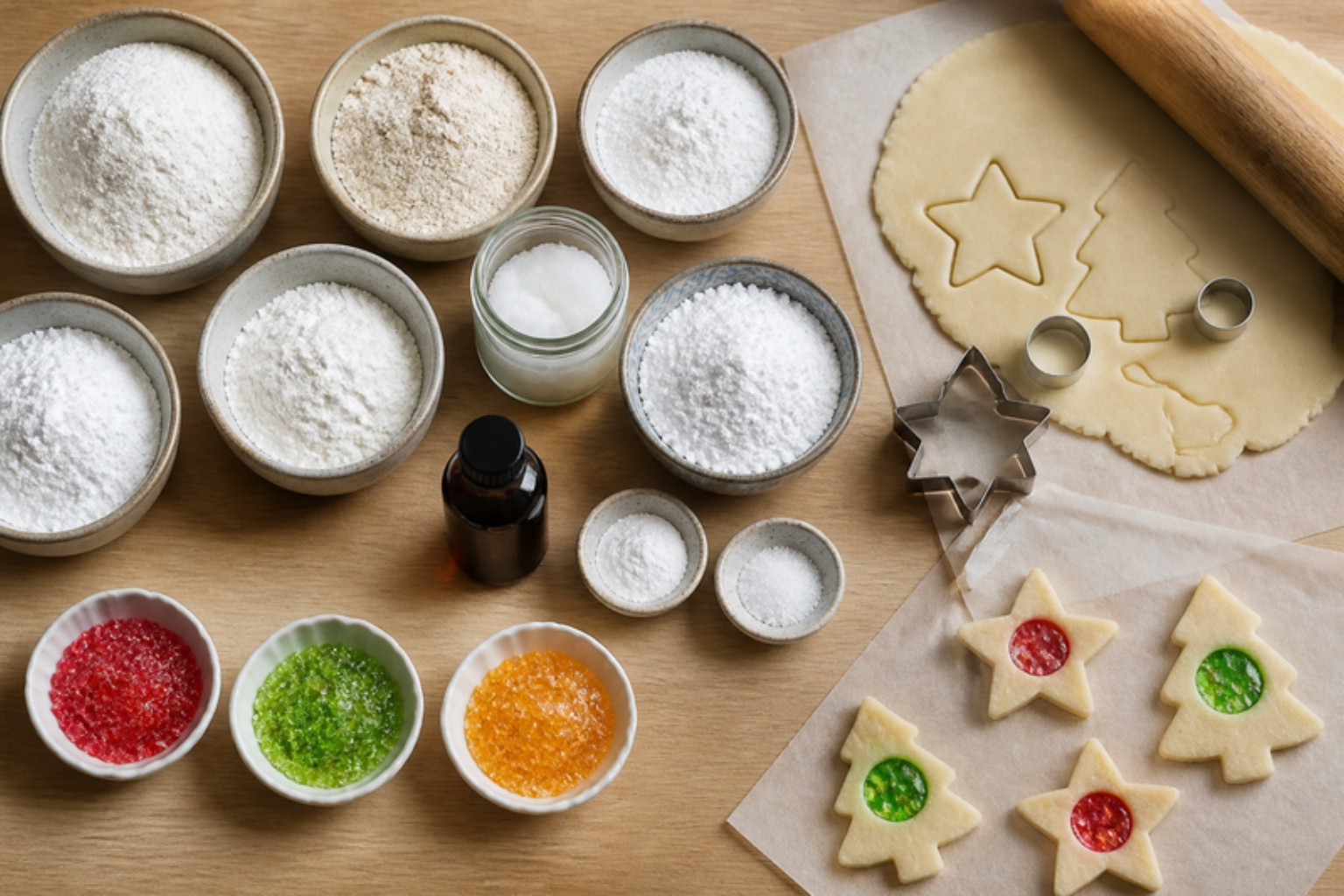
The dough is made with white rice flour, oat flour, tapioca starch, and a little cornstarch, creamed with refined coconut oil and powdered sugar and bound with a few spoonfuls of applesauce. It rolls cleanly, holds sharp edges, and bakes up crisp at the rims with a tender middle. You cut a small window from each shape, bake briefly, fill the opening with crushed candy, and bake again until the candy melts into a smooth, glassy pane. They look lovely on a cookie tray and can be strung as tree ornaments.
Made without: peanuts, tree nuts, milk, eggs, wheat, soy, fish, shellfish, sesame. Contains coconut (refined coconut oil); a leaf lard option is below.
Why You’ll Love These Stained Glass Cookies
- Showstopper look, simple method. The “glass” is just crushed candy that melts in the oven.
- A dough that holds its shape. Low leavening and a chill before cutting keep the windows neat.
- Kid-friendly decorating. Sorting candy colors and filling windows is a good job for small helpers (adults handle the hot pans).
- Ornament-ready. Poke a hole before baking and thread with ribbon.
- Bake-ahead friendly. The dough freezes for months, and baked cookies keep a week in a tin.
How These Cookies Work Without Eggs, Butter, or Wheat
In a standard cut-out cookie, egg binds the dough, butter gives it flavor and firmness when chilled, and wheat gluten holds it together when you lift a shape off the counter. This dough covers those jobs with familiar ingredients instead of a commercial egg replacer:
- Flour and starch balance. Rice flour gives structure and crisp edges, oat flour adds a wheat-like taste and tenderness, and tapioca starch makes the dough a little elastic so shapes don’t crumble.
- Applesauce for binding. Three tablespoons add just enough moisture and pectin to hold the dough together without making it cakey.
- Refined coconut oil for a firm fat. Like butter, it’s solid at cool room temperature, so the dough rolls and cuts cleanly. Refined coconut oil has no coconut flavor.
- Just a little baking powder. Too much lift makes the dough puff into the windows; half a teaspoon keeps the cookies tender without losing their shape.
Ingredients and Swap Ideas
Exact amounts in cups and grams are in the recipe card below.
- Hard candies: clear, fruit-flavored hard candies melt into the brightest windows. Sort them by color before crushing. Avoid creamy, butterscotch, or caramel candies, which contain milk and turn cloudy. Candy coatings and colorings vary, so read the bag. You can also make your own with our old-fashioned hard tack candy.
- Oat flour: use certified gluten-free oat flour; oats are often processed alongside barley and wheat.
- Fat: refined coconut oil, soft but not melted. If you avoid coconut, use the same weight of pure leaf lard. Light-tasting olive oil is liquid at room temperature and makes a dough too soft for clean cut-outs. Skip shortening, margarine, and plant butters, which are usually made with seed oils.
- Baking powder and powdered sugar: check that the baking powder is labeled gluten-free; powdered sugar may use corn or tapioca starch.
- Flavor: add 1/2 teaspoon lemon zest or swap 1/2 teaspoon of the vanilla for peppermint extract to match the candy.
Equipment
- Two rimmed baking sheets lined with parchment. Don’t use silicone mats or a bare pan; melted candy sticks to both.
- 3-inch (7.5 cm) cookie cutters, plus 1-inch (2.5 cm) cutters or a small knife for the windows
- A rolling pin, parchment, zip-top bags, and a mixer
Step-by-Step Tips
- Let the dough rest. Fifteen minutes gives the rice and oat flours time to absorb moisture, so the dough rolls smoothly and doesn’t taste gritty.
- Roll between parchment, then chill. A firm sheet of dough cuts cleaner and the shapes lift off without stretching.
- Crush candy finely. Mostly sand-like crumbs with a few small chips melt evenly. Big chunks leave bubbles and bumps.
- Par-bake first. Six minutes sets the dough so the candy doesn’t sink under the edges. Then fill the windows level with the dough; overfilled candy spills onto the cookie and browns.
- Watch the candy, not the clock. Pull the pan when the candy is fully melted and bubbling and the cookie rims are just turning pale gold. Candy left too long can turn amber.
- Cool completely on the pan. Melted sugar is very hot and fragile. Wait 15 to 20 minutes until the windows are hard before lifting.
Stained Glass Cookies (No Eggs, Butter or Wheat)
Ingredients
Equipment
Method
- Whisk the rice flour, oat flour, tapioca starch, cornstarch, baking powder, and salt. In another bowl, beat the coconut oil and powdered sugar 2 minutes until fluffy, then beat in the applesauce and vanilla.
- Mix in the dry ingredients on low until a smooth dough forms that holds together when pinched. If it’s crumbly, add cold water a tablespoon at a time. Rest 15 minutes so the flours hydrate.
- Crush each color of candy separately in a zip-top bag until it’s mostly coarse sand with a few small chips. Keep the bags sealed until you need them (crushed candy pulls in moisture).
- Heat the oven to 350°F (175°C). Roll the dough between parchment sheets to 1/4 inch (6 mm). Chill the rolled sheet 10-15 minutes until firm, then cut 3-inch shapes and cut a 1-inch window from the center of each. Move them to the parchment-lined sheets 1 inch apart. Re-roll scraps once. For ornaments, poke a hanging hole with a straw now.
- Bake 6 minutes, just until the dough looks dry on top. Pull the pan out and spoon crushed candy into each window until it’s level with the dough. Brush stray crumbs off the cookie surface.
- Bake 5-7 minutes more, until the candy has completely melted into a smooth, bubbling pool and the cookie edges are just turning pale golden.
- Cool the cookies completely on the pan, 15-20 minutes, until the candy is hard and glassy. Then slide a thin spatula underneath to lift them off.
Notes
Troubleshooting
- Dough cracks when rolling: it’s too cold or a little dry. Let it sit 5 minutes, or knead in a teaspoon of water.
- Windows have holes or thin spots: add a bit more crushed candy to the gap and return the pan to the oven for 1 to 2 minutes.
- Windows turned sticky: humidity softens hard candy. Store airtight in single layers and add a few sugar cubes to the tin to absorb moisture.
- Cookies spread into the windows: the dough was too warm. Chill cut shapes on the pan 10 minutes before the first bake.
Make-Ahead, Freezing, and Gifting
- Dough: wrap and refrigerate up to 3 days, or freeze up to 3 months. Thaw overnight in the fridge and let it soften slightly before rolling.
- Baked cookies: keep airtight at room temperature up to 1 week, in single layers separated by parchment.
- Freezing baked cookies: freeze in a rigid container up to 2 months. Thaw in the sealed container so condensation doesn’t form on the windows.
- Cookie tins: stand cookies on edge in a tin lined with parchment or pack them flat between layers. Keep them apart from soft or moist cookies, which can make the candy tacky.
- Ornaments: cookies hung on a tree soften within a few days in a warm room; treat them as decorations once they’ve hung for a while.
For more cookie tray ideas, browse the Cookies aisle of our Christmas recipes. If you want a softer cookie to decorate with icing, try the soft cut-out sugar cookies with our egg-free royal icing.
FAQ
What candy works best for stained glass cookies?
Clear, fruit-flavored hard candies in bright colors. Crushed candy canes work too, though the stripes melt into a pink window. Avoid creamy or filled candies, which contain milk or fats and won’t turn glassy.
Can I use this dough for regular cut-out cookies?
Yes. Skip the windows and bake 9 to 12 minutes at 350°F (175°C), until the edges just begin to turn golden. The cookies are crisp-edged rather than soft and thick.
Why did my candy windows get bubbles?
Large chunks of candy trap air as they melt. Crush the candy finer, and give the pan a gentle tap on the counter right after it comes out of the oven to release bubbles while the candy is still liquid.
Can I make them without coconut oil?
Pure leaf lard is the best coconut-free swap at the same weight; it’s firm when cool and has a mild flavor. Liquid oils, including olive oil, make the dough too soft for clean shapes.
A note before you cook: These recipes are ideas and suggestions, not medical or dietary advice. As with any recipe or ingredient, it is each reader’s responsibility to confirm what they can and cannot eat, read every ingredient label, and source quality ingredients that fit their own needs. Ingredient formulations change, so always check the package you’re using.