
If you’ve looked up potato pancakes for a family that can’t have eggs or wheat, you’ve probably noticed that nearly every recipe starts the same way: grated potatoes, a couple of eggs, and a few spoonfuls of flour. Take those out and most versions fall apart in the pan. These potato pancakes skip both and still hold together, with crackly, lacy edges and a tender middle, the way the German-American potato pancakes served at Midwestern church breakfasts and supper clubs are meant to be.
The trick is in the potatoes themselves. When you wring out grated russets, the liquid that drips out carries a thick layer of white potato starch. Pour off the water, keep that starch, and add a spoonful of cornstarch and a little rice flour, and you have a binder that sets up as the pancakes fry. Pan-fried in beef tallow or lard, they come out deeply golden, and a spoonful of cold applesauce on top is the classic finish.
Made without: peanuts, tree nuts, milk, eggs, wheat, soy, fish, shellfish, sesame.
Why You’ll Love These Potato Pancakes
- No eggs, no wheat flour, no egg replacer. The potatoes’ own starch does the binding.
- Crisp edges, soft centers. Thin, ragged edges fry up lacy and crunchy.
- Pantry ingredients. Potatoes, an onion, cornstarch, and a little rice flour.
- Breakfast or side dish. Serve with applesauce in the morning or alongside pork chops or sausage at dinner.
- Freezer-friendly. Fry a double batch and recrisp the extras in the oven.
How Potato Pancakes Hold Together Without Eggs
In a classic recipe, eggs and flour do two jobs: they glue the shreds together and soak up extra moisture. Here, wringing the potatoes very dry handles the moisture. The settled potato starch, plus cornstarch and rice flour, handles the glue. As the pancake hits hot fat, the starch gelatinizes and sets around the shreds, so the cake holds its shape when you flip it. A pinch of baking powder gives the centers a slightly lighter texture.
Russets work best because they’re high in starch and low in moisture. Waxy potatoes like red or Yukon Gold release less starch and make softer, more fragile pancakes.
Ingredients and Swap Ideas
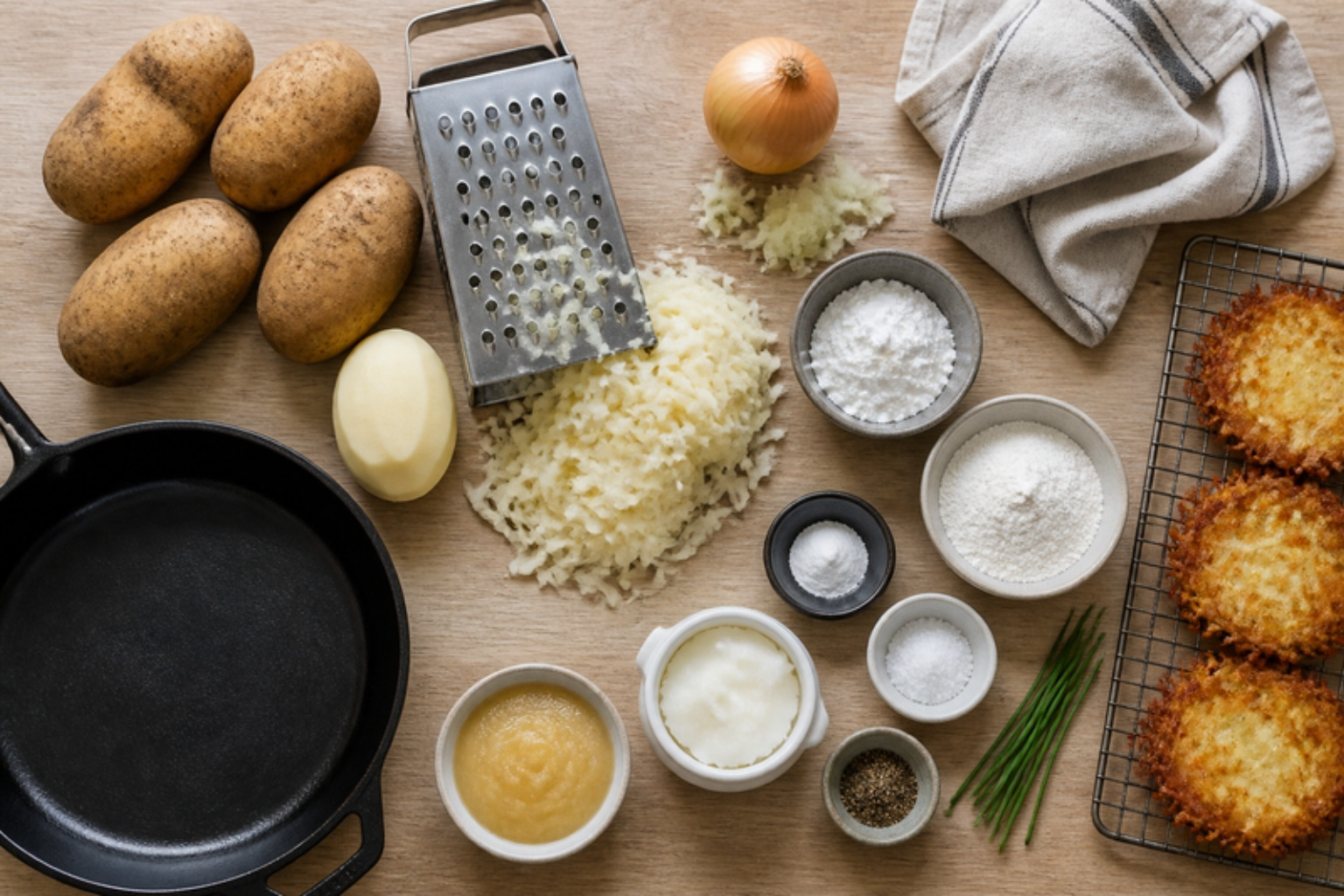
- Russet potatoes (2 lb / 900 g): peeled. Grate them right before mixing so they don’t turn gray.
- Yellow onion (1 small / 150 g): grated with the potatoes. Its juice also helps slow browning of the raw shreds.
- Cornstarch (3 tbsp / 24 g) and white rice flour (2 tbsp / 20 g): the binder along with the potato starch. Potato starch or tapioca starch can replace the cornstarch one for one.
- Baking powder (1/2 tsp): choose one labeled gluten-free.
- Kosher salt and black pepper: plus a pinch of salt on the hot pancakes.
- Chives or green onion: optional, for color and a mild onion bite.
- Beef tallow or lard (about 1/2 cup / 100 g): for frying. Bacon fat or duck fat also work. Light-tasting olive oil is another option; “light” means refined and mild in flavor, not lower in calories. Skip vegetable oil, shortening, and margarine.
- Applesauce: plain and unsweetened, for serving. Our slow cooker cinnamon applesauce is made for this.
Keep the ingredients cool or at room temperature; there’s no need to warm anything before mixing.
Kitchen Equipment
- Box grater (large holes) or a food processor with a shredding disk
- A thin, clean kitchen towel or cheesecloth for wringing
- 12-inch cast-iron skillet, or another heavy skillet
- Wire rack set over a sheet pan, plus a 200°F (95°C) oven for keeping batches warm
- Thin metal spatula
Step-by-Step Tips
- Wring hard. Twist the towel until only a drip or two comes out. Wet shreds steam instead of fry, and they don’t hold together.
- Save the starch. After 5 minutes, the liquid separates. Tip the bowl slowly and pour off the cloudy water; the white paste on the bottom is what you want.
- Mix with your hands. Rub the starch into the shreds until everything looks evenly coated and a little tacky.
- Heat the fat fully. About 1/4 inch of fat at 350°F (175°C). A shred should sizzle immediately. If the fat isn’t hot enough, the pancakes soak it up.
- Flatten and leave the edges ragged. Thin, uneven edges are where the lace and crunch come from.
- Flip once. Wait until the underside is deep golden and the edges look crisp, about 3 to 4 minutes. Moving them early breaks them.
- Drain on a rack, not paper. A rack keeps the bottoms crisp. Salt them while they’re hot.
Potato Pancakes, No Eggs or Flour
Ingredients
Equipment
Method
- Grate the potatoes and onion on the large holes of a box grater (or with a shredding disk) into a large bowl.
- Pile the shreds into a clean kitchen towel and wring hard over the bowl until almost no more liquid drips out. Set the dry shreds in a second bowl.
- Let the squeezed liquid sit 5 minutes. Slowly pour off the watery top and keep the thick white potato starch that has settled on the bottom.
- Add the potato shreds, cornstarch, rice flour, baking powder, salt, pepper, and chives to the reserved starch. Mix with your hands until the shreds look evenly coated and slightly tacky.
- Heat the tallow in the skillet over medium-high heat until it shimmers (about 350°F/175°C). A shred dropped in should sizzle right away.
- Scoop 1/4 cup of the mixture into the fat, press it into a 3-inch round about 1/2 inch thick, and leave the edges a little ragged. Fry 3 to 4 at a time without crowding.
- Cook 3 to 4 minutes, until the underside is deep golden and the edges look lacy and crisp. Flip once and cook 3 minutes more, until the second side is golden and the center feels set when pressed.
- Move to the wire rack and sprinkle with a pinch of salt. Keep finished pancakes warm in a 200°F (95°C) oven while you fry the rest, adding fat as needed. Serve hot with applesauce.
Notes
Troubleshooting
- Falling apart when flipped: the shreds were too wet or the first side wasn’t browned enough. Squeeze the remaining mix again and give the next batch another minute before flipping. A tablespoon more cornstarch also helps.
- Raw or gummy centers: they’re too thick or the fat is too hot. Press them to 1/2 inch and lower the heat slightly so the inside cooks before the outside darkens.
- Greasy pancakes: the fat cooled down. Fry fewer at a time and let the fat come back up to temperature between batches.
- Gray mixture: potatoes oxidize quickly. Grate the onion along with them and fry soon after mixing.
Storage, Freezing and Reheating
Refrigerate cooled potato pancakes in an airtight container for up to 3 days. To freeze, set them in a single layer on a sheet pan until firm, then bag them for up to 2 months. Reheat straight from the fridge or freezer on a sheet pan at 400°F (200°C) for 8 to 12 minutes, until hot and crisp again. The microwave makes them soft.
More Recipes to Try
For a full breakfast plate, pair these with homemade maple sage breakfast sausage patties. If shredded potatoes are your thing, try our crispy diner-style hash browns, or browse more ideas in breakfast recipes.
Potato Pancakes FAQ
Can you make potato pancakes without eggs?
Yes. The starch that settles out of the squeezed potato liquid, along with a little cornstarch and rice flour, binds the shreds as they fry. The key is wringing the potatoes very dry and letting the first side brown well before flipping.
What’s the difference between potato pancakes and hash browns?
Hash browns are usually just shredded potatoes fried loose or as one large cake. Potato pancakes include onion and a binder and are shaped into individual rounds, so they’re a little more tender inside.
What do you serve with potato pancakes?
Applesauce is the classic. They’re also good with sausage, pork chops, roast chicken, or a simple salad. Sour cream is traditional too, but it adds milk.
Can I bake them instead of frying?
A baked version hasn’t been worked out for this recipe. Pan-frying is what sets the starch quickly enough to hold the pancakes together without eggs, so baking may give a softer, more fragile result.
A note before you cook: These recipes are ideas and suggestions, not medical or dietary advice. As with any recipe or ingredient, it is each reader’s responsibility to confirm what they can and cannot eat, read every ingredient label, and source quality ingredients that fit their own needs. Ingredient formulations change, so always check the package you’re using.