
If you’ve gone looking for a pancake without eggs, milk, or wheat flour, you know how many recipes quietly lean on at least one of them. Johnnycakes are the exception, and they always have been. These old-fashioned cornmeal cakes come from a time when a farm kitchen had cornmeal, salt, and a kettle of boiling water, and that was enough. Pour the boiling water over the cornmeal, let it swell, then fry spoonfuls in a hot cast-iron skillet with lard or bacon fat. The outside turns into a crackly, deep golden crust and the center stays soft and tender, a little like the best edge of a piece of cornbread.
A spoonful of maple syrup in the batter rounds out the corn flavor and helps the cakes brown. There is no leavening, no binder, and nothing to replace, because the hot water does the work: it partly cooks the cornmeal so the starch turns thick and sticky enough to hold each cake together. These johnnycakes are made without peanuts, tree nuts, milk, eggs, wheat, soy, fish, shellfish, and sesame.
Made without: peanuts, tree nuts, milk, eggs, wheat, soy, fish, shellfish, sesame.
Why You’ll Love These Johnnycakes
- Five ingredients: cornmeal, salt, maple syrup, boiling water, and a fat for frying.
- No egg replacer needed: scalding the cornmeal binds the batter on its own.
- Crunchy outside, soft inside: a slow fry in cast iron builds a real crust.
- Naturally wheat-free: no flour blend to buy or measure.
- Freezer-friendly: make a double batch and re-crisp them on busy mornings.
How Johnnycakes Work Without Eggs, Milk, or Flour
Most pancakes rely on eggs for structure and wheat gluten to hold their shape. Johnnycakes skip both. When boiling water hits cornmeal, the starch in the outer layer of each grain swells and gelatinizes, turning the mix into a thick, cohesive mash. That gel is the binder. A 10-minute rest gives the cornmeal time to absorb the water fully, so the cakes don’t fall apart in the pan or taste gritty.
Johnnycakes are also different from crispy fried cornmeal mush. Mush is cooked on the stove into a porridge, chilled overnight in a loaf pan, then sliced and fried. Johnnycakes go straight from bowl to skillet in about 15 minutes, so they work when you didn’t plan ahead.
Ingredients & Swap Ideas
- Cornmeal (1 cup / 150 g): fine stone-ground yellow or white cornmeal gives the most tender centers. Medium-grind works but is a bit crunchier. Use plain cornmeal, not self-rising or a cornbread mix (those often contain wheat flour and leavening). If wheat cross-contact matters to you, choose one labeled gluten-free.
- Boiling water (1 1/4 cups / 300 ml, plus a little more): it has to be at a full boil to hydrate the cornmeal properly. Warm tap water will leave you with a crumbly batter.
- Maple syrup (1 Tbsp / 20 g): use pure maple syrup, not pancake syrup. Brown sugar or a little honey also work (honey is not for babies under 1). You can leave the sweetener out for a savory johnnycake to serve with chili or stew.
- Salt (1 tsp kosher / 3 g): don’t skip it. Cornmeal tastes flat without it.
- Fat for frying (3 to 4 Tbsp): lard gives a clean, crisp crust; bacon fat adds a smoky, savory note. Extra-virgin olive oil also works. Skip margarine, shortening, plant butters, and cooking spray, which are made with seed oils.
Keep ingredients simple and you keep the made-without profile. If you’re tempted to add milk or butter to the batter (some New England versions do), know that it changes what the recipe is made without.
Kitchen Equipment
- A 12-inch cast-iron skillet or heavy griddle. Cast iron holds steady heat, which is what makes the crust.
- A medium heatproof bowl and a wooden spoon.
- A kettle or small saucepan for boiling water.
- A thin metal spatula for flipping.
Step-by-Step Tips
- Pour, don’t dump. Stream the boiling water into the cornmeal while you stir so every grain gets hot water at once and no dry pockets form.
- Judge the batter by texture. After resting, it should look like soft mashed potatoes and mound on a spoon. Cornmeal varies, so add more boiling water a tablespoon at a time if it’s stiff.
- Medium heat, not high. The fat should shimmer but not smoke. Too hot and the outside burns before the middle firms up.
- Leave them alone. Let the first side fry 5 to 6 minutes. When the edges look dry and the cakes release easily, they’re ready to flip.
- Rest on a rack. A wire rack keeps the bottoms crisp; paper towels can steam them soft.
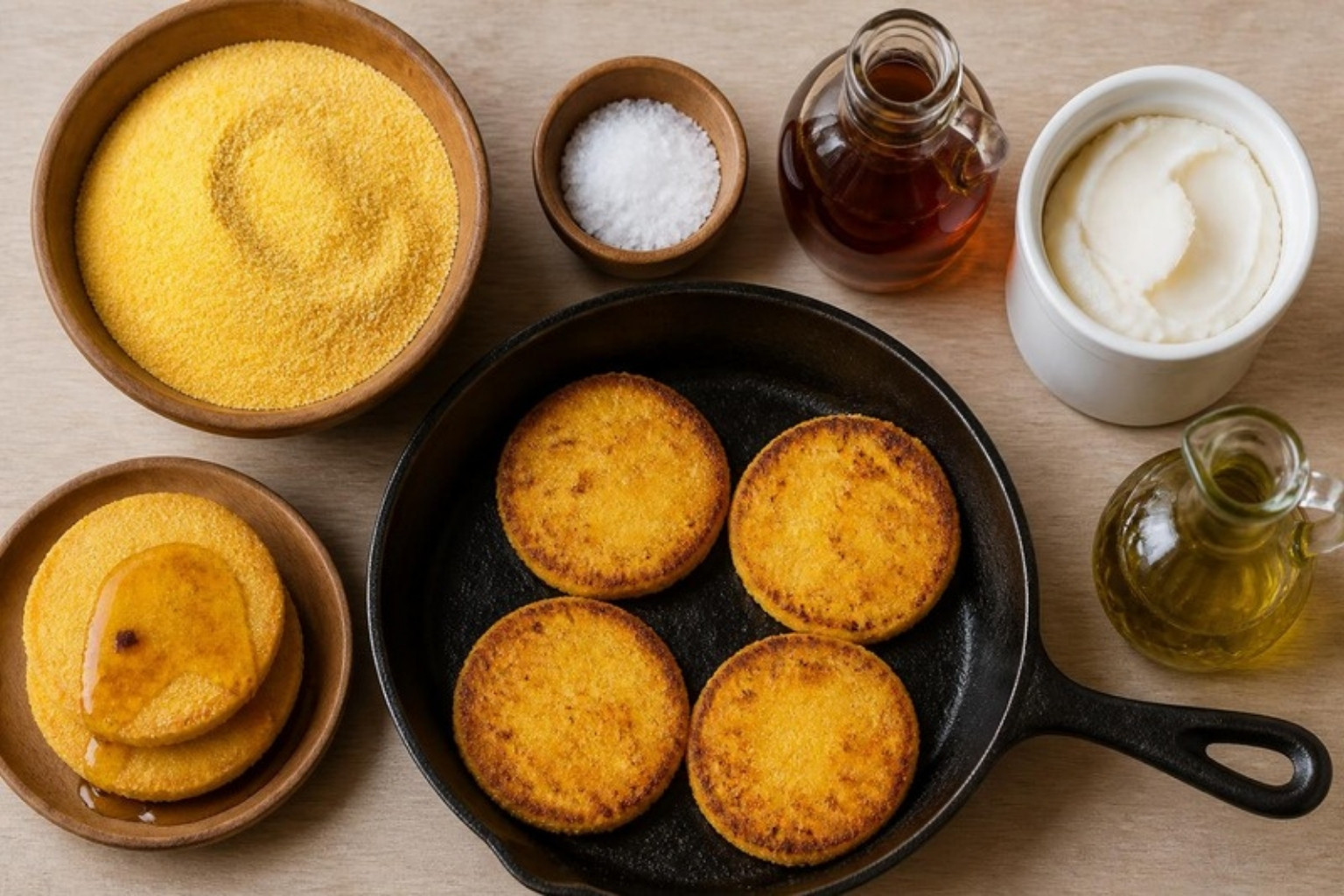
Old-Fashioned Cornmeal Johnnycakes
Ingredients
Equipment
Method
- Whisk the cornmeal and salt in a medium heatproof bowl. Add the 1 Tbsp maple syrup.
- Bring the water to a full, rolling boil. Pour 1 1/4 cups over the cornmeal in a steady stream while stirring with a wooden spoon. Keep stirring until there are no dry pockets. The mixture should look like thick, soft mashed potatoes.
- Cover and rest 10 minutes so the cornmeal swells and softens. Stir again. If it is too stiff to drop from a spoon, stir in more boiling water 1 Tbsp at a time until it mounds softly and holds its shape.
- Heat a cast-iron skillet over medium heat. Add 1 Tbsp lard or bacon fat and let it melt and shimmer, coating the pan in a thin layer.
- Drop rounded 2-Tbsp mounds of batter into the pan, leaving space between them. Wet the back of a spoon and flatten each one to about 1/2 inch thick and 2 1/2 inches across.
- Fry without moving for 5 to 6 minutes, until the edges look dry and set and the bottoms are deep golden brown with a crisp crust. Lower the heat slightly if they brown faster than that.
- Slide a thin spatula under each cake and flip. Fry 4 to 5 minutes more, until the second side is crisp and golden and the cakes feel firm when pressed. Move to a wire rack and repeat with the remaining batter, adding fat to the pan as needed.
- Serve hot with maple syrup.
Notes
Troubleshooting
- Cakes fall apart when flipped: the batter was too wet or the first side hadn’t formed a crust yet. Give it another minute, and stir a spoonful of dry cornmeal into the remaining batter.
- Gritty texture: the water wasn’t fully boiling or the batter didn’t rest long enough. Coarse cornmeal is also grittier; try a finer grind next time.
- Pale and greasy: the pan wasn’t hot enough. Let the fat shimmer before adding batter, and don’t crowd the pan.
- Dark outside, raw middle: lower the heat and flatten the cakes a little thinner.
Storage, Freezing & Reheating
Cool cooked johnnycakes completely, then refrigerate in a covered container up to 3 days. To freeze, layer them with parchment in a freezer bag and freeze up to 2 months. Reheat straight from the fridge or freezer in a dry cast-iron skillet over medium heat, 2 to 3 minutes per side, or on a sheet pan in a 375°F oven for 8 to 10 minutes, until the crust crackles again. The microwave makes them soft, so use it only in a pinch. Uncooked batter firms up as it sits; stir in a little boiling water before frying.
More Breakfasts to Try
For a make-ahead cornmeal breakfast, try the crispy fried cornmeal mush. If you’d rather have fluffy griddle cakes, the pumpkin pancakes made without eggs, milk, or wheat are a fall favorite. You can browse every breakfast recipe on the site too.
Johnnycakes FAQ
What is the difference between johnnycakes and pancakes?
Pancakes are usually made from wheat flour, eggs, milk, and baking powder, and they rise and turn fluffy. Johnnycakes are made from cornmeal and hot water with no leavening, so they’re flatter, denser, and crisp at the edges.
Are johnnycakes the same as hoecakes?
They’re close cousins. Both are simple fried cornmeal cakes, and the names are often used for the same thing. Some regional hoecake recipes add buttermilk, eggs, or flour, while traditional johnnycakes keep to cornmeal, water, and salt.
Can I make johnnycakes with white cornmeal?
Yes. White cornmeal is the traditional choice in parts of New England and gives a slightly milder, more delicate cake. Yellow cornmeal tastes a little sweeter and browns to a deeper gold. The method is the same.
What do you serve with johnnycakes?
Maple syrup is classic for breakfast, with bacon or sausage alongside. Leave out the maple in the batter and they make a good savory side for soups, stews, and chili.
A note before you cook: These recipes are ideas and suggestions, not medical or dietary advice. As with any recipe or ingredient, it is each reader’s responsibility to confirm what they can and cannot eat, read every ingredient label, and source quality ingredients that fit their own needs. Ingredient formulations change, so always check the package you’re using.