
Birthday parties, potlucks, and church suppers almost always have a chocolate sheet cake on the table, and if your family avoids eggs, milk, or wheat, it’s usually the one dessert you have to skip. This chocolate sheet cake is built to fill that spot. It’s a big 9×13 cake with a moist, tender crumb and real chocolate flavor, finished with a glossy fudge frosting poured on warm and left to set into a soft, satiny layer.
The cake uses certified gluten-free oat flour, white rice flour, and cornstarch in place of wheat flour, with baking soda and vinegar for lift and light-tasting olive oil for moisture. Hot coffee deepens the cocoa without making it taste like coffee. The frosting is powdered sugar, cocoa, refined coconut oil, and oat milk with no added oil. The whole cake is made without peanuts, tree nuts, milk, eggs, wheat, soy, fish, shellfish, and sesame.
Made without: peanuts, tree nuts, milk, eggs, wheat, soy, fish, shellfish, sesame. (The frosting uses coconut oil; see the swap below.)
Why You’ll Love This Chocolate Sheet Cake
- Feeds a crowd: 15 generous squares from one pan.
- One bowl for the cake: whisk the dry ingredients, add the wet, pour, and bake.
- No egg replacer: baking soda, vinegar, and the right flour-and-starch balance do the work.
- Made without wheat: oat flour and rice flour instead of all-purpose flour.
- Pour-on fudge frosting: no mixer, no piping, and it sets smooth on its own.
How This Cake Works Without Eggs, Milk, or Wheat
Eggs in a cake give it lift, structure, and moisture. Here, lift comes from baking soda reacting with vinegar and natural cocoa, which are both acidic. That reaction starts the moment the wet and dry ingredients meet, so the batter goes straight into the oven. Structure comes from the flour blend: oat flour brings a soft, slightly sweet crumb and some binding, rice flour adds body, and cornstarch keeps the texture fine and tender rather than gritty. Olive oil and hot liquid keep the cake moist for days.
If you’ve made our egg-free chocolate wacky cake, the method will feel familiar. The difference is that the wacky cake uses all-purpose flour and contains wheat. This sheet cake is made without wheat, and it’s bigger, with a fudge frosting on top.
Ingredients & Swap Ideas
- Oat flour (1 1/2 cups / 150 g): use certified gluten-free oat flour, since regular oats are often cross-contacted with wheat and barley. You can grind certified GF rolled oats in a blender until very fine. Weigh it if you can; oat flour packs differently by brand.
- White rice flour (1 cup / 160 g): finely ground gives the smoothest crumb. Sweet rice flour makes a slightly denser, moister cake.
- Cornstarch (1/3 cup / 40 g): tapioca starch works the same way.
- Cocoa powder: unsweetened natural cocoa in the cake (it helps the baking soda rise). Some cocoa is processed on shared lines with milk, so check the label.
- Light-tasting olive oil (2/3 cup / 145 g): “light” means refined and mild in flavor, not fewer calories. Melted refined coconut oil also works (if you avoid coconut, stick with light-tasting olive oil). Skip vegetable oil and canola.
- Vinegar (2 Tbsp): distilled white or apple cider vinegar. Avoid malt vinegar, which is made from barley.
- Hot coffee or hot water (2 cups / 480 ml): coffee makes the chocolate taste deeper. Hot water keeps it kid-friendly and caffeine-free.
- Frosting fat: refined coconut oil makes the frosting set firm and fudgy. If you avoid coconut, use light-tasting olive oil; the frosting stays softer and glossier, more like a thick glaze.
- Oat milk (1/3 cup): many oat milks contain canola or sunflower oil. Choose a gluten-free one with no added oil.
Kitchen Equipment
- A 9×13-inch metal baking pan. Glass pans bake slower at the edges; add a few minutes and check early.
- Parchment paper and a little olive oil for the pan (no cooking spray).
- A large bowl and a whisk.
- A small saucepan and an offset spatula for the frosting.
- A wire rack.
Step-by-Step Tips
- Whisk the dry ingredients well. Cocoa and baking soda clump; break them up so the cake rises evenly.
- Mix briefly, bake promptly. Whisk just until smooth and get the pan into the oven within a few minutes.
- Test in the center. A toothpick should come out with a few moist crumbs, and the top should spring back.
- Cool completely. Cakes made with rice and oat flour finish setting as they cool. Frosting or cutting too soon can leave the center gummy.
- Pour the frosting warm. It spreads easily while warm and sets to a smooth finish in 20 to 30 minutes.
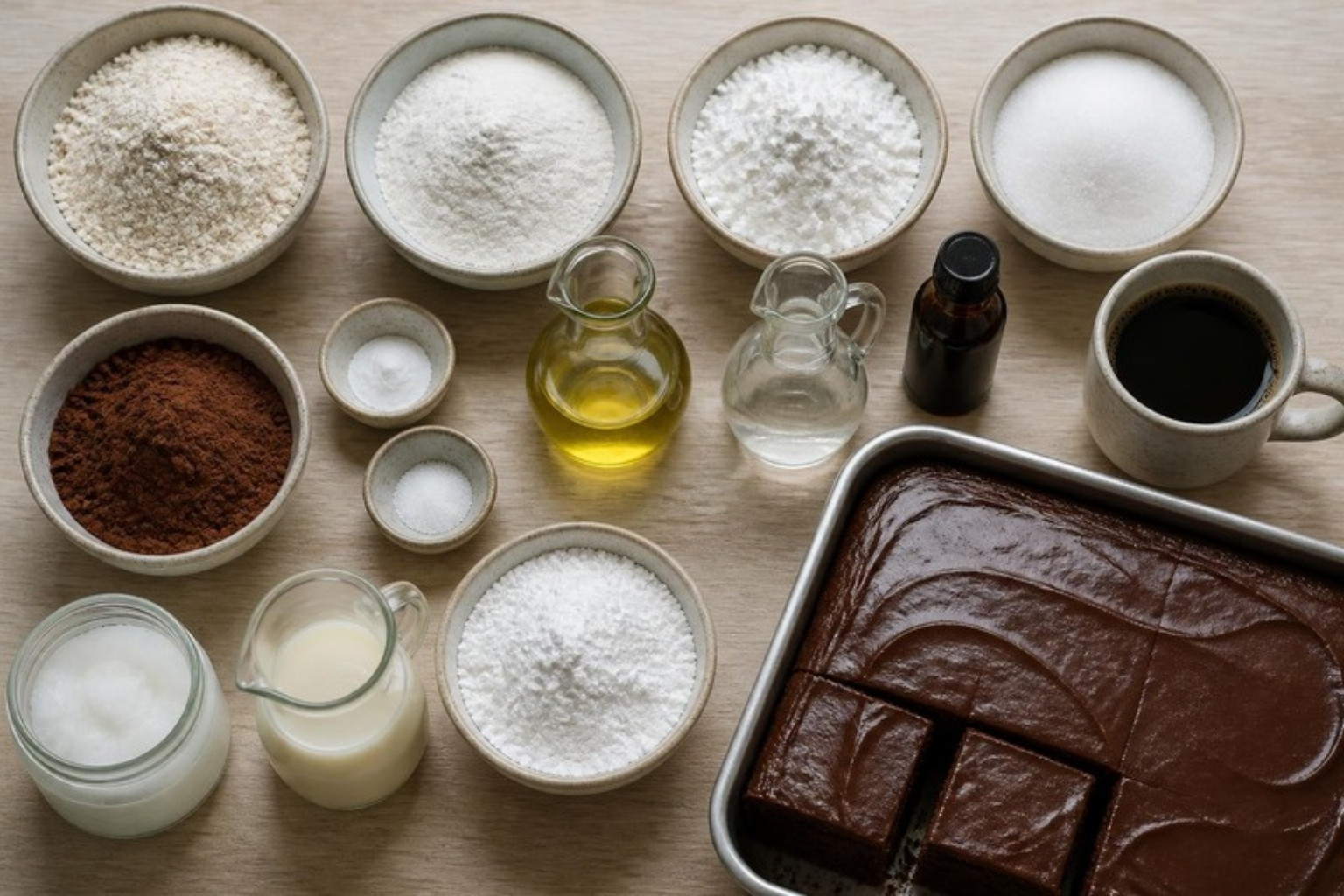
Chocolate Sheet Cake with Fudge Frosting
Ingredients
Equipment
Method
- Heat the oven to 350°F (175°C). Brush a 9×13-inch metal pan with a thin layer of olive oil and line the bottom with parchment.
- Whisk the oat flour, rice flour, cornstarch, sugar, cocoa, baking soda, and salt in a large bowl until evenly colored with no cocoa lumps.
- Add the olive oil, vinegar, vanilla, and hot coffee or water. Whisk just until smooth and glossy, about 30 seconds. The batter will be thin and pourable. Pour it into the pan right away (the soda and vinegar start working as soon as they meet).
- Bake 30 to 35 minutes, until the top springs back when pressed, the edges pull slightly from the pan, and a toothpick in the center comes out with a few moist crumbs but no wet batter.
- Cool the cake in the pan on a wire rack at least 1 hour. Gluten-free cakes finish setting as they cool, so don’t frost or cut it hot.
- Melt the coconut oil in a small saucepan over low heat. Whisk in the cocoa until smooth, then the oat milk. Heat just until it steams and looks glossy; don’t boil.
- Take the pan off the heat. Whisk in the powdered sugar a cup at a time, then the vanilla and salt, until thick, smooth, and shiny, like warm fudge sauce.
- Pour the warm frosting over the cooled cake and spread it to the edges with an offset spatula. Let it set 20 to 30 minutes at room temperature (or 10 minutes in the fridge), until the surface looks satiny and no longer sticky. Cut into 15 pieces.
Notes
Troubleshooting
- Cake sank in the middle: the batter sat too long before baking, or the cake came out early. Bake right after mixing and check that the center springs back.
- Gummy center: it was cut warm or underbaked. Let it cool fully; next time add 3 to 5 minutes.
- Gritty texture: the rice flour was coarse. Look for finely ground rice flour.
- Frosting too thick to spread: warm it gently over low heat with a teaspoon of oat milk. Too thin? Whisk in a few more spoonfuls of powdered sugar.
Storage, Make-Ahead & Freezing
Cover the pan and keep the cake at cool room temperature up to 2 days, or refrigerate up to 5 days. Coconut oil frosting firms up in the fridge, so let chilled pieces sit 20 minutes before serving. To make ahead for a party, bake the cake the day before, cool, cover, and frost the next day. To freeze, wrap the unfrosted cake (in the pan or out) in plastic and foil for up to 3 months, or freeze frosted squares on a tray until firm, then wrap individually for up to 2 months. Thaw covered at room temperature.
More Desserts to Try
For a smaller chocolate cake, see the egg-free chocolate wacky cake (contains wheat). The same oat and rice flour system makes the baked apple cider donuts. Find more in the Top 9 Free recipe collection.
Chocolate Sheet Cake FAQ
Can I bake this in a jelly roll pan like a Texas sheet cake?
Yes. Use a 10×15-inch rimmed pan, lined and greased with olive oil, and start checking at 18 to 20 minutes. The cake will be thinner, so you may want only about two-thirds of the frosting.
Will the cake taste like coffee?
Not noticeably. Coffee makes chocolate taste richer. If you’d rather skip it, use hot water; the cake will be slightly milder.
Can I use a store-bought gluten-free flour blend?
This recipe hasn’t been worked out with a blend. Many blends include ingredients like bean flours, almond flour, or added gums that change the made-without profile and the texture, so read the label carefully if you try one.
Can I make cupcakes from this batter?
Yes. Fill lined muffin cups two-thirds full and bake at 350°F for 18 to 22 minutes, until the tops spring back. Expect about 24 cupcakes. Dip the cooled tops in the warm frosting.
A note before you cook: These recipes are ideas and suggestions, not medical or dietary advice. As with any recipe or ingredient, it is each reader’s responsibility to confirm what they can and cannot eat, read every ingredient label, and source quality ingredients that fit their own needs. Ingredient formulations change, so always check the package you’re using.