
If you’ve ever stood in the meat aisle reading sausage labels and put package after package back, you know the problem. Store-bought breakfast sausage often comes with seasoning blends, fillers, “natural flavors,” or added ingredients that are hard to sort out, and pre-cooked links can bring even more. The simplest fix is to make your own. Homemade breakfast sausage takes about fifteen minutes of mixing and shaping, and the ingredient list is short enough to read in one breath: plain ground pork, a little maple syrup, sage, thyme, salt, and pepper.
These patties land somewhere between a classic country sausage and a maple breakfast link: savory and herby first, with a gentle sweetness that caramelizes into crisp brown edges in the skillet. They are made without peanuts, tree nuts, milk, eggs, wheat, soy, fish, shellfish, and sesame, and there are no breadcrumbs or binders, because ground pork holds together on its own when it’s mixed properly. Make a double batch, freeze the raw patties flat, and you have a quick hot breakfast for weeks.
Made without: peanuts, tree nuts, milk, eggs, wheat, soy, fish, shellfish, sesame.
Why You’ll Love This Recipe
- Nine simple ingredients, all of them easy to read on a label.
- No fillers, breadcrumbs, or egg binder needed.
- Freezer-friendly: shape once, cook straight from frozen on busy mornings.
- Maple and sage give a classic breakfast flavor with crisp, caramelized edges.
- Easy to scale up for a holiday brunch or down to a single pound.
How Sausage Holds Together Without Fillers or Eggs
Sausage makers don’t rely on eggs or breadcrumbs to bind sausage. They rely on salt and mixing. When salt meets ground meat and you work it briefly with your hands, some of the meat’s proteins dissolve and turn sticky, and that tacky film glues the patty together as it cooks. That is why the mixing step matters: about 45 to 60 seconds is enough. Too little, and the patties crumble; too much, and they turn dense and springy.
The two tablespoons of cold water help too. They dissolve the salt and spread the maple and herbs evenly through the pork, and they add a bit of moisture that keeps the patties juicy. Pork with roughly 20 to 25 percent fat gives the best texture; very lean ground pork cooks up dry.
Ingredients and Swap Ideas
- Plain ground pork (2 lb / 900 g): look for unseasoned ground pork, not “sausage.” Keep it cold until you mix it. Ground turkey works with a teaspoon of olive oil added, though it will be leaner and softer.
- Pure maple syrup (2 tbsp / 40 g): pancake syrup is mostly corn syrup with flavoring, so check the label. Brown sugar (1 tablespoon) works in a pinch.
- Dried rubbed sage and thyme: rubbed sage is fluffy and gives the classic breakfast sausage flavor. Fresh sage works at three times the amount, finely chopped.
- Salt (12 g): about 2 teaspoons of fine sea salt. Kosher salts differ a lot in crystal size, so weigh it if you can.
- Black pepper and optional red pepper flakes: add the flakes if you like a little heat.
- Fat for the pan: just a teaspoon of light-tasting olive oil or lard to get the first batch started. (“Light” olive oil means refined and mild in flavor, not lower in calories.) After that, the pork renders its own fat.
Kitchen Equipment
- Large mixing bowl and a kitchen scale for even patties
- 12-inch cast-iron or heavy-bottomed skillet
- Instant-read thermometer
- Rimmed baking sheet and parchment for freezing
Step-by-Step Tips
- Season the liquid first. Stirring the herbs, salt, and maple into cold water before it meets the pork keeps you from overmixing while chasing pockets of seasoning.
- Mix until tacky. When you press a bit between your fingers and it sticks and holds together, stop.
- Fry a test bite. Raw pork can’t be tasted, so cook a teaspoon-size piece and adjust the seasoning before shaping all sixteen patties.
- Dimple the centers. Patties puff in the middle as they cook. A shallow thumbprint keeps them flat so they brown evenly.
- Use medium heat. The maple caramelizes quickly. Medium heat gives deep golden edges without scorching before the center is done. Cook ground pork to 160°F (71°C), as shown on the USDA safe temperature chart.
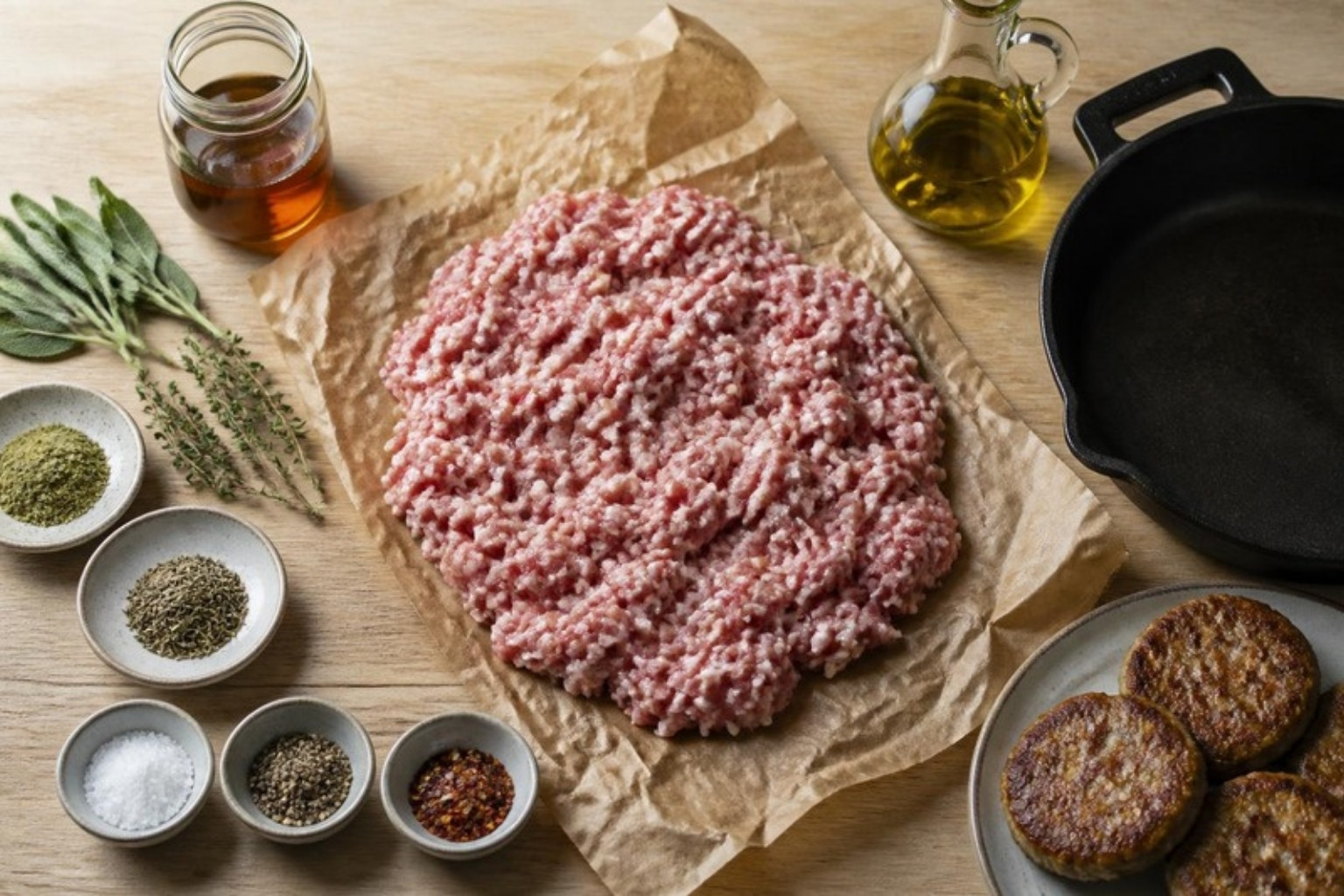
Homemade Maple Sage Breakfast Sausage Patties
Ingredients
Equipment
Method
- In a small bowl, stir together the maple syrup, sage, thyme, salt, black pepper, red pepper flakes (if using), and cold water.
- Put the ground pork in a large bowl, pour the seasoning over it, and mix with your hands for 45 to 60 seconds, just until the seasoning is evenly distributed and the mixture feels slightly tacky and holds together when pressed. Stop before it looks pasty.
- Optional taste test: cook a teaspoon-size piece in the skillet until no pink remains, taste, and adjust the salt or sage in the raw mixture.
- Divide into 16 portions (about 2 oz / 56 g each). Roll each into a ball, then press into a 3-inch patty about 1/2 inch thick. Press a shallow dimple into the center of each so it cooks flat. Chill the patties for 30 minutes if you have time; cold patties hold their shape better.
- Heat the oil in the skillet over medium heat until it shimmers. Cook the patties in batches without crowding, 4 to 5 minutes per side, until deep golden brown with crisp edges and the juices run clear. An instant-read thermometer in the center of the thickest patty should read 160°F (71°C). If the maple starts to darken too quickly, turn the heat down slightly.
- Drain briefly on a paper towel-lined plate and serve hot.
- To freeze raw patties: arrange shaped patties on a parchment-lined baking sheet, freeze until firm (about 2 hours), then stack in a freezer bag with parchment between layers. Cook from frozen over medium-low heat, covering the pan for the first 4 minutes, about 6 to 7 minutes per side, until they reach 160°F (71°C).
Notes
Troubleshooting and Tips
- Patties crumble or fall apart: the mixture was undermixed or the pork was very lean. Mix another 15 to 20 seconds until it feels sticky, and chill the shaped patties before cooking.
- Patties are tough or rubbery: they were overmixed or overcooked. Pull them as soon as the thermometer reads 160°F.
- Outside burned before the inside cooked: lower the heat and cover the pan for the first couple of minutes, especially with thick or frozen patties.
- Too salty or bland: that’s what the test bite is for. Add salt in 1/4-teaspoon steps and fry another bite.
Storage, Freezing and Reheating
Cooked patties keep 3 to 4 days in the refrigerator. To freeze raw patties, set them on a parchment-lined baking sheet, freeze until firm, then stack them in a freezer bag with parchment between the layers. They keep about 3 months. Cook them from frozen over medium-low heat with the lid on for the first few minutes. Cooked patties also freeze well; reheat them in a skillet or a 350°F oven until they reach 165°F (74°C) in the center.
What to Serve With It
Round out a weekend breakfast with crispy diner-style hash browns or a stack of egg-free Belgian waffles. If you’d rather cook the sausage loose with vegetables, the same maple-sage seasoning shows up in our sweet potato breakfast hash. You can find more ideas in the breakfast recipes collection.
FAQ
Do I need an egg or breadcrumbs to bind homemade breakfast sausage?
No. Salt and a short mix make the pork sticky enough to hold its shape. Binders are used in meatballs and meatloaf, but sausage patties don’t need them.
Can I make links instead of patties?
You can roll the mixture into small logs about 3 inches long and cook them the same way, turning often. Stuffing casings is a separate project; if you try it, read the casing label.
Can I bake the patties instead of frying?
Yes. Bake on a parchment-lined rimmed sheet at 400°F for 15 to 18 minutes, flipping halfway, until browned and 160°F inside. They won’t get quite as crisp at the edges as skillet-cooked patties.
How do I keep the maple from burning?
Keep the heat at medium, don’t crowd the pan, and wipe out any dark bits between batches. If the edges darken before the center is done, cover the pan for a minute to finish the inside.
A note before you cook: These recipes are ideas and suggestions, not medical or dietary advice. As with any recipe or ingredient, it is each reader’s responsibility to confirm what they can and cannot eat, read every ingredient label, and source quality ingredients that fit their own needs. Ingredient formulations change, so always check the package you’re using.