
If you’ve stood in the bread aisle in November reading gluten-free loaf labels, you already know the problem with Thanksgiving stuffing: most gluten-free breads are held together with eggs, many contain soy flour or soy lecithin, and nearly all of them use canola or sunflower oil. Classic stuffing starts with bread and butter, so the side dish everyone expects ends up being the one some families quietly skip.
This old-fashioned Thanksgiving stuffing solves that by starting one step earlier, with a simple homemade cornbread. Cornmeal and rice flour give it structure, applesauce and oat milk keep it moist, baking powder and a splash of vinegar lift it, and olive oil replaces butter. Once it’s cubed and dried, it soaks up broth, onion, celery, sage, and thyme the way stuffing should: soft and savory in the middle, crisp and golden on top. It’s made without milk, eggs, wheat, soy, peanuts, tree nuts, fish, shellfish, and sesame.
Made without: peanuts, tree nuts, milk, eggs, wheat, soy, fish, shellfish, sesame.
Why You’ll Love This Recipe
- Tastes like the stuffing you remember: sage, thyme, onion, and celery do the heavy lifting, just as they do in a bread-and-butter version.
- No hunting for a special bread: the cornbread uses pantry ingredients and no egg replacer.
- Made for planning ahead: bake the cornbread days early, freeze it, or assemble the whole dish the night before.
- Crisp top, tender middle: a covered bake followed by an uncovered finish gives you both.
- Works for Christmas dinner too: it pairs with roast chicken, turkey, ham, or pork.
How Stuffing Works Without Eggs, Butter, or Wheat Bread
Most stuffing recipes rely on three things: wheat bread for a sturdy sponge, butter for richness, and often an egg to bind the mixture. Here, each job is handled a different way.
The sponge: cornbread made with cornmeal and rice flour is naturally crumbly, which is a plus once it’s dried. The cubes hold their shape and absorb broth without turning to paste. Resting the batter for five minutes before baking lets the cornmeal hydrate so the bread isn’t gritty.
The richness: extra-virgin olive oil softens the vegetables and goes into the bread, and a final drizzle on top helps it brown. Rendered bacon fat is an option if you want a smoky, old-fashioned flavor.
The binding: instead of an egg, the starch in the cornbread does the work. As broth soaks in and the dish bakes, the starches swell and hold the cubes together loosely, which is exactly the texture you want in a scoop of stuffing.
Ingredients & Swap Ideas
- Cornmeal (210 g): fine or medium yellow cornmeal labeled gluten-free. Skip cornbread mixes and self-rising cornmeal, which often contain wheat flour or milk powder.
- White rice flour (160 g): adds structure. A finely ground flour gives the most even crumb.
- Oat milk with no added oil (360 ml): many oat milks contain canola or sunflower oil, so check the label. Room temperature is best.
- Applesauce: unsweetened, for moisture. It doesn’t make the bread taste of apple.
- Fat: extra-virgin olive oil throughout, or rendered bacon fat for sautéing the vegetables. Skip butter substitutes and vegetable oil, which are usually made from seed oils.
- Herbs: fresh sage and thyme are best; dried rubbed sage and dried thyme work at one-third the amount.
- Broth: chicken or vegetable. Read the label for wheat, soy, yeast extract, and added oil. Homemade broth or turkey stock from the neck and giblets also works.
- Add-ins (optional): sautéed mushrooms, a diced tart apple, dried cranberries with no added oil, or crumbled cooked plain pork sausage. Read sausage labels; some contain milk, soy, or wheat fillers.
Kitchen Equipment
You’ll need a 9×13-inch metal pan for the cornbread, a 9×13-inch baking dish for the stuffing, a large skillet, a rimmed baking sheet for drying the cubes, foil, and an instant-read thermometer.
Step-by-Step Tips
- Bake the cornbread until it’s truly done. Look for a golden top, edges that pull away from the pan, and a clean toothpick. Underbaked cornbread falls apart in the stuffing.
- Dry the cubes. Leaving them out overnight is easiest. If you’re short on time, a low oven for 20–30 minutes works; the outsides should feel dry and lightly crisp but not browned.
- Cook the vegetables slowly. Ten to twelve minutes over medium heat turns the onion and celery soft and sweet. Add the herbs at the end so they stay fragrant.
- Add broth gradually. Fold gently and stop when a squeezed handful holds together loosely. Cornbread absorbs broth faster than wheat bread, so go slowly.
- Bake covered, then uncovered. The foil keeps the center moist; the last 15–20 minutes crisp the top.
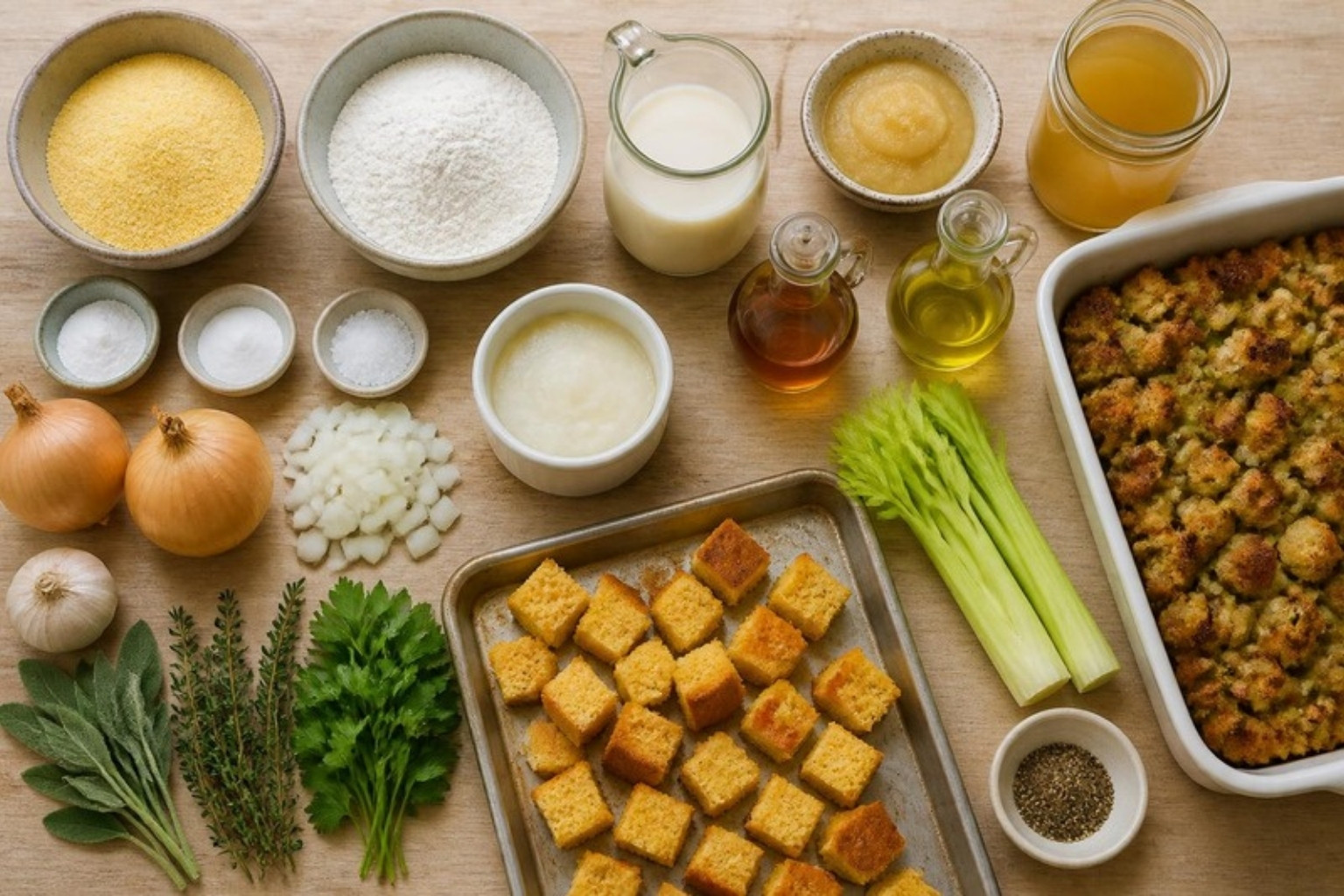
Old-Fashioned Thanksgiving Stuffing (Top 9 Free)
Ingredients
Equipment
Method
- Heat the oven to 400°F (200°C). Brush a 9×13-inch metal pan with olive oil.
- Whisk the cornmeal, rice flour, sugar, baking powder, baking soda, and salt in a large bowl.
- In another bowl, whisk the oat milk, vinegar, applesauce, and 1/3 cup olive oil. Let it sit 2 minutes; it will look slightly curdled.
- Pour the wet ingredients into the dry and stir just until no dry streaks remain. Rest the batter 5 minutes so the cornmeal and rice flour hydrate, then spread it in the pan.
- Bake 22–26 minutes, until the top is golden, the edges pull away from the pan, and a toothpick in the center comes out clean. Cool completely in the pan.
- Cut the cornbread into 3/4-inch cubes (about 10 cups). Spread on a rimmed baking sheet and leave uncovered overnight, or toast at 300°F (150°C) for 20–30 minutes, stirring once, until the surfaces feel dry and lightly crisp but not browned.
- Heat the oven to 375°F (190°C). Brush a 9×13-inch baking dish with olive oil.
- Warm 1/4 cup olive oil or bacon fat in a large skillet over medium heat. Add the onions and celery with a pinch of salt and cook 10–12 minutes, until soft and translucent with a few golden edges.
- Stir in the garlic, sage, and thyme and cook 1 minute, until fragrant. Remove from the heat and stir in the parsley, salt, and pepper.
- Put the cornbread cubes in a very large bowl, add the vegetables, and fold gently. Pour in 2 1/2 cups broth a little at a time, folding as you go. The cubes should be moist through but not swimming; squeeze a handful and it should hold together loosely. Add the remaining broth only if it still looks dry.
- Spoon into the baking dish without packing it down and drizzle with 2 tbsp olive oil. Cover with foil and bake 25 minutes.
- Uncover and bake 15–20 minutes more, until the top is golden and crisp at the edges and the center reaches 165°F (74°C) on an instant-read thermometer. Rest 5 minutes before serving.
Notes
Food Safety: Bake It Outside the Bird
Stuffing cooked inside a turkey has to reach a safe temperature at the very center of the bird, which often means overcooking the meat. Baking it in its own dish is simpler and gives you more crispy edges. Because this recipe contains broth (and meat drippings if you add them), bake until the center reaches 165°F (74°C). The USDA safe temperature chart lists 165°F for stuffing and casseroles.
Troubleshooting & Tips
- Mushy stuffing: the cubes weren’t dry enough or too much broth went in. Bake uncovered a few minutes longer to drive off moisture.
- Dry stuffing: drizzle a few tablespoons of warm broth over the top halfway through the covered bake.
- Bland flavor: low-sodium broth needs more salt. Taste the vegetable mixture before you add it to the bread.
- Crumbly cornbread: that’s normal and helpful here. Cut it with a serrated knife and don’t worry about perfect cubes.
Make-Ahead, Storage & Freezing
- Cornbread: bake up to 2 days ahead and keep wrapped at room temperature, or cube and freeze up to 3 months. Thaw on a baking sheet; it dries nicely as it thaws.
- Assemble ahead: combine everything up to 1 day ahead, cover, and refrigerate. Add about 10 minutes to the covered bake, and still check for 165°F in the center.
- Leftovers: refrigerate up to 4 days or freeze up to 2 months. Reheat covered at 350°F (175°C) with a splash of broth until hot in the center.
Planning the rest of the table? Browse every side, pie, and main on our Thanksgiving recipes page and the Christmas recipes page. This stuffing goes well with our creamy dairy-free mashed potatoes and green bean casserole from scratch.
FAQ
Can I use store-bought gluten-free bread instead of cornbread?
You can, but read the label closely. Many gluten-free loaves contain eggs, soy, milk, or seed oils such as canola and sunflower. The homemade cornbread avoids all of those and holds up well in stuffing.
Is this stuffing or dressing?
Technically it’s dressing, since it bakes in a dish rather than inside the bird. Many families, especially in the South, call cornbread versions dressing; most of the Midwest calls it stuffing either way.
Can I make it vegetarian?
Yes. Use vegetable broth and olive oil rather than bacon fat. Sautéed mushrooms add savory depth.
How many people does a 9×13 pan serve?
About 12 side-dish servings of roughly 1 cup each. For a bigger crowd, bake two pans rather than one deeper dish so the center heats evenly.
A note before you cook: These recipes are ideas and suggestions, not medical or dietary advice. As with any recipe or ingredient, it is each reader’s responsibility to confirm what they can and cannot eat, read every ingredient label, and source quality ingredients that fit their own needs. Ingredient formulations change, so always check the package you’re using.