
Chocolate and orange is a classic Christmas pairing, from foil-wrapped chocolate oranges in stockings to orange-scented truffles. If you’ve searched for a chocolate orange cookie that skips eggs, butter, wheat, and the nuts many recipes add, these are for you. They’re soft and chewy with crackly tops, full of real orange zest and melty dark chocolate chunks, and rolled in orange sugar so they sparkle on a cookie tray.
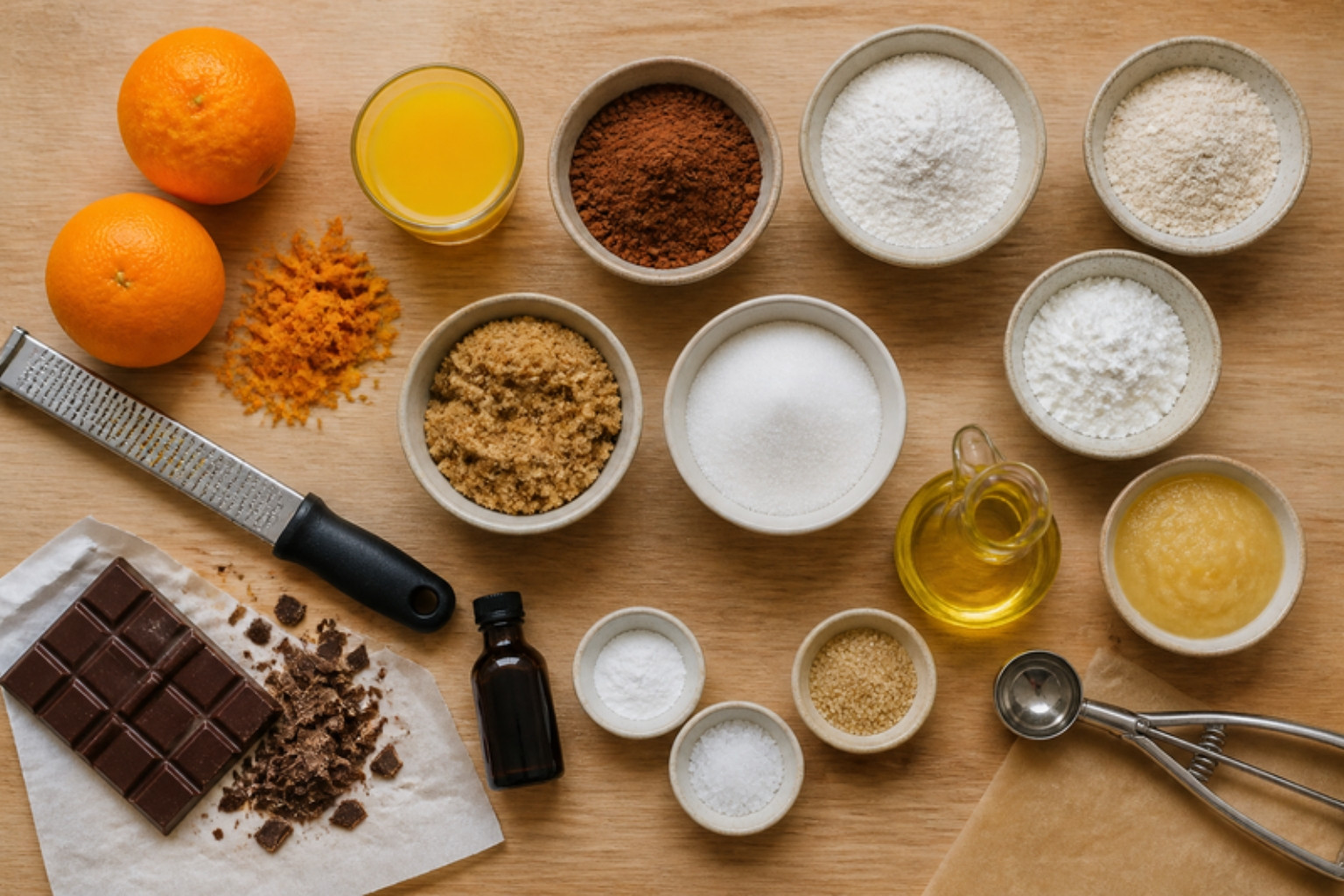
The dough is mixed in one bowl with light-tasting olive oil, rice flour, oat flour, and natural cocoa. Applesauce takes the place of the egg, and a short rest lets the flours hydrate so the cookies bake up chewy rather than gritty. They’re made without peanuts, tree nuts, milk, eggs, wheat, soy, fish, shellfish, and sesame.
Made without: peanuts, tree nuts, milk, eggs, wheat, soy, fish, shellfish, sesame.
Why You’ll Love These Chocolate Orange Cookies
- Bright, fresh orange flavor from zest in both the dough and the sugar coating.
- One bowl, no mixer, and no butter to soften.
- Chewy centers with pockets of melted chocolate.
- Freezer-friendly dough for fresh-baked cookies all season.
How These Cookies Work Without Eggs, Butter, or Wheat
In a typical chocolate cookie, eggs bind the dough and help it puff, butter gives richness and spread, and wheat flour provides structure. Here, rice flour and oat flour share the structural work: rice flour sets up crisp edges, and oat flour keeps the centers soft and tender. A couple of tablespoons of cornstarch makes the texture finer. Whisking the oil with both sugars until thick and glossy dissolves some of the sugar, which is what gives the tops their shiny crackle.
Applesauce supplies the moisture and binding an egg would, and natural cocoa plus a little orange juice provide the acid that activates the baking soda for lift. The 30-minute rest is important. Rice flour absorbs liquid slowly, and a rested dough spreads less and bakes up chewy instead of sandy.
Ingredients & Swap Ideas
- Light-tasting olive oil: “light” means refined and mild in flavor, not fewer calories. Melted refined coconut oil works too and gives slightly crisper edges; if you avoid coconut, stick with light-tasting olive oil. Skip vegetable oil and butter substitutes.
- Cocoa: natural (non-alkalized) cocoa reacts with baking soda. Dutch-process cocoa makes flatter, denser cookies.
- Dairy-free dark chocolate: many dark chocolates contain milk, soy lecithin, or added oils, or share equipment with milk chocolate, so read the label. Dairy-free chocolate chips work in place of chopped chocolate.
- Oranges: one large navel orange gives enough zest and juice. Zest before juicing, and avoid the bitter white pith.
- Flours: certified gluten-free oat flour avoids wheat and barley cross-contact.
Kitchen Equipment
A large bowl and whisk, a spatula, a microplane for zesting, a 1 1/2-tablespoon cookie scoop, two parchment-lined baking sheets, and a wire rack. Bake at 350°F (175°C).
Step-by-Step Tips
- Whisk the oil and sugars well. A full minute, until thick and glossy, sets up the crackly top.
- Don’t skip the rest. The dough goes from loose to scoopable in 30 minutes.
- Rub the zest into the sugar. It releases the orange oils so the coating is fragrant.
- Pull them while soft. Dark cookies are hard to judge by color, so look for set edges and puffed, cracked centers.
- Cool on the pan. Ten minutes on the hot sheet finishes the centers.
Chocolate Orange Cookies
Ingredients
Equipment
Method
- Whisk the rice flour, oat flour, cocoa, cornstarch, baking soda, and salt in a bowl, breaking up any cocoa lumps.
- In a large bowl, whisk the olive oil, brown sugar, and granulated sugar 1 minute, until thick and glossy. Whisk in the applesauce, orange juice, orange zest, and vanilla.
- Stir the dry ingredients into the wet with a spatula until no dry streaks remain, then fold in the chopped chocolate. The dough will be soft. Cover and let it rest 30 minutes at room temperature (or up to 2 days in the fridge) so the rice flour hydrates and the dough firms up.
- Heat the oven to 350°F (175°C). Rub the sugar and orange zest together with your fingertips in a small bowl until fragrant.
- Scoop 1 1/2-tablespoon balls, roll each in the orange sugar, and set 2 inches apart on lined sheets.
- Bake 10 to 12 minutes, until the cookies have spread, the edges look set and slightly firm, and the centers are puffed with a few cracks but still soft. Cool on the sheet 10 minutes (they finish setting there), then move to a rack.
Notes
Troubleshooting
- Cookies spread too thin: the dough was too warm or not rested. Chill it 20 minutes and try again.
- Cookies stayed puffy balls: flatten each scoop slightly before baking, and check that your cocoa is natural, not Dutch-process.
- Gritty texture: the rice flour needs a longer rest. Try refrigerating the dough overnight.
- Orange flavor is faint: use freshly grated zest (bottled or dried zest is much weaker), and add an extra teaspoon.
Make-Ahead, Freezing & Gifting
The dough keeps covered in the fridge for up to 2 days. To freeze, scoop dough balls onto a lined tray, freeze until firm, and store in a freezer bag up to 3 months; roll them in orange sugar and bake from frozen, adding about 2 minutes. Baked cookies keep in a tin at room temperature for up to 5 days or in the freezer for 3 months. For gift tins and cookie exchanges, layer them with parchment so the sugar coating stays sparkly.
More Christmas Cookies
Find every holiday cookie on our Christmas recipes page. If you love citrus, try the cranberry orange cookies with orange glaze; for more chocolate, the chocolate crinkle cookies and the dairy-free chocolate truffles belong on the same tray.
FAQ
How are these different from chocolate crinkle cookies?
Crinkle cookies are rolled in powdered sugar and have a soft, fudgy center. These are rolled in orange sugar, have chopped chocolate inside, and are chewier, with orange in every bite.
Can I use orange extract?
Yes. Add 1/4 to 1/2 teaspoon of pure orange extract along with the zest for a stronger orange flavor. Check the label for added ingredients.
Can I make them without coconut?
Yes. The recipe is written for light-tasting olive oil, which has no coconut. Coconut oil is only an option.
Why are my cookies dry?
They were likely baked too long. Take them out when the centers still look soft and slightly underdone; they firm up as they cool on the sheet.
A note before you cook: These recipes are ideas and suggestions, not medical or dietary advice. As with any recipe or ingredient, it is each reader’s responsibility to confirm what they can and cannot eat, read every ingredient label, and source quality ingredients that fit their own needs. Ingredient formulations change, so always check the package you’re using.
Leave a Reply