
Rolled cut-out cookies are one of the hardest Christmas cookies to make without eggs, butter, or wheat. Most egg-free doughs either crumble when you roll them or puff and spread until the stars look like blobs. Chocolate versions are trickier still, because cocoa dries the dough out. These chocolate sugar cookies were built to solve both problems: a soft, rollable cocoa dough that bakes into crisp-edged, tender cookies that keep their shapes.
They taste like a dark cocoa sugar cookie, with real chocolate flavor and just enough sweetness to pair with icing. Decorated with white royal icing without egg whites, they look striking on a cookie tray next to classic vanilla cut-outs, and they’re sturdy enough to stack in a gift tin.
Made without: peanuts, tree nuts, milk, eggs, wheat, soy, fish, shellfish, sesame. Contains coconut (refined coconut oil).
Why You’ll Love These Chocolate Cut-Out Cookies
- Sharp edges for detailed cutters, thanks to a firm fat and a short chill.
- Rich cocoa flavor without chocolate chips or melted chocolate.
- No commercial egg replacer, flax, or aquafaba.
- The dough freezes, so you can bake in stages through December.
- A dark canvas that makes white icing and sprinkles stand out.
How These Cookies Hold Their Shape Without Eggs
In a classic cut-out, egg binds the dough and butter gives it flavor and firmness. Here, the binding comes from the flour mix. Rice flour gives crispness and structure, oat flour adds tenderness and a mild, wheat-like taste, and cornstarch keeps the texture fine and soft. Applesauce brings in moisture and helps bind the dough the way an egg would, without adding much lift.
Refined coconut oil is solid at room temperature, so it behaves like butter: it creams with the sugar, firms up in the fridge, and keeps the cookies from spreading. Only a quarter teaspoon of baking soda goes in. Natural cocoa is slightly acidic, and that small amount of soda reacts with it for a tender bite without puffing the shapes out of line.
Ingredients and Swap Ideas
- Cocoa powder: unsweetened natural cocoa works with the baking soda. Dutch-process cocoa gives a darker, smoother cookie; if you use it, swap the baking soda for 1/2 teaspoon baking powder. Some cocoa is made on lines shared with milk, so check the label.
- Rice flour, oat flour, cornstarch: use certified gluten-free oat flour, since oats can pick up barley in processing. Weighing the flours gives the most consistent dough.
- Refined coconut oil: it should be soft and scoopable, like room-temperature butter, not melted. Refined oil has no coconut flavor. If you avoid coconut, cold leaf lard can replace it by weight (untested, and mild in flavor). Liquid oils, including light-tasting olive oil, make the dough too soft to roll. Skip shortening, margarine, and plant butters.
- Applesauce: plain and unsweetened, at room temperature so it doesn’t seize the coconut oil.
- Oat milk: choose one with no added oil, since many contain canola or sunflower oil.
- Decorations: sprinkles and candy decorations often contain seed oils, soy lecithin, milk, or confectioner’s glaze. Read every label.
Kitchen Equipment
- Stand mixer or hand mixer
- Rolling pin and parchment paper (rolling between sheets avoids extra flour)
- 3-inch cookie cutters
- Two rimmed baking sheets lined with parchment
- Cooling rack
Step-by-Step Tips
- Cream well. Beat the coconut oil and sugar for a full 2 minutes so the sugar starts to dissolve and the mixture looks lighter.
- Mix gently once the flour is in. Stop when the dough holds together when pinched.
- Chill about an hour. The dough should be firm but still give slightly when pressed. Coconut oil gets very hard when cold; if the edges crack while rolling, wait a few minutes.
- Roll 1/4 inch thick between parchment dusted with cocoa, not flour, so the cookies stay dark.
- Chill the cut shapes 10 to 15 minutes on the baking sheet. This is the biggest help for sharp edges.
- Watch the surface, not the color. They’re done when the tops look matte and dry and the edges feel set. The centers firm up as they cool.
- Cool completely before icing. Warm cookies melt icing and can break when moved.
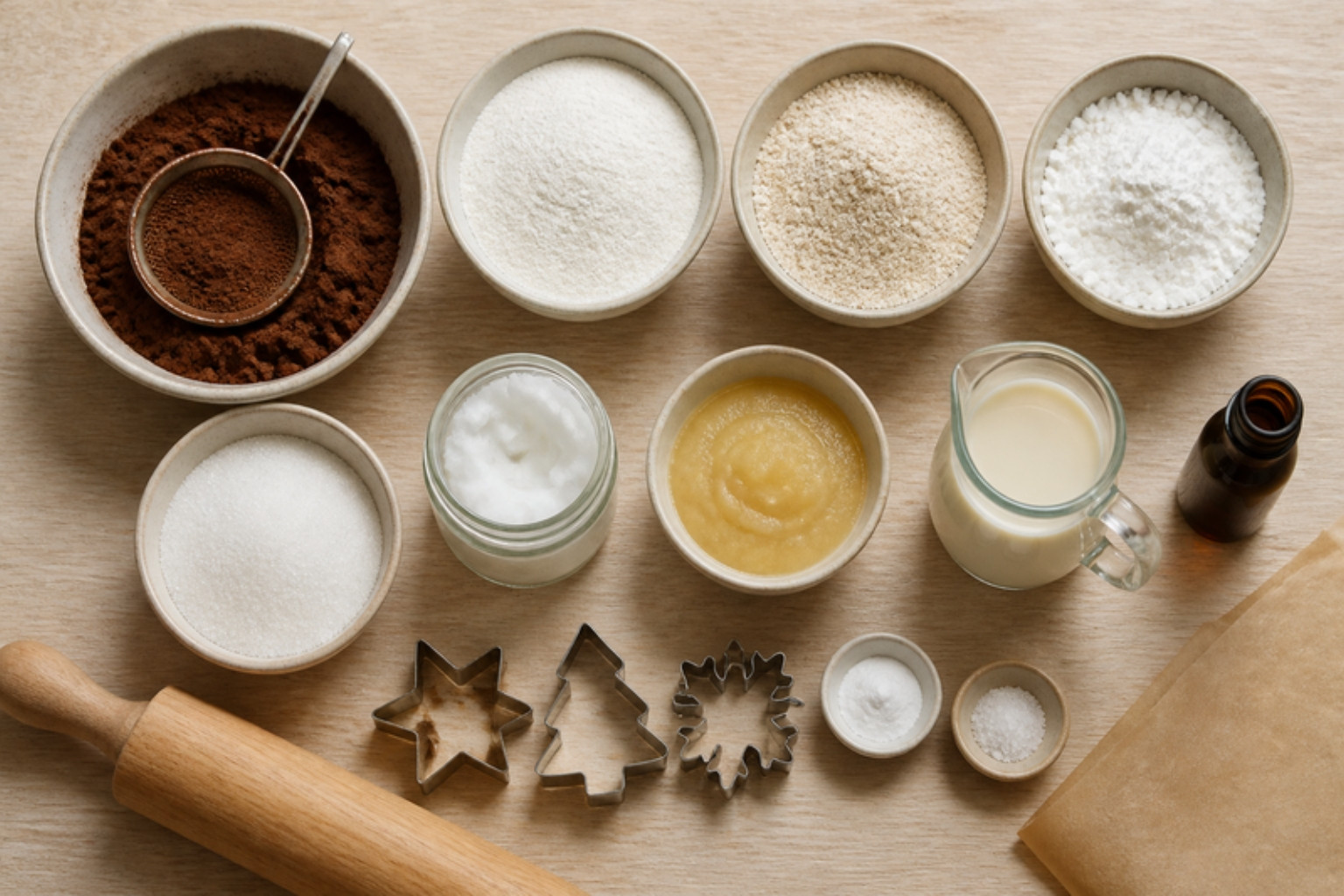
Chocolate Sugar Cookies (Cut-Outs), No Eggs, Dairy-Free
Ingredients
Equipment
Method
- Whisk the rice flour, oat flour, cornstarch, 1/2 cup cocoa, baking soda, and salt in a bowl. Sift if the cocoa is lumpy.
- Beat the softened coconut oil and sugar on medium speed for 2 minutes, until creamy and slightly lighter. Beat in the applesauce, oat milk, and vanilla. It may look a little separated; that is fine.
- Add the dry ingredients and mix on low just until a soft, uniform dough forms that holds together when pinched.
- Divide in half, flatten into discs, wrap, and chill about 1 hour, until firm enough to roll without sticking but not rock hard. If it cracks badly when rolled, let it sit 5 to 10 minutes.
- Heat the oven to 350°F (175°C). Roll one disc between two sheets of parchment lightly dusted with cocoa to 1/4 inch thick. Cut shapes and move them to a lined baking sheet 1 inch apart. Re-roll scraps once.
- Chill the cut cookies on the sheet for 10 to 15 minutes so the edges stay sharp.
- Bake one sheet at a time for 9 to 11 minutes, until the tops look matte and dry and the edges feel set when touched gently. The centers will still feel soft. Do not wait for browning; the cocoa hides it.
- Cool on the sheet 5 minutes, then move to a rack. Cool completely before decorating.
Notes
Troubleshooting
- Dough too crumbly to roll: knead in oat milk a teaspoon at a time, or let cold dough warm for a few minutes.
- Dough sticky: the coconut oil was too warm. Chill 15 minutes more.
- Cookies spread: chill the cut shapes longer and make sure the baking sheet is cool between batches.
- Dry, hard cookies: they baked too long. Pull them at the matte-top stage; they firm up on the sheet.
Make-Ahead, Freezing, and Gifting
Wrapped dough discs keep 3 days in the fridge or 2 months in the freezer; thaw frozen dough overnight in the fridge before rolling. Baked, undecorated cookies freeze up to 2 months in a sealed container with parchment between layers; thaw at room temperature, still covered, then decorate. Once the icing is fully dry (usually overnight for royal icing), decorated cookies keep about a week at room temperature in a cookie tin or airtight container, layered with parchment. For gift tins and cookie exchanges, pack them flat and snug so they don’t slide.
More Christmas Cookies
Find every cookie, candy, and holiday dessert on our Christmas recipes page. These pair well with our soft cut-out sugar cookies for a two-tone tray, and our egg-free royal icing pipes clean outlines on both. For another chocolate gift, try the peppermint bark with dairy-free dark chocolate.
FAQ
How do I keep cut-out cookies from spreading?
Use a fat that’s solid at room temperature, keep the leavening low, and chill the cut shapes before baking. All three are built into this recipe.
Can I make these with olive oil instead of coconut oil?
Not as cut-outs. Liquid oil makes the dough too soft to roll and the shapes spread. If you avoid coconut, cold leaf lard by weight is the closest swap, though it hasn’t been tested in this dough.
What icing works on chocolate sugar cookies?
White royal icing gives the sharpest contrast. A simple glaze of powdered sugar and a little oat milk with peppermint extract also works and sets softer.
Can I add chocolate chips or mint?
Chips make cut-outs bumpy, so skip them here. For mint, add 1/2 teaspoon peppermint extract with the vanilla. If you do use chocolate, look for dairy-free chocolate without added oils.
A note before you cook: These recipes are ideas and suggestions, not medical or dietary advice. As with any recipe or ingredient, it is each reader’s responsibility to confirm what they can and cannot eat, read every ingredient label, and source quality ingredients that fit their own needs. Ingredient formulations change, so always check the package you’re using.