
Oatmeal cake is one of those recipes that used to live on index cards in church cookbooks and community fundraiser booklets, sometimes under the name Lazy Daisy cake. It is a humble 9×13 sheet cake: oats soaked in boiling water so the crumb turns incredibly moist, brown sugar and cinnamon for warmth, and a sticky, bubbling broiled topping that caramelizes right in the oven. The trouble for allergy families is that the classic version leans on eggs and butter in the cake, butter and evaporated milk in the topping, and chopped pecans or walnuts on top. If you have been looking for an oatmeal cake without eggs, dairy, or nuts, this version keeps the soft crumb and that toasty, candy-like top.
The cake uses soaked oats, applesauce, rice and oat flours, and light-tasting olive oil. The topping is brown sugar, refined coconut oil, coconut milk, and shredded coconut, broiled for a few minutes until it bubbles and toasts. There is also a coconut-free broiled oat topping in the recipe notes.
Made without: peanuts, tree nuts, milk, eggs, wheat, soy, fish, shellfish, sesame. Contains coconut.
Why You’ll Love This Recipe
- Extra-moist crumb from oats soaked in boiling water.
- A caramelized, chewy topping that bakes right on the cake, so there’s no frosting to make.
- Feeds a crowd. A 9×13 pan cuts into 15 generous pieces for potlucks and family dinners.
- Keeps well and tastes even better on day two.
- No nuts, no egg replacer, and no specialty flour blend.
How Oatmeal Cake Works Without Eggs or Butter
Oatmeal cake is a good candidate for egg-free baking because the soaked oats already do much of the work. When you pour boiling water over rolled oats and let them stand, the oats swell and release starch, turning into a thick porridge. That porridge binds the batter and holds moisture, two of the jobs eggs usually handle. Applesauce adds a little more binding, rice flour and cornstarch give the crumb structure, and baking soda reacting with cider vinegar and brown sugar gives the lift.
For the topping, the classic mix of butter, brown sugar, and evaporated milk becomes refined coconut oil, brown sugar, and thick canned coconut milk. Refined coconut oil has a neutral flavor and sets firm as it cools, so the topping turns chewy and candy-like instead of greasy. Shredded coconut takes the place of chopped nuts and toasts under the broiler.
Ingredients and Swap Ideas
Exact amounts with metric weights are in the recipe card below.
- Rolled oats: old-fashioned oats give the classic texture. Quick oats work and make a slightly finer crumb. Avoid steel-cut oats here. Choose certified gluten-free oats and oat flour if you avoid gluten or barley cross-contact.
- Light-tasting olive oil: “light” means refined and mild in flavor, not fewer calories. It keeps the cake tasting like brown sugar and cinnamon, not olives. Please skip vegetable oil, shortening, and butter substitutes.
- Refined coconut oil: refined has no coconut flavor and works best for the topping. If you avoid coconut, use the broiled oat topping in the recipe notes, made with light-tasting olive oil, brown sugar, and oats.
- Coconut milk: use full-fat canned coconut milk, stirred well. Oat milk with no added oil can stand in, with a slightly thinner topping.
- Shredded coconut: sweetened gives the classic sticky topping. Unsweetened works too; add 2 extra tablespoons of brown sugar.
Kitchen Equipment
A 9×13-inch metal pan is best, since it can go under the broiler. Don’t broil in a glass baking dish; glass can crack under direct broiler heat. You’ll also need two mixing bowls, a small saucepan for the topping, a whisk, an offset spatula, and a rack for cooling.
Step-by-Step Tips
- Give the oats the full 20 minutes. They should look thick and porridge-like, and only be warm, not hot, when you add the sugar and flours.
- Fold gently. Stop as soon as the flour disappears. Overmixing can make the crumb dense.
- Bake until it springs back. Look for a golden top, edges just pulling from the pan, and a center that springs back when pressed.
- Top the cake while it’s hot. The warm cake helps the topping spread and soak in slightly at the bottom.
- Stay at the oven for the broil. It takes 2 to 4 minutes, and every broiler is different. Turn the pan if one side toasts faster. Pull it when the whole surface is bubbling and the coconut is golden.
- Let it set. Cool at least 30 minutes so the topping firms up and slices cleanly.
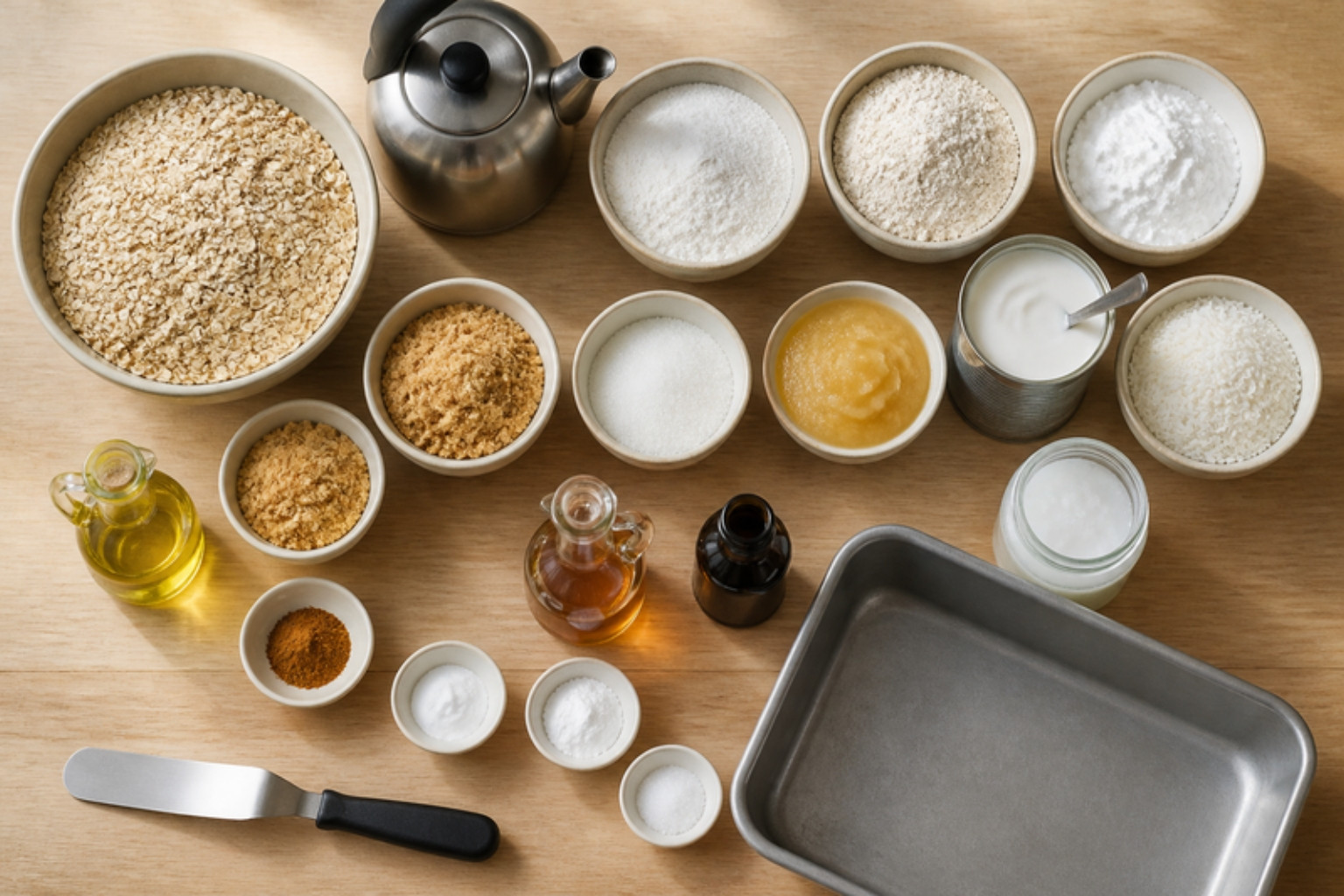
Old-Fashioned Oatmeal Cake with Broiled Coconut Topping, No Eggs, Dairy-Free (Top 9 Free)
Ingredients
Equipment
Method
- Put the oats in a large bowl, pour the boiling water over them, stir, and let stand 20 minutes, until the oats are swollen and the mixture is thick and just warm.
- Heat the oven to 350°F (175°C). Brush a 9×13-inch metal pan with light-tasting olive oil.
- Whisk the olive oil, brown sugar, granulated sugar, applesauce, vinegar, and vanilla into the soaked oats until well combined.
- In a medium bowl, whisk the rice flour, oat flour, cornstarch, baking soda, baking powder, salt, cinnamon, and nutmeg. Add to the oat mixture and fold just until no dry flour shows. Rest the batter 5 minutes, then spread it evenly in the pan.
- Bake 30 to 35 minutes, until the cake is golden brown, pulls slightly from the sides of the pan, and springs back when pressed in the center; a toothpick should come out clean or with a few moist crumbs.
- While the cake bakes, make the topping: in a small saucepan over low heat, stir the coconut oil, brown sugar, and coconut milk until the sugar is mostly dissolved, about 2 minutes. Off the heat, stir in the shredded coconut, vanilla, and salt.
- Move an oven rack about 6 inches below the broiler and heat the broiler to high. Spoon the topping over the hot cake and gently spread it to the edges with an offset spatula.
- Broil 2 to 4 minutes, watching the whole time and turning the pan if needed, until the topping is bubbling all over and the coconut is toasted golden brown at the edges. Pull it as soon as it is evenly golden; it goes from toasted to burnt quickly.
- Cool on a rack at least 30 minutes so the topping sets before cutting into 15 pieces. Serve warm or at room temperature.
Notes
Troubleshooting
- Topping burned in spots: the rack was too close or the broiler runs hot. Move the rack lower next time and turn the pan halfway through.
- Topping is runny: it needed a little longer under the broiler to bubble all over, or the cake needed more time to cool. It firms up as it cools.
- Cake sank in the middle: it was likely underbaked. Bake until the center springs back before adding the topping.
- Gummy crumb: the oats may have been too hot or the batter overmixed. Let the oats cool to warm and fold gently.
Storage, Freezing, and Reheating
Cover the pan and keep the cake at room temperature for up to 2 days, or refrigerate for up to 5 days. The topping stays chewy, and the crumb gets even moister on day two. To freeze, cut into pieces, wrap each one, and freeze in a bag for up to 3 months. Thaw at room temperature for about an hour, or warm a piece in the microwave for 10 to 15 seconds.
More Old-Fashioned Cakes
If you like nostalgic sheet cakes, try the Depression cake (boiled raisin spice cake), the chocolate sheet cake with fudge frosting, or the self-saucing hot fudge pudding cake. You’ll find more in our dessert recipes.
Frequently Asked Questions
What is Lazy Daisy cake?
Lazy Daisy cake is an old name for a simple sheet cake with a broiled coconut and brown sugar topping. Many versions, like this one, are oatmeal cakes. The “lazy” part is that the topping bakes right onto the cake, so there is no frosting to make.
Can I make oatmeal cake without eggs?
Yes. Oats soaked in boiling water turn into a thick porridge that binds the batter, and applesauce adds moisture. With baking soda and vinegar for lift, the cake bakes up moist and tender without eggs.
Can I skip the coconut?
Yes. The recipe notes include a broiled oat topping made with light-tasting olive oil, brown sugar, water, and rolled oats. You can also serve the cake plain with a dusting of powdered sugar or a spoonful of warm applesauce.
Can I bake it in a smaller pan?
Halve the recipe for an 8×8-inch metal pan and start checking at 25 minutes. Use half of the topping and broil as written.
A note before you cook: These recipes are ideas and suggestions, not medical or dietary advice. As with any recipe or ingredient, it is each reader’s responsibility to confirm what they can and cannot eat, read every ingredient label, and source quality ingredients that fit their own needs. Ingredient formulations change, so always check the package you’re using.