
Most stuffed cabbage roll recipes hold the filling together with an egg, and many add breadcrumbs or a spoonful of Worcestershire to the sauce. If those are off the table at your house, it can feel like this church-supper classic is too. These old-fashioned cabbage rolls, the golabki that Polish families brought to Detroit, Chicago, and towns all over the Midwest, are made without any of that.
Soft cabbage leaves wrap a juicy filling of ground beef, ground pork, onion, and par-cooked rice seasoned with smoked paprika and marjoram. They bake slowly under a blanket of sweet-and-tangy tomato sauce until the leaves are fork-tender and the sauce is thick and glossy. It’s a hands-on Sunday project that pays off with a freezer full of dinners.
Made without: peanuts, tree nuts, milk, eggs, wheat, soy, fish, shellfish, sesame.
Why You’ll Love These Cabbage Rolls
- Classic flavor: beef and pork, rice, and a sweet-sour tomato sauce, the way they’re served at Polish festivals and potlucks.
- No egg, no breadcrumbs: rice and a well-mixed filling do the binding.
- Better the next day: the sauce soaks in overnight.
- Freezer-friendly: bake once, eat twice.
How the Filling Holds Together Without Egg
An egg in meat fillings mostly acts as glue. In a cabbage roll, the leaf itself does most of that job, since it’s wrapped snugly and baked seam side down. The rest comes from two things. First, the rice is par-cooked for just 8 minutes, so it’s still firm and soaks up meat juices and sauce in the oven, binding the filling as it finishes cooking. Second, mixing the meat by hand until it feels slightly tacky develops the proteins that help ground meat stick to itself, the same principle behind a good sausage patty. A quarter cup of water or broth keeps the filling juicy without making it loose.
Ingredients and Swap Ideas
- Green cabbage: a large, loose head (about 3 lb / 1.4 kg) gives the biggest leaves. Savoy cabbage is more tender and easier to roll.
- Ground beef and pork: 85% lean beef plus pork keeps the rolls juicy. All beef works; the filling will be a little firmer. Ground turkey works with an extra tablespoon of olive oil.
- Long-grain white rice: par-cooked only. Fully cooked rice turns mushy in the long bake.
- Extra-virgin olive oil: for softening the onion. Bacon fat or lard is a good, savory swap.
- Broth and tomato products: check broth for wheat, soy, and added oils, and choose plain tomato sauce.
- Skip: Worcestershire sauce (it usually contains anchovies, and some brands contain soy or wheat), and any “vegetable oil.”
Kitchen Equipment
A large stockpot for blanching, tongs, a paring knife, a skillet, a 9×13-inch baking dish or a large Dutch oven with a lid, foil, and an instant-read thermometer.
Step-by-Step Tips
- Peel leaves as they soften. Cut around the core, lower the whole head into boiling water, and lift off the outer leaves one at a time once they turn bright green and bendy. Or freeze the head overnight and thaw it; the leaves come off limp and ready.
- Shave the rib. Slice the thick center rib flat with a paring knife so the leaf rolls without cracking.
- Roll like a burrito. About 1/3 cup filling at the stem end, fold the bottom up, fold in the sides, and roll snugly. Seam side down, packed close.
- Line the pan with scraps. Chopped small leaves on the bottom keep the rolls from scorching and add flavor to the sauce.
- Bake covered, then uncovered. 1 1/2 hours covered, 15 minutes uncovered. The leaves should cut easily with a fork, and the filling should reach 160°F (71°C). See the USDA safe temperature chart for ground meat.
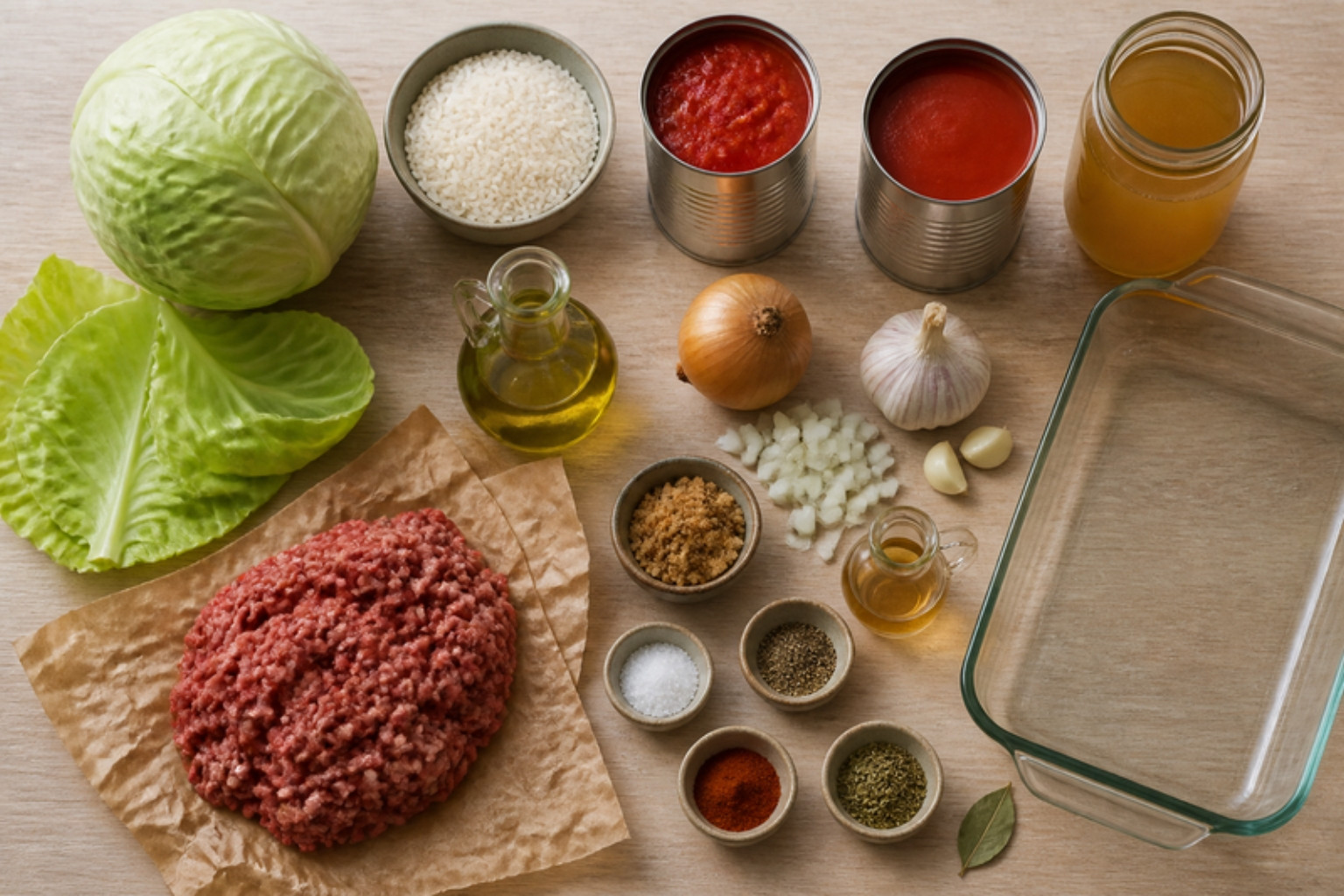
Stuffed Cabbage Rolls in Tomato Sauce (Golabki)
Ingredients
Equipment
Method
- Bring a large pot of salted water to a boil. Cut around the core of the cabbage with a paring knife, about 2 inches deep. Lower the whole head into the water core side down. After 2 to 3 minutes, use tongs to peel off the outer leaves as they turn bright green and floppy, and lift them onto a towel. Keep going until you have 12 large leaves plus a few small ones. (Shortcut: freeze the whole head overnight and thaw; the leaves peel off soft.)
- Shave down the thick center rib on the back of each leaf with a paring knife so it is as thin as the rest of the leaf. This makes rolling easy and keeps the leaves from cracking.
- Par-cook the rice: simmer it in plenty of salted water for 8 minutes, then drain. It should still be firm in the center; it finishes cooking in the oven.
- Heat the olive oil in a skillet over medium heat. Cook the onion until soft and golden, 6 to 8 minutes, add the garlic for 30 seconds, then let it cool a few minutes.
- In a large bowl, combine the beef, pork, par-cooked rice, onion and garlic, salt, pepper, smoked paprika, marjoram, and water or broth. Mix with your hands until evenly combined and slightly tacky; this is what holds the filling together without egg.
- Heat the oven to 350°F (175°C). Whisk the crushed tomatoes, tomato sauce, broth, brown sugar, vinegar, and salt in a bowl. Chop the leftover small cabbage leaves and scatter them in the baking dish, then spoon about 1 cup of sauce over them.
- Place about 1/3 cup filling near the stem end of each leaf. Fold the stem end over, fold in the sides, and roll up snugly. Set the rolls seam side down in the dish, packed close together.
- Pour the remaining sauce over the rolls, tuck in the bay leaf, and cover tightly with foil or a lid.
- Bake 1 1/2 hours, then uncover and bake 15 minutes more, until the sauce is bubbling and slightly thickened and the leaves are tender enough to cut with a fork. The filling should read at least 160°F (71°C) in the center of a roll.
- Rest 10 minutes, remove the bay leaf, and serve the rolls with plenty of sauce spooned over.
Notes
Troubleshooting and Tips
- Leaves tearing: they need another minute in the water, or the rib wasn’t shaved thin enough. Patch small tears by overlapping a second small leaf.
- Rolls unrolling: pack them tightly in the dish, seam side down. A smaller dish is better than a roomy one.
- Crunchy rice: the rolls weren’t covered tightly enough or the sauce cooked down too far. Add 1/2 cup broth and bake covered 15 minutes more.
- Sauce too tart: stir in another teaspoon of brown sugar at the end. Too sweet, add a splash of vinegar.
What to Serve with Cabbage Rolls
Cabbage rolls are a full meal on their own, with meat, rice, and vegetables in every bite, but a scoop of mashed potatoes or boiled potatoes tossed with olive oil and dill is the traditional partner for soaking up the tomato sauce. A crisp, vinegary side like coleslaw or quick cucumber salad balances the richness. For a festival-style plate, add a spoonful of warm sauerkraut on the side.
Storage, Freezing, and Reheating
Refrigerate cabbage rolls in their sauce for up to 4 days. To freeze, cool completely and pack in freezer containers with plenty of sauce for up to 3 months. Thaw overnight in the refrigerator, then reheat covered at 350°F (175°C) for 30 to 40 minutes, or microwave single servings, until the center reaches 165°F (74°C).
Round out the meal with creamy dairy-free mashed potatoes to catch the sauce. If you like old-world Midwestern suppers, try the Swedish meatballs without cream or eggs or slow cooker pork and sauerkraut, and browse more dinner recipes.
Cabbage Rolls FAQ
What is golabki?
Golabki (often spelled gołąbki) is the Polish name for stuffed cabbage rolls, usually filled with meat and rice or barley and baked in tomato sauce. Similar rolls are made across Eastern Europe. This version uses rice only, no barley.
Can I use uncooked rice in cabbage rolls?
Some recipes do, but raw rice needs more liquid and time and can stay crunchy in the center of the rolls. Par-cooking for 8 minutes is a small step that makes the result more reliable.
Can I make cabbage rolls in a slow cooker?
Layer them in a large slow cooker with the sauce and cook on low for 7 to 8 hours, until the filling reaches 160°F (71°C). The slow cooker method hasn’t been worked out in detail, so check the leaves and rice for doneness.
How do I keep the leaves from tearing?
Blanch until fully pliable, shave the rib flat, and don’t overfill. If you’re short on large leaves, overlap two smaller ones.
A note before you cook: These recipes are ideas and suggestions, not medical or dietary advice. As with any recipe or ingredient, it is each reader’s responsibility to confirm what they can and cannot eat, read every ingredient label, and source quality ingredients that fit their own needs. Ingredient formulations change, so always check the package you’re using.