
Cooking Thanksgiving for four people, or for a table where half the guests only want dark meat? A whole bird can feel like a lot of work for a lot of leftovers, and many store-bought turkeys come pre-basted with butter, broth, or flavorings that are hard to sort out from the label. Roasted turkey legs are the simple answer: four plain drumsticks, a garlic-herb rub, and one pan.
These legs get an overnight dry brine of salt, a little brown sugar, smoked paprika, sage, and thyme, then a rub of extra-virgin olive oil and fresh garlic. They roast on a bed of onion, carrot, and celery with a cup of broth, which keeps the drippings from scorching and turns into an easy pan gravy thickened with cornstarch. The skin crisps to deep mahogany, and the dark meat turns tender enough to pull from the bone. There’s no butter, flour, or wheat anywhere in the pan.
Made without: peanuts, tree nuts, milk, eggs, wheat, soy, fish, shellfish, sesame.
Why You’ll Love These Turkey Legs
- Right-sized. One drumstick per person, no carving station needed.
- Hard to dry out. Dark meat stays juicy even if you roast it a little past done.
- Gravy from the same pan. Strained juices plus a cornstarch slurry, ready in five minutes.
- Budget-friendly. Turkey legs usually cost less per pound than breast or a whole bird.
How It Works Without Butter or Flour
Classic roast turkey recipes often call for butter under the skin (our whole roast turkey without butter uses an olive oil herb rub instead) and a flour-and-butter roux for gravy. Here, each job gets a different tool:
- Dry brine for juicy meat. Salt drawn into the meat overnight seasons it all the way through and helps it hold moisture. Leaving the legs uncovered in the fridge dries the skin, which is what makes it crisp.
- Olive oil for browning. Extra-virgin olive oil (or duck fat) carries the garlic and spices and browns the skin without butter.
- Cornstarch for gravy. A slurry of cornstarch and cold water thickens the pan juices into a glossy gravy without wheat flour.
Ingredients and Swap Ideas
Full amounts in cups and grams are in the recipe card below.
- Turkey drumsticks: look for plain legs, about 1 to 1 1/4 pounds (450 to 565 g) each. Skip packages labeled “enhanced,” “basted,” or “self-basting,” which can contain broth, flavorings, or oils. Turkey thighs (bone-in, skin-on) work the same way and often cook 10 to 15 minutes faster.
- Fat: extra-virgin olive oil or melted duck fat. Skip butter, butter substitutes, and seed oils.
- Spices: single dried herbs and spices rather than seasoning blends, which can include fillers, anti-caking agents, or added oils. Leave out the brown sugar if you prefer; it mainly helps the skin brown.
- Broth: chicken or turkey broth. Read the label: many contain wheat, soy, yeast extract, or added oil. Water with an extra onion works if you can’t find one that fits.
- Vegetables: parsnips or chunks of potato can join the onion and carrots for a one-pan meal.
Equipment
- A 9×13-inch (23×33 cm) roasting pan or large cast-iron skillet
- An instant-read thermometer (the most important tool here)
- A wire rack and sheet pan for dry brining, plus a fine-mesh strainer and small saucepan for the gravy
Step-by-Step Tips
- Thaw in the fridge. Frozen drumsticks need about a day in the refrigerator. Don’t thaw them on the counter.
- Brine uncovered. Set the seasoned legs on a rack over a sheet pan, uncovered, on a low shelf for 8 to 24 hours. Even 1 hour helps.
- Pat dry, don’t rinse. Rinsing raw poultry spreads bacteria around the sink, and wet skin won’t crisp.
- Keep the skin above the liquid. Rest the legs on the vegetables so only the bottoms touch the broth.
- Cook by temperature. Poultry is safe at 165°F (74°C), the temperature on the USDA safe temperature chart. Dark meat is chewy at 165°F, though, and turns tender as its connective tissue melts at 175 to 180°F (79 to 82°C). Check the thickest part without touching bone.
- Rest, then make gravy. While the legs rest 10 minutes, strain and skim the juices and thicken them with the cornstarch slurry.
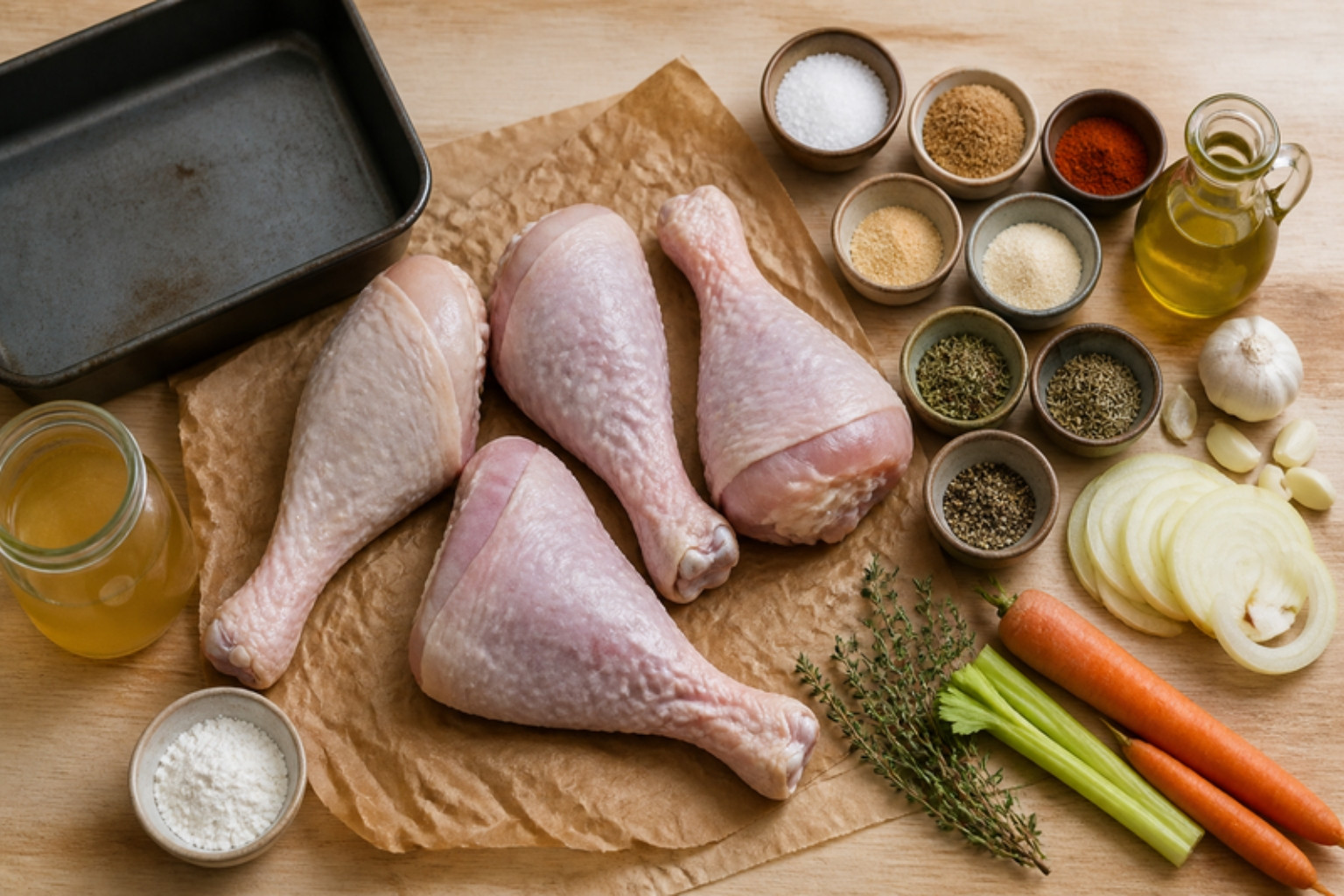
Roasted Turkey Legs with Garlic Herb Rub
Ingredients
Equipment
Method
- Dry brine (recommended): mix the salt, brown sugar, paprika, garlic powder, onion powder, thyme, sage, and pepper. Pat the drumsticks dry, rub the mix all over, and refrigerate uncovered on a rack 8-24 hours (at least 1 hour if short on time).
- Heat the oven to 375°F (190°C). Scatter the onion, carrots, celery, and thyme sprigs in the pan and pour in 1 cup broth.
- Stir the minced garlic into the olive oil. Pat the drumsticks dry again (don’t rinse) and rub them with the garlic oil. Set them on the vegetables so the skin stays above the liquid.
- Roast 1 hour 15 minutes to 1 hour 45 minutes, turning once halfway, until the skin is deep golden and crackly and an instant-read thermometer in the thickest part (not touching bone) reads at least 165°F (74°C). For fall-apart dark meat, keep going to 175-180°F (79-82°C). Add a splash of broth if the pan runs dry.
- Move the legs to a board and rest 10 minutes. For the gravy, strain the pan juices into a saucepan, press on the vegetables, skim off most of the fat, and add 1/2 cup broth. Bring to a simmer, whisk in the cornstarch mixed with cold water, and simmer 1 minute until glossy and thick enough to coat a spoon. Taste for salt.
Notes
Troubleshooting
- Skin is pale or rubbery: the legs were damp or sat in liquid. Pat them very dry, keep them on top of the vegetables, and finish with 5 to 10 minutes at 425°F (220°C).
- Meat is tough: it needs more time, not less. Keep roasting until it reaches 175 to 180°F and the meat starts to pull away from the knuckle.
- Gravy is too salty: brined drippings can be salty. Add more unsalted broth or water before thickening, and taste before adding any salt.
- Gravy is thin: simmer it a minute longer; cornstarch needs to bubble to thicken fully. Add a second teaspoon of cornstarch mixed with cold water if needed.
Make-Ahead, Storage, and Leftovers
- Make ahead: season the legs up to 24 hours before roasting. The gravy can be made a day ahead and reheated.
- Fridge: refrigerate the meat and gravy separately within 2 hours, up to 4 days.
- Freezer: pull the meat from the bones, cover with a little gravy, and freeze up to 3 months.
- Reheat: covered in a 325°F (165°C) oven with a splash of broth until it reaches 165°F (74°C). Leftover dark meat is great in soups, hash, or over rice.
Find sides, pies, and more mains in our Thanksgiving recipes collection. If you’d like more gravy for the table, the make-ahead turkey gravy freezes for weeks, and for a white-meat option, try the herb roasted turkey breast.
FAQ
How long do turkey legs take to roast?
At 375°F (190°C), most 1- to 1 1/4-pound drumsticks take 1 hour 15 minutes to 1 hour 45 minutes. Size and starting temperature vary, so go by an instant-read thermometer rather than the clock.
Why cook dark meat past 165°F?
165°F is the safe minimum for poultry. Legs have lots of connective tissue and tendons that only soften at higher temperatures, so 175 to 180°F gives more tender meat. The extra time doesn’t dry them out the way it would a breast.
Can I smoke or grill the turkey legs instead?
Yes, though the timing hasn’t been worked out here. The same rub works on a smoker at 275 to 300°F (135 to 150°C) over apple or cherry wood; cook to the same temperatures. For a whole smoked bird, see our smoked turkey with dry brine.
Can I use the drumsticks for a Christmas dinner too?
Absolutely. They make an easy main for a small Christmas table. Swap the sage for rosemary and add a strip of orange zest to the pan for a slightly different flavor.
A note before you cook: These recipes are ideas and suggestions, not medical or dietary advice. As with any recipe or ingredient, it is each reader’s responsibility to confirm what they can and cannot eat, read every ingredient label, and source quality ingredients that fit their own needs. Ingredient formulations change, so always check the package you’re using.