
If you’ve ever stood over a pie plate at 11 p.m. the night before Thanksgiving, patching a cracked egg-free, wheat-free crust and wondering why you signed up for a lattice, a galette is the dessert for you. It’s a pie without the pie plate: you roll one round of dough, pile fruit in the middle, and fold the edges up around it in loose pleats. Cracks and uneven folds are part of the look.
This pear galette pairs sweet, sliced Bosc or Anjou pears with a handful of tart cranberries, brown sugar, cinnamon, and a little ginger. The juices thicken with a spoonful of cornstarch, and the crust is a flaky mix of white rice flour, oat flour, sweet rice flour, and tapioca starch, made tender with cold lard. There’s no butter, no egg wash, and no wheat, and the folded edges bake up crisp and deep golden with a sprinkle of coarse sugar. It’s a relaxed alternative to a double-crust pie on a crowded holiday table.
Made without: peanuts, tree nuts, milk, eggs, wheat, soy, fish, shellfish, sesame.
Why You’ll Love This Pear Galette
- No pie plate, no crimping. One round of dough, folded by hand. Rustic is the goal.
- Sweet and tart. Cranberries cut through the mellow pears and give the filling a jewel-red color.
- Flaky crust without butter or wheat. Lard and a blend of rice flours, oat flour, and tapioca do the work.
- Make-ahead friendly. Freeze the dough disk, or freeze the whole unbaked galette and bake it straight from the freezer.
- No nuts. Many galettes add almond frangipane or chopped walnuts; this one leaves them out.
How This Galette Works Without Eggs, Butter, or Wheat
A classic galette crust is butter and wheat flour, brushed with beaten egg. Wheat gluten is what lets that dough stretch and fold without tearing. Without it, the crust needs a little help holding together:
- Sweet rice flour (also sold as glutinous rice flour; it contains no gluten) turns slightly sticky when hydrated, which keeps the dough flexible enough to fold.
- Tapioca starch gives the crust a crisp, browned surface, and oat flour adds a toasty, wheat-like flavor.
- Cold lard cut into pea-sized bits makes flaky layers as it melts in the oven. A teaspoon of cider vinegar keeps the dough tender.
- Instead of an egg wash, a light brush of light-tasting olive oil and a sprinkle of coarse sugar give the edges shine and crunch.
Ingredients and Swap Ideas
Exact amounts in cups and grams are in the recipe card below. A few notes:
- Pears: Bosc and Anjou hold their shape when baked. Choose pears that give slightly near the stem but still feel firm. Very ripe Bartletts turn mushy and watery.
- Cranberries: fresh or frozen both work; add frozen berries straight from the freezer. Dried cranberries aren’t a good swap here, and many are coated in sunflower oil.
- Oat flour: use certified gluten-free oat flour. Oats are often processed alongside barley and wheat, so check the label.
- Fat: pure lard (not hydrogenated or blended with other oils) gives the flakiest result. Chilled refined coconut oil works too; if you avoid coconut, stay with lard. Skip shortening, margarine, and plant butters, which are usually made with seed oils.
- Brushing oil: light-tasting olive oil. “Light” means refined and mild, not fewer calories.
- Other fruit: apples (cut thinner, 1/8 inch) can replace the pears with the same amounts of sugar and cornstarch.
Equipment
- A rimmed baking sheet lined with parchment (the rim catches any juice)
- A rolling pin and two sheets of parchment
- A pastry cutter or fork, and a pastry brush
Step-by-Step Tips
- Keep the lard cold. Cut it in until most pieces are pea-sized. Visible bits of fat are what make flaky layers.
- Add water slowly. The dough is ready when a squeezed handful holds together and feels like soft play dough. Rice flours absorb water more slowly than wheat, so the 30-minute chill also helps them hydrate.
- Roll on parchment. Roll between two sheets dusted with tapioca starch, then slide the dough onto the baking sheet on its bottom sheet. You won’t have to lift a fragile round.
- Leave the juice behind. Pile the fruit in with a slotted spoon or your hands, leaving most of the liquid in the bowl so the bottom crust stays crisp.
- Fold with the paper. Lift the parchment to fold the border up over the fruit. If a fold cracks, pinch it closed.
- Bake until the center bubbles. The galette is done when the crust is deep golden and the juices bubble thickly in the middle, not only at the edges. That’s when the cornstarch has fully thickened.
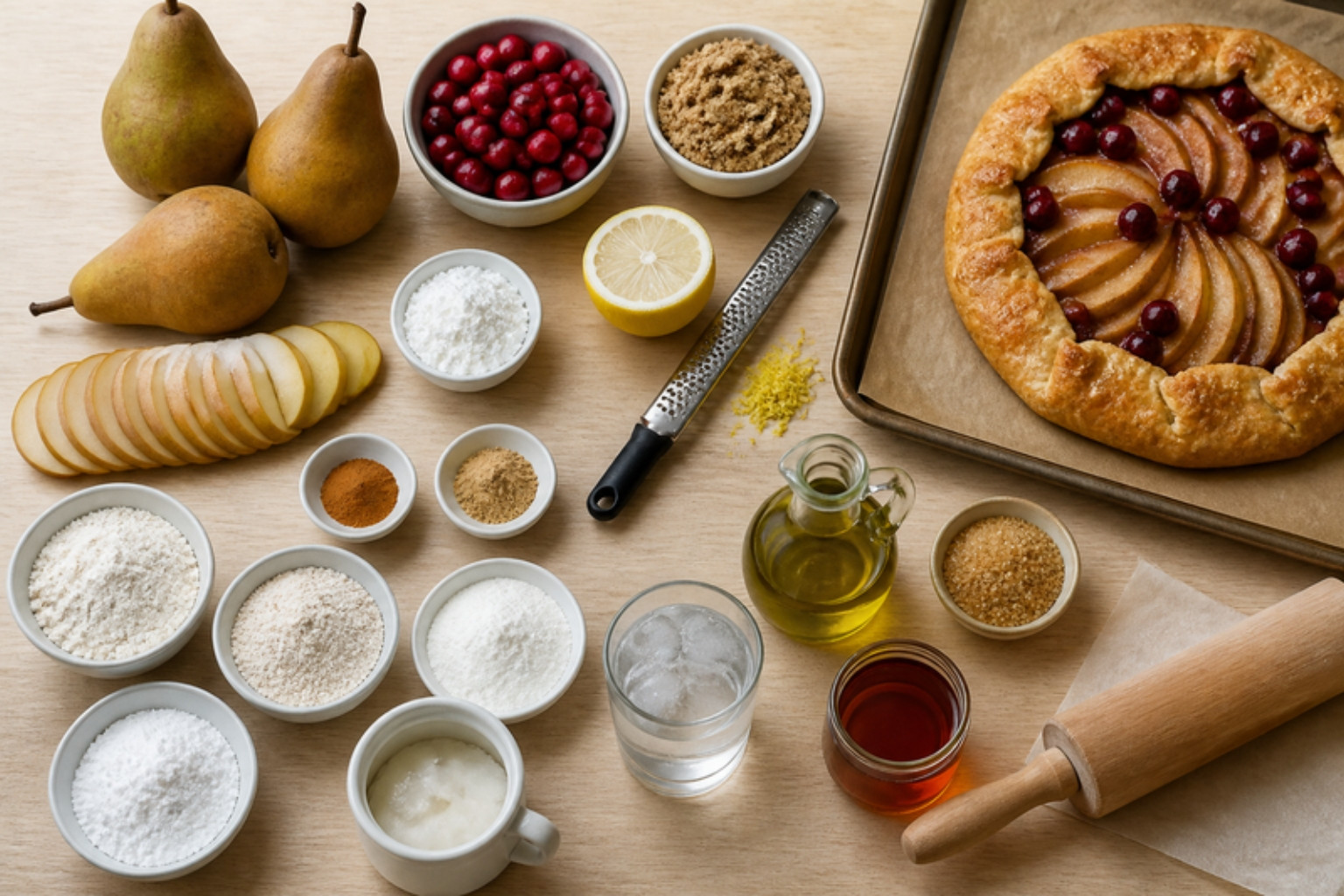
Pear Cranberry Galette (No Eggs, Butter or Wheat)
Ingredients
Equipment
Method
- Whisk the rice flour, oat flour, sweet rice flour, tapioca starch, sugar, and salt. Cut in the cold lard with a pastry cutter or fork until most pieces are the size of small peas.
- Mix the vinegar into 5 tbsp ice water and drizzle it over the flour, tossing with a fork. Add more water a teaspoon at a time until the dough holds together when squeezed and feels like soft play dough, not crumbly. Press into a disk, wrap, and chill 30 minutes.
- Heat the oven to 400°F (200°C) with a rack in the lower third. Toss the pears, cranberries, brown sugar, cornstarch, lemon juice and zest, cinnamon, ginger, and salt in a bowl.
- Roll the dough between two sheets of parchment dusted with tapioca starch into a 12-inch (30 cm) round about 1/8 inch (3 mm) thick. Peel off the top sheet and slide the dough, on the bottom sheet, onto the baking sheet. If the edges crack, pinch them back together.
- Arrange the pears and cranberries in the center, leaving a 2-inch (5 cm) border, and leave most of the juices in the bowl. Use the parchment to lift and fold the border over the fruit in overlapping pleats, pressing gently where the folds meet.
- Brush the crust with olive oil and sprinkle it with coarse sugar. Bake 40-45 minutes, until the crust is deep golden and crisp at the edges and the juices bubble thickly in the center, not just at the sides. Tent with foil after 30 minutes if the edges brown too fast.
- Brush the warm fruit with maple syrup if you like. Cool at least 30 minutes so the juices thicken before slicing.
Notes
Troubleshooting
- Dough cracks when folding: it’s a little dry or too cold. Let it sit at room temperature 5 minutes, or knead in a teaspoon of water. Patch any holes with scraps.
- Juice leaked onto the pan: a small leak is normal and caramelizes nicely. For bigger leaks, leave more juice in the bowl next time and keep a full 2-inch border.
- Bottom is pale or soft: bake on the lower rack, and use a light-colored metal pan rather than an insulated one.
- Crust tastes gritty: the flours need more time to hydrate. Chill the dough a full 30 minutes, or overnight.
Make-Ahead, Storage, and Freezing
- Dough: refrigerate the wrapped disk up to 2 days or freeze it up to 3 months. Thaw overnight in the fridge.
- Unbaked galette: assemble on the parchment-lined pan, freeze until solid, then wrap well. Bake from frozen at 400°F (200°C), adding 10 to 15 minutes. Brush with oil and sugar just before it goes in.
- Baked galette: keep loosely covered at room temperature on the first day, then refrigerate up to 3 days. Re-crisp slices at 350°F (175°C) for 8 to 10 minutes. Wrapped baked galette freezes up to 2 months.
- To bring to a gathering: carry it on its baking sheet and slice at the table, or bake two smaller galettes from halved dough so they travel more easily.
Building a dessert table? Browse every pie, bar, and cake in our Thanksgiving recipes collection. For a classic double crust with the same style of dough, try the classic apple pie with no eggs or milk, and for a nut-free stand-in for pecan pie, see the old-fashioned maple syrup pie.
FAQ
What’s the difference between a galette and a pie?
A galette is baked free-form on a sheet pan with the crust folded over the edge of the filling, so there’s no pie plate and no top crust. It bakes faster than a deep pie and has a higher ratio of crisp crust to fruit.
Can I use butter in the crust?
Butter contains milk, so it would change what this galette is made without. If milk isn’t a concern for you, cold butter can replace the lard in equal weight; the recipe as written uses lard or refined coconut oil.
Can I make it with only pears?
Yes. Use about 4 pears (700 g) and cut the brown sugar to 1/4 cup (50 g), since you won’t be balancing tart cranberries. A squeeze of extra lemon keeps the flavor bright.
How far ahead can I bake it for Thanksgiving?
The crust is crispest the day it’s baked. For the least stress, freeze the assembled galette a week or more ahead and bake it from frozen on Thanksgiving morning, or bake it the day before and re-crisp it in a warm oven.
A note before you cook: These recipes are ideas and suggestions, not medical or dietary advice. As with any recipe or ingredient, it is each reader’s responsibility to confirm what they can and cannot eat, read every ingredient label, and source quality ingredients that fit their own needs. Ingredient formulations change, so always check the package you’re using.