
Holiday turkey has a way of sneaking in allergens. Store-bought birds are often “enhanced” or self-basting, which means they’ve been injected with a solution that can include broth, butter, oils, or flavorings. Classic recipes then add butter under the skin, and the gravy packet brings wheat. This smoked turkey keeps it simple: a plain bird, a dry brine of salt, brown sugar, and herbs, a coat of olive oil, and a few hours over apple or cherry wood.
The result is juicy, lightly smoky meat with deep mahogany skin. Smoking also frees up the oven for pies and sides on the big day. It works for Thanksgiving and just as well as a Christmas centerpiece.
Made without: peanuts, tree nuts, milk, eggs, wheat, soy, fish, shellfish, sesame.
Why You’ll Love This Recipe
- No butter, no injection. Salt and time do the work that butter and injected marinades usually do.
- Hands-off. The dry brine sits in the fridge a day or two; the smoker does the rest.
- Better skin. Leaving the bird uncovered in the fridge dries the skin so it browns well in the smoker.
- Frees the oven for stuffing, rolls, and pie.
How Dry Brining Replaces Butter and Injections
Salt rubbed on raw turkey first pulls a little moisture to the surface. Over the next day, that salty liquid is reabsorbed into the meat, seasoning it deeply and helping the muscle hold on to its juices as it cooks. That’s the same goal as injecting or wet brining, with no bucket of liquid and no added ingredients beyond salt, a bit of sugar, and spices.
Butter under the skin mostly adds flavor and color. Here the brown sugar and smoked paprika help with color, and a thin coat of light-tasting olive oil (refined and mild; “light” doesn’t mean fewer calories) helps the skin brown. Duck fat or lard also work if you have them.
Ingredients & Swap Ideas
- Turkey, 12 to 14 lb. Look for a plain turkey. Skip ones labeled pre-brined, kosher (already salted), enhanced, self-basting, or “contains up to X% solution.” Read the label for anything added.
- Kosher salt. Brands differ in density: 3 tablespoons of Diamond Crystal equals about 2 tablespoons of Morton. If you only have table salt, use about 1½ tablespoons.
- Brown sugar, smoked paprika, garlic and onion powder, dried thyme, dried sage, black pepper. Use single-ingredient spices rather than poultry seasoning blends, which can vary.
- Light-tasting olive oil. Or melted duck fat or pure lard. Skip butter, cooking spray, and seed oils.
- Wood. Apple or cherry gives a mild, sweet smoke that suits poultry. Hickory is stronger; use it sparingly.
Equipment
- A smoker or grill set up for indirect heat that holds 275°F
- A rimmed sheet pan with a wire rack for the fridge
- A reliable probe thermometer (a leave-in probe makes this much easier)
- A foil pan to catch drippings for gravy
Step-by-Step Tips
- Start early. A frozen turkey needs about a day in the fridge for every 4 to 5 pounds to thaw, plus 1 to 2 days of dry brining. For a 14-lb bird, take it out of the freezer about 5 days ahead.
- Dry thoroughly before salting. Pat the skin and cavity with paper towels so the rub sticks.
- Season under the skin. Slide your fingers between the breast meat and skin and rub some of the brine directly on the meat.
- Leave it uncovered in the fridge. The skin should look dry and a little papery by smoking day.
- Cook to temperature, not time. Times vary with the smoker, wind, and bird. The turkey is done when the thickest part of the breast and the thigh both read 165°F. Leg joints should move loosely.
- Finish hot for crisper skin. Smoked skin can be chewy. Raising the heat to 325–350°F for the last half hour helps.
- Rest before carving. 30 to 45 minutes under loose foil keeps the juices in the meat.
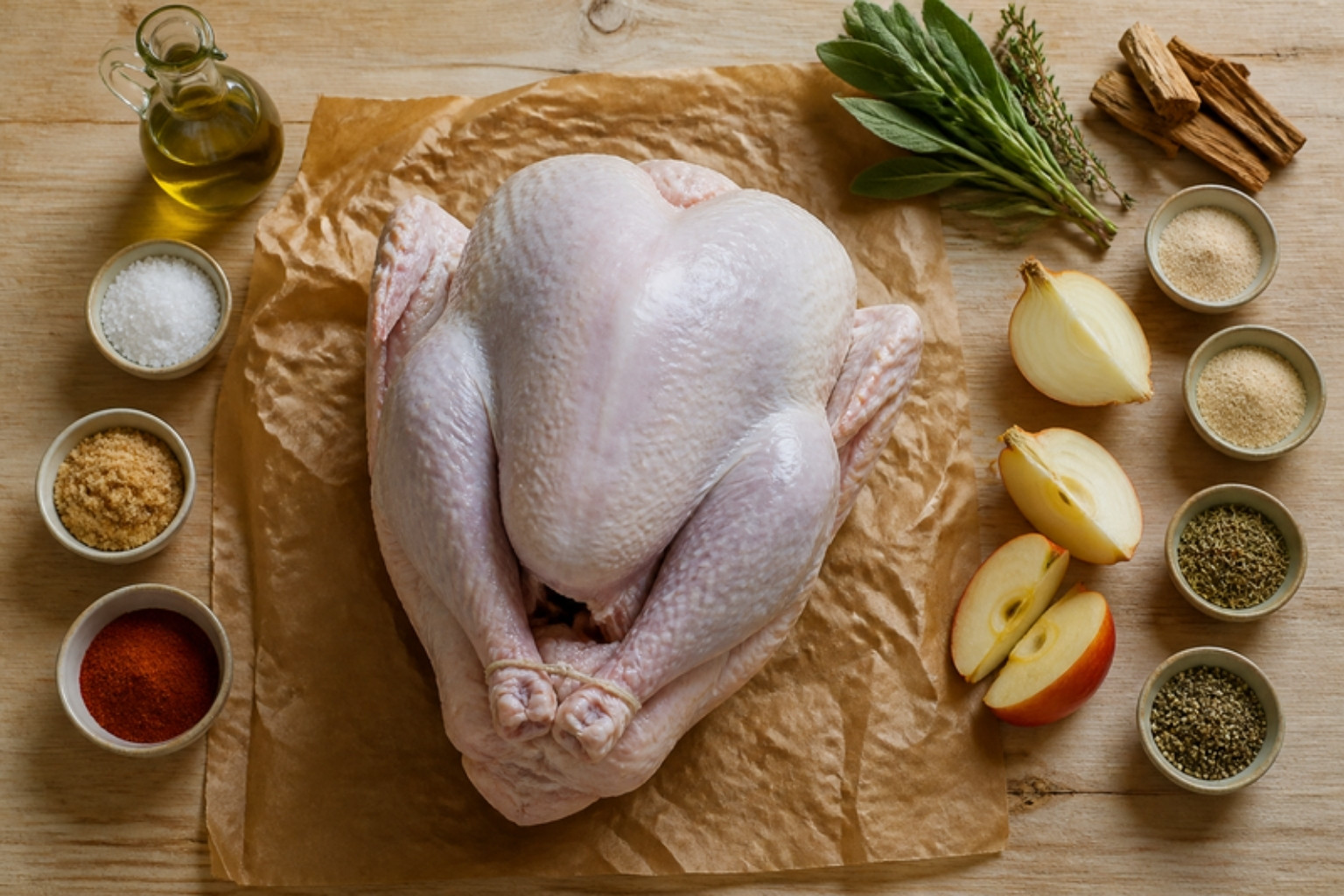
Smoked Whole Turkey with Dry Brine and Herb Rub
Ingredients
Equipment
Method
- Remove the neck and giblets (save them for gravy). Pat the turkey very dry inside and out with paper towels.
- Mix the salt, brown sugar, paprika, garlic powder, onion powder, thyme, sage, and pepper. Sprinkle about a third inside the cavity and rub the rest evenly over the skin, including under the skin of the breast where you can loosen it gently with your fingers.
- Set the turkey breast side up on a rack over a sheet pan and refrigerate uncovered for 24 to 48 hours. The skin will look dry and slightly translucent; that’s what helps it brown and crisp.
- Heat the smoker to 275°F (135°C) with apple or cherry wood. Let the turkey stand at room temperature while the smoker heats, no more than 1 hour.
- Tuck the wing tips behind the breast. Add the onion, apple, and herbs to the cavity if using (no stuffing). Brush the skin all over with the olive oil.
- Place the turkey breast side up on the grate with a foil pan underneath to catch drippings. Insert a probe into the thickest part of the breast, not touching bone.
- Smoke until the thickest part of the breast reads 165°F (74°C) and the thickest part of the thigh reads at least 165°F, about 20 to 25 minutes per pound (4 to 5½ hours for a 12- to 14-lb bird). The skin should be deep mahogany and the leg should wiggle loosely.
- For crisper skin, raise the smoker to 325–350°F (165–175°C) for the last 30 minutes, watching the color.
- Transfer to a board, tent loosely with foil, and rest 30 to 45 minutes before carving.
Notes
Food Safety
Poultry should reach 165°F (74°C) in the thickest part of the breast and thigh; check the USDA safe temperature chart. Don’t smoke a stuffed turkey: low heat keeps the stuffing in the cavity too cool for too long. Bake your stuffing separately. Refrigerate leftovers within 2 hours and reheat to 165°F.
Troubleshooting
- Too salty: the bird was likely pre-brined or kosher. Next time, check the label or cut the salt in half.
- Rubbery skin: finish at higher heat, and make sure the skin dried uncovered in the fridge.
- Breast done long before the thighs: point the legs toward the hottest part of the smoker, or spatchcock the bird for even cooking.
- Bitter, dark smoke flavor: too much wood or smoldering wood. Aim for thin, pale blue smoke.
Storage & Freezing
Carve all the meat off the bones before storing. Keep it covered in the fridge for up to 4 days. To freeze, pack sliced meat in freezer bags with a splash of broth to keep it moist, and freeze up to 3 months. Thaw overnight in the fridge and reheat covered at 325°F until it reaches 165°F. Save the carcass for soup stock.
Round out the menu from our Thanksgiving recipes hub. The drippings go well in our make-ahead turkey gravy thickened with cornstarch, and our old-fashioned Thanksgiving stuffing bakes in the oven while the bird smokes. Smaller crowd? Try the herb roasted turkey breast.
FAQ
How long does it take to smoke a turkey at 275°F?
Plan on about 20 to 25 minutes per pound, so roughly 4 to 5½ hours for a 12- to 14-pound turkey. Always go by internal temperature (165°F in the breast and thigh), not the clock.
Do I need to rinse off the dry brine?
No. Rinsing wets the skin and spreads raw poultry juices around the sink. Just brush on the oil and smoke.
Can I smoke a larger turkey?
Birds over about 15 pounds take a long time to pass through the low temperatures in a smoker. For a big crowd, two smaller turkeys or a spatchcocked bird are better options.
Can I make gravy from smoked turkey drippings?
Yes. The drippings are smoky and salty, so taste before adding more salt, and skim off excess fat. Use them in place of some of the broth in a cornstarch-thickened gravy.
A note before you cook: These recipes are ideas and suggestions, not medical or dietary advice. As with any recipe or ingredient, it is each reader’s responsibility to confirm what they can and cannot eat, read every ingredient label, and source quality ingredients that fit their own needs. Ingredient formulations change, so always check the package you’re using.